
Net Investment Income Tax Exposure for Pass-Through Owners Under Section 1411
Material participation status determines whether pass-through income faces the 3.8% surtax.
Net Investment Income Tax Exposure for Pass-Through Owners Under Section 1411. For pass-through entity owners, Section 1411 liability turns on a single pivotal question, whether their involvement in the business constitutes material participation, because that classification determines whether business income and gains flow into net investment income or escape it entirely. This article maps the statutory framework and its practical implications for S corp shareholders, partners, and LLC members navigating the 3.8% surcharge.
What Section 1411 taxes and who it reaches
IRC § 1411 imposes a 3.8% surtax on the lesser of net investment income or the excess of MAGI over applicable thresholds, added to regular income tax rather than replacing it Net Investment Income Tax (IRC §1411) Guide 2026 | CPA Validated. The provision came out of the Health Care and Education Reconciliation Act of 2010 and took effect for tax years starting after December 31, 2012.
The income thresholds are fixed by statute rather than adjusted for inflation, and they haven't moved since the tax was written: $250,000 for married couples filing jointly and for qualifying surviving spouses, $200,000 for single filers and heads of household, and $125,000 for married taxpayers filing separately IRC Section 1411 26 USC 1411: Imposition of tax IRC 1411: Net Investment Income Tax Explained. Estates and trusts face a parallel version of the tax, triggered when undistributed net investment income pushes adjusted gross income above $16,000 in 2026, and unlike the individual thresholds, that trust figure does get adjusted for inflation each year Instructions for Form 8960 (2025). The tax is computed on Form 8960 and added to regular tax via Schedule 2. Because it sits outside the regular tax computation, the standard deduction, itemized deductions, and most credits can't touch it; it functions as a standalone surtax that has to be paid in full once triggered.
The stagnant thresholds create a quiet form of bracket creep, exposing pass-through owners, whose income can swing widely year to year based on business performance, to landing above the threshold in a strong year even if they weren't there the year before.
What counts as net investment income
Wages, non-passive business income, Social Security benefits, and tax-exempt interest are not included in net investment income, but are not explicitly excluded by § 1411(c)(5) or (c)(6).
The self-employment tax carve-out reads narrower than most practitioners assume. Only income that is actually taken into account when figuring self-employment tax under § 1401(b) gets excluded from net investment income. Income that happens to be excepted from net earnings from self-employment under § 1402(a)(1) through (17), even though it never faces SE tax, doesn't automatically escape NIIT. The absence of one tax doesn't guarantee the absence of the other, and treating them as mirror images of each other is a mistake that appears in refund claims.
Digital assets round out the picture in a way that surprises some filers. The 2025 Form 8960 instructions note that income from digital asset transactions may be subject to NIIT, a signal that the definition of net investment income keeps pace with newer asset classes. None of these carve-outs function as loopholes in the colloquial sense. They reflect the statute's underlying logic: the tax is aimed at returns on capital, not compensation for labor. That is exactly why the line between passive and active involvement carries so much weight for owners of pass-through entities whose income sits at the intersection of both. Under Treas. Reg. § 1.1411-4, NII is organized into three categories. Explicit exclusions: self-employment income subject to SE tax under § 1401(b) and qualified retirement plan distributions, per IRC § 1411(c)(6) and (c)(5), respectively.
Why the passive/active line is the central exposure question for pass-through owners
For an S corporation shareholder, a general partner, or an LLC member, the identical dollar of business income can either escape the 3.8% surtax entirely or attract it, depending on how the owner's involvement is classified Net Investment Income Tax (IRC §1411) Guide 2026 | CPA Validated. Nothing about the income itself changes; what changes is how the owner's involvement in the business gets classified Net Investment Income Tax (IRC §1411) Guide 2026 | CPA Validated. That single classification question, active or passive, is the fulcrum on which most NIIT exposure for pass-through owners actually turns Instructions for Form 8960 (2025).
The test that decides it has two parts, and both have to be satisfied for the income to avoid NIIT. The activity must qualify as a trade or business under § 162, and it must also be nonpassive under the passive activity rules of § 469. Missing either prong pulls the income back into net investment income. Section 162's trade-or-business threshold is actually narrower than the passive activity rules under § 469: an activity conducted in anticipation of a future trade or business, or one involving research and experimentation, can satisfy § 469 without meeting § 162. In practice, that means some income which clears the passive activity loss hurdles can still get caught in net investment income, a distinction easy to miss if you assume the two regimes ask the same question.
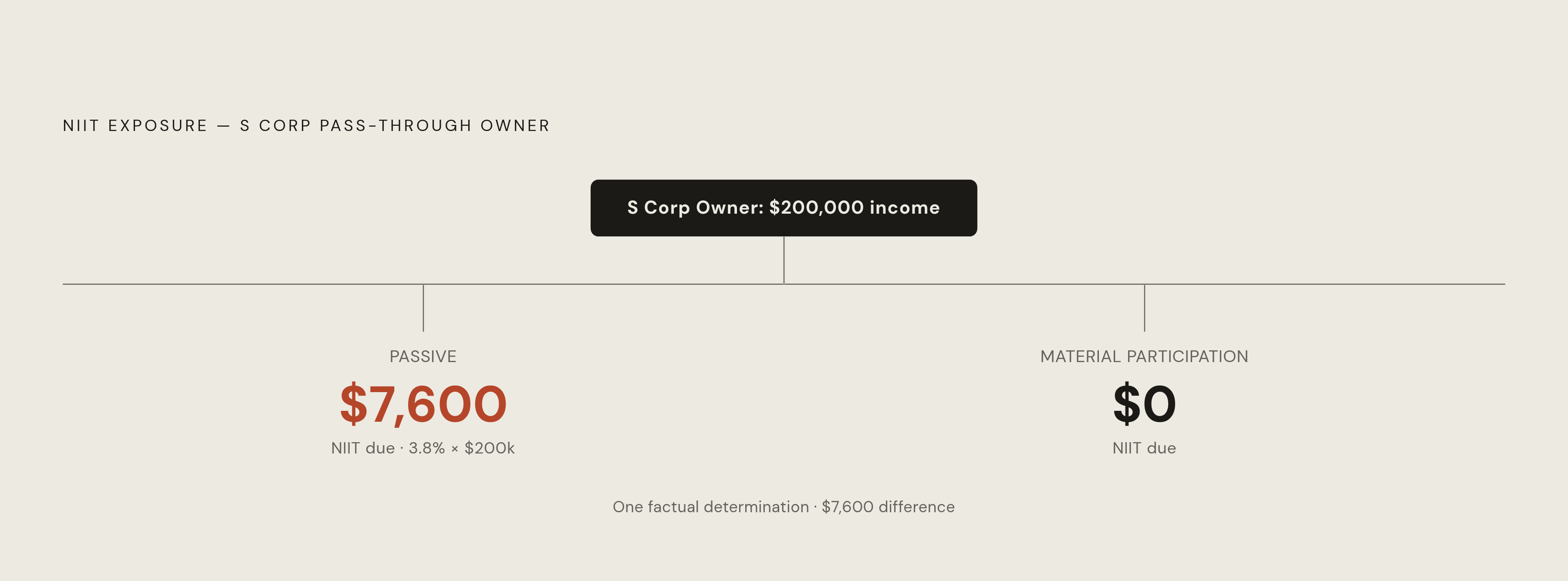
That assumption is exactly where practitioners get into trouble. Treating an activity as "nonpassive for loss purposes" and concluding NIIT automatically doesn't apply skips a step the statute requires. The § 162 trade-or-business threshold has to be checked separately, on its own terms, not inferred from the passive loss analysis. Adding another layer of complexity, the regulations split where each determination happens: the passive-activity question under § 1.1411-5(a)(1) gets decided at the owner level, while the trading-business question under § 1.1411-5(a)(2) gets decided at the entity level. The dollar consequences aren't abstract. An owner with $200,000 of S corporation income faces a $7,600 NIIT bill if that income is treated as passive, and zero if the owner establishes material participation, with the entire tax riding on one factual determination IRC Section 1411 tscpatax.com 26 USC 1411: Imposition of tax.
The seven material participation tests in practice
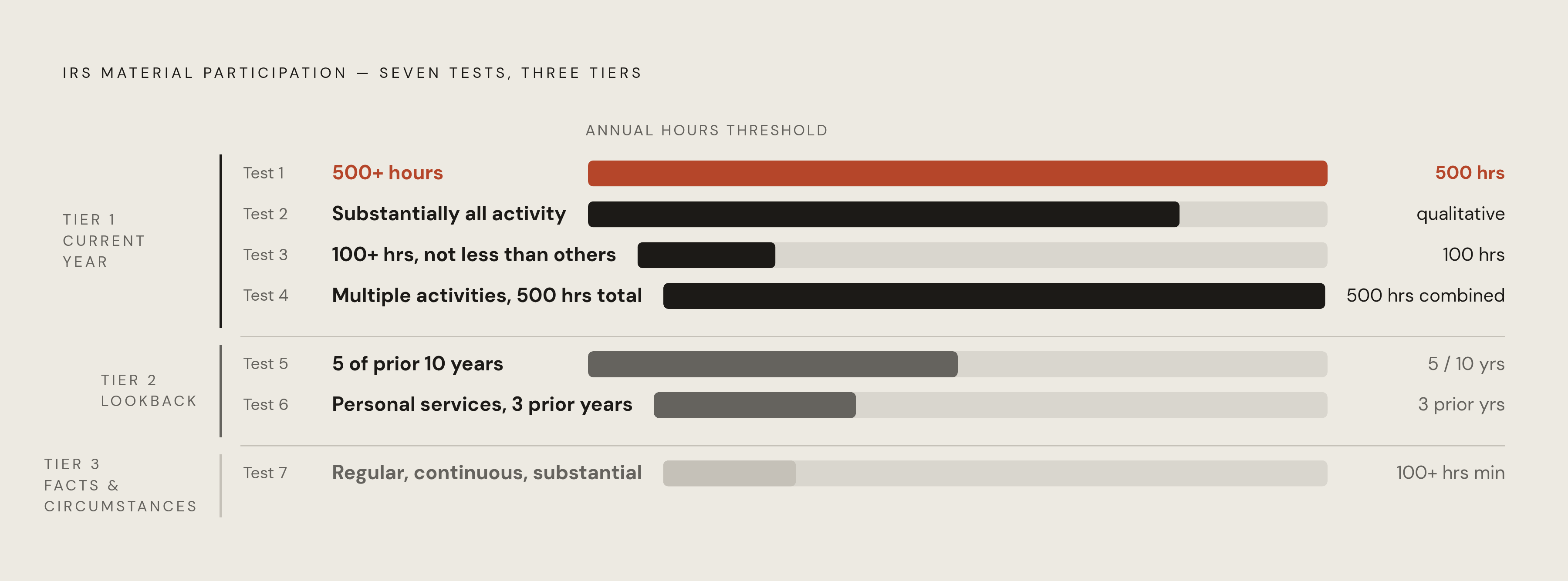
There are seven tests, and they group naturally into three tiers.
The first tier, Tests 1 through 4, revolves around hours logged in the current year. Test 1 is the one most owners rely on: participation exceeding 500 hours in the activity during the taxable year IRC 1411: Net Investment Income Tax Explained. The second tier looks backward rather than at the current year. Test 5 allows material participation in any five of the prior ten taxable years to satisfy the current year, a provision that matters for owners who've handed off day-to-day responsibilities but still want the exclusion to apply. Test 6 shortens that lookback to three prior years for personal service activities.
Test 7, the facts-and-circumstances test, is available based on all facts and circumstances showing that participation was regular, continuous, and substantial, with participation of more than 100 hours required. The requirement that no other individual put in more time than the taxpayer belongs to Test 3 specifically, not to Test 7. Confusing the two tests' requirements is a common error, and it matters because the IRS and courts will hold a taxpayer to the actual language of whichever test is being invoked.
None of these tests reward vague recollection. Hours spent on tasks not customarily performed by owners get disqualified if the principal purpose looks like manufacturing participation after the fact, and investor-type activity, reviewing financial statements, monitoring performance from a distance, doesn't count unless it ties directly to day-to-day management. The determination also resets every year and applies activity by activity; qualifying once creates no presumption for the following year. Contemporaneous logs are what the IRS wants to see, and general testimony reconstructed from memory tends not to hold up under audit scrutiny. Material participation is determined under Temp. Reg. § 1.469-5T (the same tests used for passive activity loss purposes apply for NIIT). Tests 2–4 provide alternative hour-based paths for owners who fall short of 500 hours but whose participation is still substantial relative to others involved (IRC 1411: Net Investment Income Tax Explained). Historical participation (Tests 5–6).
What Senty v. United States reveals about the burden of proof
Senty v. The case gives a rare, detailed look at what a material participation dispute actually looks like once it reaches litigation rather than staying inside an audit file.
The IRS had examined James Senty's joint returns for 2014 and 2015 and assessed NIIT against him. The Sentys paid the assessment and sued for a refund, and the entire case turned on one question: had Senty materially participated in three separate entities, Deerfield Financial Corporation, Reconyx, Inc., and Park Capital, LLC? That's not a small evidentiary lift.
What the court found instructive wasn't the substance of Senty's involvement so much as the standard of proof it demanded. General discussion of what someone remembers doing isn't enough on its own; the court wanted corroboration from contemporaneous, objective sources, emails, text messages, EZ Pass toll records, phone logs, credit card receipts, and narrative summaries detailed enough to describe specific activities performed on specific days. Proving you met them, after the fact, in front of a court or an examiner, requires a paper trail built while the year was happening. Ironically, the sophistication of the businesses at issue, a financial services company, a technology manufacturer, an investment vehicle, made the burden harder to carry rather than easier, since sophisticated operations tend to generate less of the mundane physical-presence evidence that simpler businesses leave behind. For practitioners advising active owners, contemporaneous time logs, calendar entries, and operational correspondence belong in the client's ongoing compliance routine, not on a checklist reserved for when the IRS comes calling. United States, 132 AFTR 2d 2023-6735 (Dist. Wis., a certain month.
Grouping elections as a tool for meeting the participation threshold
For estates and trusts, NIIT applies when undistributed NII pushes AGI above $16,000 in 2026, a threshold that is adjusted annually for inflation, unlike individual thresholds Instructions for Form 8960 (2025). If it is missed, the original grouping choices stay locked in.
Grouping has limits that no amount of planning can work around. Activities run through a publicly traded partnership can't be grouped with anything else, including another publicly traded partnership, so owners of PTP interests have no path to escape NIIT on those holdings through aggregation. And grouping elections are never a one-way lever. Once made, they affect passive activity loss calculations just as much as they affect NIIT exposure, so a grouping choice that solves an NIIT problem might create or worsen a loss limitation problem elsewhere on the return. Any grouping decision needs to be evaluated across both regimes at once. Reg. § 1.469-4 permits grouping of activities that form an appropriate economic unit (similar and synergistic businesses can be aggregated so hours across the group count toward a single participation test). The grouping rules under § 1.469-4 are respected for NIIT purposes under Treas. Reg. § 1.1411-5, per the Form 8960 instructions. One-time regrouping opportunity: a taxpayer subject to the NIIT for the first time may be able to regroup activities under Reg. § 1.469-11(b)(3)(iv), a window that should be evaluated immediately upon first NIIT exposure.
S corporation shareholders: how material participation works and the C corp contrast
For S corporation shareholders, the mechanics run through the same § 469 tests used everywhere else in this framework: materially participate in the corporation's trade or business, and the distributive share of income comes out of net investment income entirely. The complication for S corp owners specifically is that many of them wear more than one hat at once, investor, corporate officer, and rank-and-file employee, all inside the same entity. The IRS expects a genuinely activity-specific assessment of what that person actually does day to day rather than a title on an org chart.
C corporations sit under a structurally different rule. Dividend income paid out of a C corporation is subject to NIIT regardless of whether the corporation is closely held and regardless of how deeply the shareholder is involved in running the business. The active-business exclusion that S corp owners can reach through material participation simply doesn't exist for C corp dividends. That creates a real planning wrinkle: an owner who converts an S corp to C status, or who holds a minority stake in a C corp alongside an actively run S corp, faces NIIT on those dividends no matter how hands-on the operational role is. Entity choice, in other words, isn't just about corporate tax rates; it changes the NIIT calculus on distributions in a way that participation can't fix Instructions for Form 8960 (2025).
Shareholder-employees who pay themselves reasonable W-2 compensation reduce the amount of distributable S corp income that's even up for NIIT debate, but the wages themselves sidestep net investment income because they're wages, full stop, not because of any participation analysis. It's a different exclusion working through a different mechanism, and conflating the two can lead to sloppy planning.
Partnership and LLC owners: the Medicare tax gap and carried interest
General partners and LLC members follow the identical material participation framework: participate materially, and the distributive share stays out of net investment income.
Under existing statutory guidance, active limited partners in state-law organized limited partnerships may be positioned to avoid both NIIT and self-employment tax on the same distributive share, a combination that has attracted ongoing IRS scrutiny and litigation. Limited partner income is excluded from self-employment tax under § 1402(a)(13), and if that same partner is actively participating in the business, the income can also escape NIIT Net Investment Income Tax (IRC §1411) Guide 2026 | CPA Validated. Two different 3.8%-range charges, and neither one applies. It's not a drafting accident so much as an artifact of two statutes, written for different purposes, that happen to leave a corridor between them.
Anyone tempted to "fix" NIIT exposure by simply participating more actively should understand what that move actually does Instructions for Form 8960 (2025). Ramping up participation in an LLC taxed as a partnership can flip passive income (no self-employment tax, but NIIT applies) into nonpassive income (no NIIT, but potentially subject to self-employment tax). The 3.8% saved on one side can reappear as SE tax on the other; it's a trade that needs to be modeled as one Net Investment Income Tax (IRC §1411) Guide 2026 | CPA Validated.
Carried interest doesn't play by any of these rules at all. Fund managers who receive carried interest, typically structured as long-term capital gains allocated through partnership agreements, stay subject to NIIT no matter how much they materially participate, because the income is classified as investment income rather than compensation for services. The SE tax carve-out is precise: only income actually taken into account in determining SE tax under § 1401(b) is excluded; income excepted from net earnings from self-employment under § 1402(a)(1)–(17) remains subject to NIIT. For fund managers, registered investment advisers, and active partners inside management companies, limited partner status alone provides no shield against self-employment tax on management fee income, carried interest remains inside net investment income, and S corporations are identified as the primary structure for reducing Medicare-related taxes on the management fee side. For LLC members generally, the passive-versus-active determination still runs through § 469, and the entity's own classification of an activity never substitutes for the owner-level analysis of what that specific member actually did.
NIIT on sale of a pass-through interest: the gain exposure most owners underestimate
Selling an ownership stake in a pass-through entity carries an NIIT trap that catches owners who've spent years building material participation into their day-to-day operations Instructions for Form 8960 (2025). A partnership interest or S corporation's stock generally isn't treated as property held in a trade or business for NIIT purposes Instructions for Form 8960 (2025). Gain from selling it is presumed to be net investment income under § 1411(c)(1)(A)(iii). That presumption applies even to an owner who has materially participated in the underlying business for decades, unless a specific exception is claimed.
The exception, found in § 1411(c)(4), works through what's often called a look-through approach: gain only counts as net investment income to the extent that it would have been NII if the entity itself had sold all of its underlying assets at fair market value right before the ownership interest changed hands. Claiming that exception requires showing material participation in the business at the time of the sale. An owner who has stepped back from active involvement in the years leading up to an exit can lose the exception right when the stakes are highest.
Installment sales add a further layer of bookkeeping. When a partnership interest or S corp stock sells on installment terms under § 453, the adjustment between how the gain is treated for regular income tax versus NIIT purposes gets calculated in the year of the sale, and then that difference has to be tracked and applied as each future payment comes in, a multi-year compliance obligation. Complicating matters further, the regulation that would spell out detailed computational rules for this exception, § 1.1411-7, remains reserved: proposed but never finalized, according to the IRS's own Form 8960 instructions. Practitioners are left working from the bare statutory exception and general principles while that regulatory gap sits open. Given all of this, an owner planning to sell a pass-through interest should start assessing NIIT exposure two to three years ahead of the transaction, while there's still time to shore up or reestablish material participation before the year of disposition arrives.
Real estate professionals and rental property: a parallel material participation regime
Rental real estate runs on its own version of material participation, layered with an additional threshold that doesn't apply anywhere else in this framework. To exclude rental income from net investment income as a real estate professional, a taxpayer has to clear two separate conditions at once: more than half of the personal services performed during the year have to be in real property trades or businesses in which the taxpayer materially participates, and the taxpayer has to log more than 750 hours of service in those activities Instructions for Form 8960 (2025). Both conditions have to be true simultaneously; clearing one without the other gets nowhere.
Qualifying as a real estate professional doesn't end the analysis, either. Without that election on file, an owner juggling several rental properties is stuck proving participation property by property, which in practice means keeping separate time records for each address rather than one combined log across the portfolio.
The exposure tends to concentrate sharply in a single year: the year a rental property actually sells. That's typically the year NIIT hits hardest, because the full taxable gain, including the portion tied to unrecaptured depreciation under § 1250, is in net investment income all at once if material participation isn't firmly established. For owners planning an eventual sale, that concentration is the real argument for treating participation tracking as a habit built years in advance. Even after qualifying as a real estate professional, a taxpayer must materially participate in each rental activity separately, unless a grouping election under Treas. Reg. § 1.469-9(g) is in place; without the election, a client with multiple properties must establish separate participation in each one.

