
S Corporation Reasonable Compensation Audit Risk and IRS Criteria
The IRS uses a nine-factor test to challenge suppressed S corp owner salaries.
S corporation reasonable compensation is where payroll tax planning meets audit exposure, and the mechanics are simple enough to state in one breath: distributions from an S corp escape FICA, wages don't, and that asymmetry is the reason the IRS scrutinizes owner salaries. Every dollar an owner-employee shifts from W-2 wages into a distribution avoids the 15.3% self-employment tax rate (12.4% for Social Security, 2.9% for Medicare) that would otherwise apply. Left unchecked, that incentive would let an owner pay themselves almost nothing and take the rest of the profit as a distribution, which is exactly the pattern the IRS has built a dedicated enforcement effort to find. This isn't a grey area or a clever structuring play. Salary has to come first, set at a defensible market rate, before distributions are appropriate at all, and the agency has made that sequencing a focal point of its Employment Tax Program, with reasonable compensation reviews embedded as a specialty workstream.
Clients rarely arrive at this conversation with an open mind. They arrive with a number already picked, usually the smallest one that felt safe. The job isn't to bless that number. It's to test whether it survives contact with the IRS's own framework, and that framework is more specific than most owners assume.
What the IRS means by "reasonable" (the nine-factor framework and where it comes from)
The tax code never actually defines reasonable compensation with any precision. The regulatory language just says it's whatever would be paid "for like services by like enterprises under like circumstances," which sounds clean until you try to apply it to an actual business. The operative framework comes from case law, not statute: Mayson Manufacturing Co. v. Commissioner in 1949 laid down nine factors, later refined in cases including Owensby & Kritikos, and that nine-factor test is still what examiners reach for today.
The factors themselves cover the owner's training and experience, the duties actually performed and the responsibilities carried, the time devoted to the business, the history of dividends and distributions, how other employees at the company are paid, the timing of bonuses relative to company performance, comparable wages at similar businesses, and the relationship between the owner's compensation and what the business earned overall. No single factor decides the case. The IRS weighs the whole picture, which cuts both ways: an owner logging 60-hour weeks can't justify a token salary by pointing to thin margins, and a business whose profit doubled because a product suddenly took off doesn't automatically owe the owner double salary if the owner's actual duties never changed.
The agency isn't improvising this analysis case by case, either. The IRS Reasonable Compensation Job Aid for IRS Valuation Professionals formalizes three specific valuation methodologies. These are the Market Approach, the Income Approach (also called the independent investor test), and the Cost Approach. These are the IRS's own tools, built for its own examiners, not something practitioners invented to defend clients after the fact. That distinction matters, because it means an advisor can build a client's compensation number using the same methodology the agency will use to challenge it. Because the whole test is facts-and-circumstances rather than a formula, the documentation behind the number ends up mattering nearly as much as the number itself. A defensible salary with contemporaneous records behind it holds up far better under examination than a technically correct number with nothing to show how it was reached.
The three valuation methods the IRS uses
The Market Approach is the workhorse. It pulls from general industry compensation surveys organized by SIC or NAICS code and compensation data sources, and practitioners search by job title, industry code, and metro area to anchor a salary in something objective. In practice, this is the primary method most of the time, with the other two approaches serving as corroboration rather than substitutes.
The Cost Approach works differently. It breaks the owner's role apart into its component functions, CEO, bookkeeper, salesperson, operations manager, and assigns wage data from compensation data sources to each function, weighted by how much time the owner actually spends on it. This method earns its keep when an owner wears several hats at once, since it makes visible what it would cost to staff each of those functions separately. It doesn't replace the market approach so much as reinforce it from a different angle.
The Income Approach, sometimes called the independent investor test, asks a sharper question: would a third-party investor be satisfied with the return on invested capital, given what the company pays the owner in wages? If the return looks unusually rich relative to that investment, it signals that wages were suppressed specifically to inflate distributions, and the IRS treats that pattern as evidence of underpayment. This approach earns its usefulness in businesses where capital, systems, or a broader workforce drive revenue alongside the owner's personal labor.
Using more than one method together builds a stronger record than leaning on any single approach alone. Third-party software tools, RCReports among them, can package this analysis into a printable, audit-ready report, and a formal study typically runs $200 to $400, a cost that's easy to justify for owners earning above roughly $150,000. What doesn't hold up, despite its popularity in practitioner shorthand, is the so-called 60/40 rule, the idea that 60% of profit should go to salary and 40% to distributions. That rule has no legal standing whatsoever. In JD & Associates, Ltd. v. United States, the court said that mechanical formulas can't substitute for market-based analysis. As a general practitioner observation rather than any kind of safe harbor, reasonable compensation for many owner-operators tends to be somewhere between $45,000 and $150,000, running substantially higher for physicians, attorneys, and specialized consultants whose market rates simply run higher.
The specific patterns that put a return on the IRS's radar
Every S corp examination includes a reasonable compensation review, and it starts in an obvious place: officer compensation on Line 7 of Page 1 of Form 1120-S, measured against total distributions and overall revenue. From there, five patterns tend to draw the closest look.
Zero or near-zero W-2 salary paired with substantial distributions is the most direct red flag there is. Barron v. Commissioner is the textbook example: an Arkansas accountant took $83,000 in distributions in a year he paid himself no salary. Salary that's simply low relative to revenue, profit, and industry norms draws scrutiny too, since the IRS cross-references industry wage data and flags returns sitting well below market for a business at that level of profitability. Large or inconsistent distributions that don't match up with payroll records raise a flag on their own, especially where the numbers on payroll filings don't line up with what shows on the W-2. Improperly handled health insurance for 2%-shareholders is a recurring, narrower trigger. And disguising what is functionally wage income as loans, gifts, or business expenses invites exactly the kind of reclassification this whole framework exists to prevent.
Family payroll deserves its own mention here. Spouses and children on the payroll need to be paid market rate for work they actually perform, and phantom roles or inflated family salaries draw audit attention independent of whatever's happening with the owner's own compensation. Owners running multiple related entities face a wider lens still, since the IRS looks at compensation across all related entities together, not just the one entity currently under review.
More of these challenges now start as a correspondence audit, a letter, rather than a full-blown examination, and that shift raises the stakes on documentation being ready before the letter arrives rather than assembled after. As of 2025, the IRS is reportedly using AI and data analysis tools to spot lopsided salary-to-distribution ratios at scale. Whatever margin of safety used to come from getting lost in the volume of routine processing, that margin is gone.
What reclassification costs (the penalty cascade that follows an adverse determination)
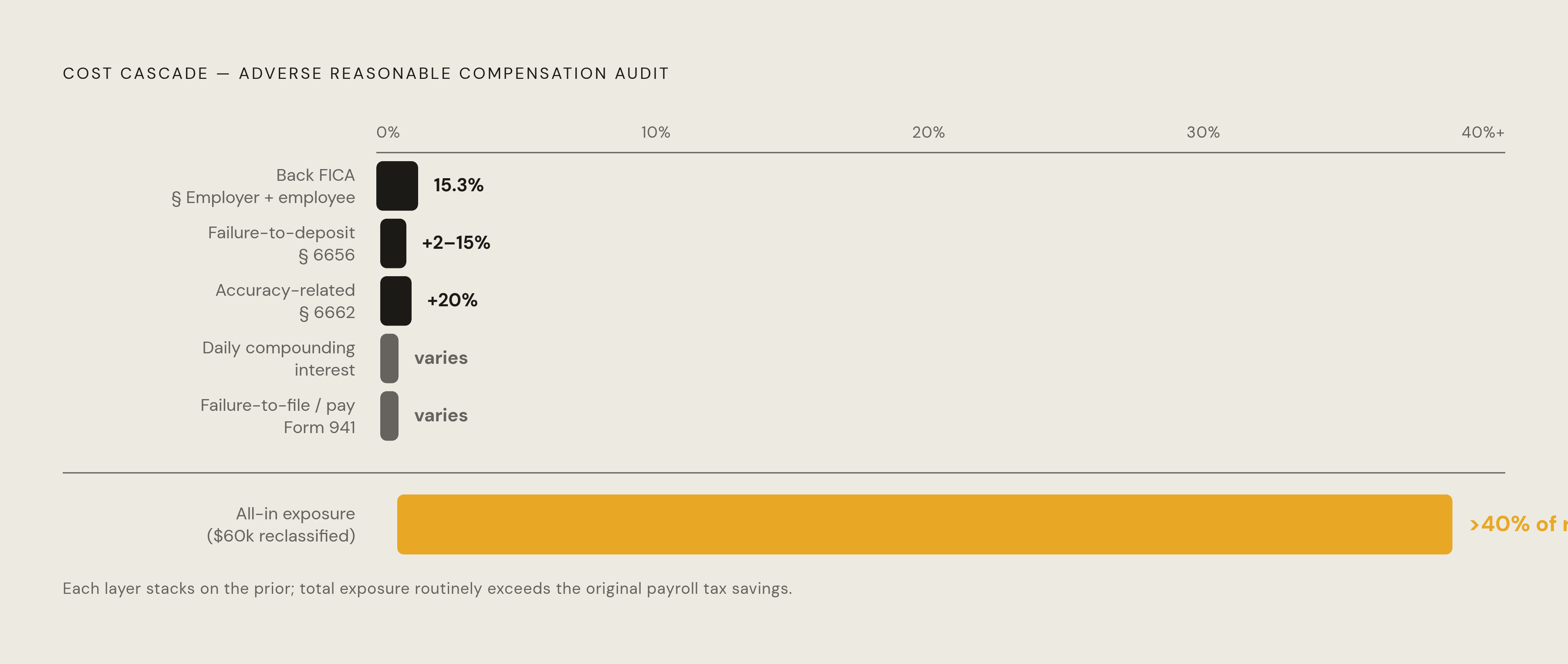
Total exposure from an adverse reclassification often exceeds 40% of the reclassified amount once back taxes, penalties, and professional fees are all added up, and that single figure is the one that ought to reframe the whole conversation. This isn't a story about payroll tax savings anymore once a notice arrives. It's a story about whether the original bet was worth the downside.
The cascade runs in a fairly predictable order. Back FICA at the full 15.3% applies to the reclassified amount, covering both the employer and employee portions. A failure-to-deposit penalty under Section 6656 adds 2% to 15%, depending on how late the deposit turns out to have been. An accuracy-related penalty of 20% under Section 6662 kicks in once the underpayment counts as substantial. Interest accrues on every reclassified dollar, compounding daily, running all the way back to the original due date. And failure-to-file or failure-to-pay penalties on Form 941 can stack on top of all of it. For a moderate case, say $60,000 of distributions reclassified across three years, the all-in cost typically runs $25,000 to $40,000, and reclassification reaches back through every open audit year, usually three. When the IRS pursues these cases, the litigation record has generally favored the government.
The costs that follow don't stop at the tax bill, either. Solo 401(k) contribution room is tied directly to W-2 compensation, and that room can't be recovered retroactively once the year has closed. The 2026 elective deferral limit is $24,500, with an $8,000 catch-up for those 50 and older and $11,250 for ages 60 through 63, and no reclassification after the fact lets an owner go back and capture contribution room that a properly-set salary would have unlocked at the time. For non-SSTB owners above the QBI phase-out thresholds, forfeited W-2 wages can shrink the Section 199A deduction too, or eliminate it outright where the W-2 wage limitation applies.
Watson v. United States, decided by a federal appeals court in 2012, is the case practitioners still point to. David Watson paid himself $24,000 a year while his S corp distributed $203,651 in 2002 and $175,470 in 2003. The court set his reasonable compensation at $91,044, reclassifying $67,044 per year as wages, and back taxes, penalties, interest, and years of legal fees followed from there. Watson is the exact pattern the IRS still has a dedicated team looking for. It's the exact pattern the IRS still actively looks for.
The permanent QBI deduction's reshaping of the salary-versus-distribution tradeoff in 2026
The One Big Beautiful Bill Act made the Section 199A qualified business income deduction permanent starting in 2026, and that permanence sharpens the underlying incentive problem rather than resolving it. Reasonable W-2 salary doesn't count as qualified business income. Only the distribution portion of an owner's earnings qualifies for the deduction. The deduction grows largest precisely when the salary shrinks smallest, which is the pattern that draws an audit.
The phase-out mechanics for 2026 matter here. The deduction begins phasing out at $201,750 for single and head-of-household filers and $403,500 for those married filing jointly, and above those thresholds the W-2 wage limitation caps the deduction against wages the business actually paid out. OBBBA also widened the phase-in range itself for taxpayers in the phase-out zone. Separately, Section 199A(i) now guarantees a minimum deduction of $400 for any taxpayer with at least $1,000 of qualified business income from an active trade or business in which they materially participate, with those figures applicable beginning in 2026.
That leaves a genuine structural tension. Setting the salary too high causes an owner to forfeit QBI deduction room they didn't need to give up. Setting it too low invites a reclassification that can collapse the deduction entirely while stacking penalties on top of the collapse. The permanence of the QBI deduction only strengthens the pull toward suppressing wages. That is precisely why reasonable compensation now ranks among the most closely watched, highest-risk areas in small business tax planning heading into 2026. The only sound way through it is modeling the payroll tax cost and the QBI impact together, in the same pass. A salary tuned to optimize one variable while ignoring the other doesn't just leave money on the table, it builds an unstable position that a single audit letter can knock over.
Building a documentation record that holds up from the day the return is filed
Documentation isn't a fallback plan to build after a notice shows up. It's the primary defense, full stop, and a correspondence audit resolves in weeks or drags on for years largely because of whether the record already existed at the moment the notice arrived, rather than because a practitioner can reconstruct one under pressure afterward.
A defensible file has a few core pieces. A written job description naming the owner's actual responsibilities, hours worked, revenue-generating activities, and operational role. Dated market research, whether BLS wage data, industry surveys, or job postings for comparable roles in the same geography, with the source, the date it was pulled, and the specific figures all preserved rather than summarized from memory later. Time records or reasonable time estimates broken out by function, particularly where the Cost Approach is used to document an owner covering multiple roles at once. A board or shareholder resolution that sets the salary and references the methodology used to get there. And consistent payroll records proving the salary was actually run through payroll, not simply written down on paper somewhere.
Where the Income Approach comes into play, the rate-of-return analysis needs to be documented in enough detail that an examiner can follow the logic without needing anyone in the room to explain it. This record isn't a one-time exercise, either. Wage inflation and shifting labor markets mean a benchmark that held up last year can understate what the market actually pays in 2026, and rising wages across many fields mean a number that cleared scrutiny a few years back may now read as low. Owners running multiple entities should have their compensation documented across all of those entities together, showing the aggregate pay is reasonable for the aggregate services performed, since that's the full picture the IRS will actually examine.
A formal third-party compensation study, an RCReports analysis running $200 to $400 among them, provides a contemporaneous, audit-ready record that signals the number was reached through real diligence rather than picked for convenience. And purpose-built tax workflow tools, the kind designed specifically for how tax practitioners actually work rather than adapted from general accounting software, can help systematize the annual review, flag when a client's distribution-to-wage ratio drifts outside a defensible range, and keep the documentation trail running as a normal part of the engagement instead of a scramble after a letter shows up.
The scale of the underlying problem isn't new, even if enforcement attention now is. Using IRS National Research Program data from tax years 2003 and 2004, the most recent comprehensive audit data of its kind, the GAO found that roughly 13% of S corporations paid inadequate wage compensation. Given how much distributions have grown as a share of owner income since then, and how much sharper the agency's detection tools have gotten, that 13% almost certainly understates where things stand today.