At-Risk and Passive Activity Loss Rules for Pass-Through Investors
Four separate tax limits must clear before a pass-through loss reaches your return.
A K-1 loss appearing under your basis doesn't mean you get to deduct it this year. That belief costs taxpayers real money and real penalties, because basis is only the first of four separate limitations a pass-through loss has to clear before it lands on the taxpayer's personal return. Missing the ordering means misapplying the whole framework: basis under Section 704(d) or 1366(d), at-risk under Section 465, passive activity under Section 469, and the excess business loss cap under Section 461(l). Each gate operates on whatever survived the one before it, and a loss stopped at gate one never even reaches gate two. Understanding that sequence, not just the individual rules, is what separates a defensible return from a guess.
Gate 1: Basis, the foundational limit and the partnership/S-corp asymmetry that determines starting position
Basis is where the analysis has to start, and it works the same way conceptually for both partners and S corp shareholders. You start with what you put in, cash or the adjusted basis of contributed property. That number moves up when the entity allocates you income and moves down when it allocates losses or makes distributions. Simple enough on paper.
Liabilities factor into partnerships and S corps differently, and it's the single most consequential difference between the two entity types for loss planning. A partner's outside basis under Section 704(d) includes their allocated share of partnership liabilities, recourse and qualified nonrecourse alike. That means a partner in a leveraged real estate deal can carry substantial basis even without contributing much cash, simply because the partnership borrowed money and allocated a share of that debt to them.
S corp shareholders get no such benefit. Corporate-level debt, no matter how it's structured or what it's used for, does not increase a shareholder's stock or debt basis under Section 1366(d). If an S corp shareholder wants basis from debt, the shareholder has to personally loan money directly to the corporation. Anything short of that, including a personal guarantee of a bank loan made to the corporation, does not count. A federal tax regulation makes this explicit, and a federal appeals court affirmed it in Maloof v. Commissioner: a guarantee is a promise to pay if the corporation defaults, not an outlay of the shareholder's own capital, so it creates no basis.
In Selfe v. United States, a federal appeals court found that where the lender looked primarily to the shareholder, not the corporation, for repayment, in substance the shareholder had made the loan... In Selfe v. United States, a federal appeals court found that where the lender looked primarily to the shareholder, not the corporation, for repayment, in substance the shareholder had made the loan and the corporation was merely a conduit. That's a fact-intensive argument that shouldn't be relied on as a planning strategy by default. The safer, cleaner move for an S corp shareholder who needs basis is a direct loan to the entity, documented as debt, before year-end.
Gate 2: At-Risk (how the recourse/nonrecourse distinction narrows what basis already opened)
Clearing gate one means the loss is now eligible to be tested against a second, narrower limitation: how much the taxpayer is actually at risk of losing if the activity goes to zero. It means the loss is now eligible to be tested against a second, narrower limitation: how much the taxpayer is actually at risk of losing if the activity goes to zero. Section 465 exists precisely because basis, especially partnership basis inflated by nonrecourse debt, can overstate real economic exposure. The at-risk rules bring the deduction back in line with what the taxpayer could actually lose. Reporting happens on Form 6198.
At-risk amount includes cash contributed, the adjusted basis of contributed property, and recourse debt, meaning borrowed amounts for which the taxpayer is personally on the hook. It also includes property pledged as collateral, as long as that property isn't used in the activity itself. What doesn't count is nonrecourse debt, where the lender's only remedy on default is to seize the secured property, leaving the taxpayer's other assets untouched. Loss-protection arrangements, stop-loss agreements, and similar arrangements that insulate the taxpayer from the downside also get excluded from the at-risk figure.
The partnership/S corp asymmetry from gate one comes back around in an interesting way. A partner's outside basis might include a healthy allocation of nonrecourse debt, and that debt is real for basis purposes under Section 704(d). But that same nonrecourse debt does nothing for the at-risk calculation under Section 465, unless it qualifies as qualified nonrecourse financing under a specific carve-out for real estate. So a partner can have ample basis and still be capped hard by at-risk, because the two numbers measure different things and the tax code doesn't pretend otherwise.
Gate 3: Passive Activity (how material participation determines whether a loss can offset ordinary income)
A loss that survives basis and at-risk is now allowed in an economic sense, but it still hasn't answered the question of what kind of income it's allowed to offset. That's the job of Section 469, enacted in 1986 specifically to shut down a popular shelter strategy: high earners buying into leveraged partnerships that threw off large paper losses, then using those losses to wipe out wages and portfolio income that had nothing to do with the activity generating the loss.
The rule that resulted sorts income and loss into three separate buckets, and they don't mix. Passive losses can only offset passive income. They cannot touch wages, they cannot touch active trade or business income, and they cannot touch portfolio income like interest, dividends, or capital gains. A loss that's passive in character gets suspended and carried forward until there's passive income to absorb it or the activity is disposed of.
Whether an activity is passive gets determined at the individual taxpayer level, not at the entity level, which matters enormously for multi-member pass-through entities and multi-shareholder S corps. Two partners in the same partnership, holding identical percentage interests, can have entirely different passive/active characterizations on the same K-1 line item, because the test looks at each partner's own hours and involvement, measured against the entity's tax year.
The regulations, specifically Temp. Treas. Reg. 1.469-5T, lay out seven separate tests for material participation, and satisfying any single one is enough to convert an activity from passive to active. More than 500 hours in the year clears it. Participating more than any other individual in the activity also clears it. A middle test allows more than 100 hours, provided no other individual puts in more time than the taxpayer does. There's a test for aggregating multiple "significant participation" activities that individually fall short of 500 hours but collectively exceed it. Material participation in five of the preceding ten years qualifies, which catches taxpayers who scale back involvement gradually. The remaining tests cover additional participation scenarios not addressed by the earlier ones.
Gate 4: Excess Business Loss, the post-2017 cap that applies after the other three gates have run
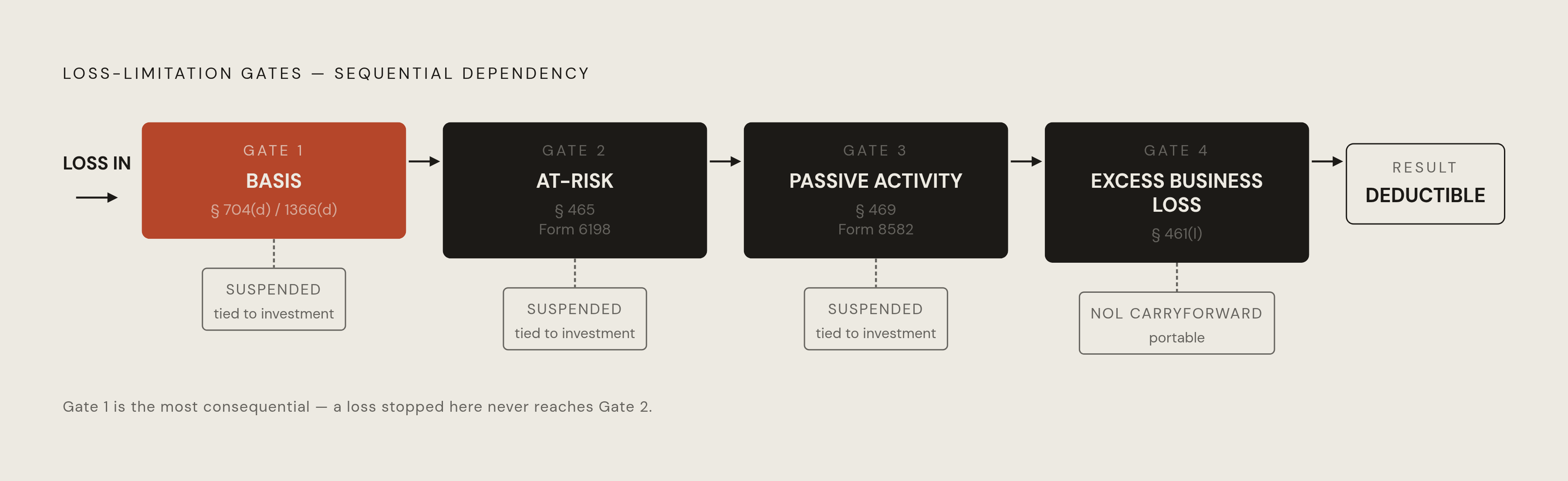
Assume a loss has cleared basis, cleared at-risk, and qualified as non-passive under material participation. There's still one more gate, and it's the newest one. Section 461(l), added by the 2017 tax law, caps the amount of net business loss a noncorporate taxpayer can deduct against nonbusiness income in a single year. It applies to individuals, and to trusts and estates as well. The disallowed amount is tracked and carried forward on the taxpayer's return.
IRS Publication 925 spells out the ordering explicitly: the excess business loss limitation is the last step, applied only after the basis limitation, the at-risk limitation on Form 6198, and the passive activity limitation on Form 8582 have all run their course. Whatever loss remains after those three gates is what gets tested against the Section 461(l) cap, rather than the raw K-1 number reported at the start of the year.
Losses knocked out at this fourth gate aren't gone. They convert into a net operating loss carryforward, available to offset income in future years subject to the rules governing that carryforward. That's a meaningfully different outcome from a loss trapped at basis or at-risk, which simply sits suspended, tied to that specific investment, waiting for basis or at-risk amount to be restored. An excess business loss, once disallowed, becomes a general-purpose carryforward. That distinction matters for anyone modeling multi-year tax positions across several K-1 investments at once.
How the ordering of the four gates changes the planning calculus before a transaction closes
The four gates run in a strict, non-negotiable sequence, and a loss stopped at an earlier gate is invisible to every gate that follows. It's that the four gates run in a strict, non-negotiable sequence, and a loss stopped at an earlier gate is invisible to every gate that follows. A loss suspended at basis never gets tested for at-risk. A loss suspended at at-risk never gets tested for passive activity. So the first question in any pass-through loss analysis has to be: which gate is actually going to stop this loss, and can that be changed before the year closes?
At gate one, partners should confirm how the entity is characterizing its liabilities before year-end, since how the entity characterizes its liabilities can affect both basis and at-risk amount. S corp shareholders facing a basis shortfall have one clean lever: a direct loan to the corporation, made and documented before year-end, which creates both stock or debt basis and at-risk amount simultaneously. A guarantee alone, no matter how solid the shareholder's credit, accomplishes neither.
At gate two, real estate investors need to confirm, not assume, that their financing qualifies as qualified nonrecourse debt under Section 465(b)(6), coming from an institutional lender and secured by real property. That qualification is what lets nonrecourse real estate debt count toward at-risk when it otherwise wouldn't. Outside real estate, nonrecourse financing that inflates basis provides zero at-risk benefit, so partners in those structures should model basis and at-risk as two separate numbers rather than assuming they move together. Pulling cash out, or a shift in how liabilities get allocated, can push at-risk below zero and trigger income recapture under Section 465(e). Any distribution decision should account for where the at-risk balance sits.
At gate three, documentation is the whole game. Participation hours need to be logged as they happen, not reconstructed months later for an audit, and reconstructed logs are consistently one of the weakest points examiners find, particularly on real estate professional status claims. Taxpayers with multiple rental properties should evaluate how each property's participation hours are measured, since the characterization of activities can determine whether a material participation test is cleared or missed. Short-term rental investors chasing an exception to passive treatment still need to separately satisfy one of the seven material participation tests, since meeting a rental-period threshold alone is not sufficient. And for taxpayers near the income phase-out range, the $25,000 special allowance for active participation in rental real estate disappears once modified AGI hits $150,000, so managing modified AGI relative to that threshold can determine whether that allowance survives.
Four gates, one sequence, and no shortcuts between them. The ordering isn't a filing quirk; it's the structural logic built into the code over decades, one gate at a time, each one closing a specific shelter strategy the last one didn't reach. Treating basis as the finish line, rather than the starting gate, is the single most common and most costly misread in pass-through loss planning.
Sources
- Publication 925 (2025), Passive Activity and At-Risk Rules | Internal Revenue Service
- 2025 Publication 925
- At-Risk Rules and Passive Activity Limits Explained | SDO CPA
- Beyond basis: understanding at-risk limits on loss deductions - Condley & Company, L.L.P.
- thismatter.com
- irs.gov
- 6.2 Shareholder’s Basis, Loss Limitations and S-corp Distributions – Fundamentals of Federal Taxation
- Understanding Passive Activity Losses: A Comprehensive Guide|Greg O’Brien, CPA