
Excess Business Loss Limitation Under Section 461(l) After TCJA
The permanent cap on business losses reaching noncorporate taxpayers just dropped sharply.
Section 461(l) puts a hard dollar cap on how much business loss a noncorporate taxpayer can use to offset non-business income in a single year. It's one of the more consequential provisions to survive a major tax reform law, and one of the least understood, largely because it sits behind several other loss limitations that most practitioners already know cold.
What Section 461(l) does and who it hits
The rule targets a specific behavior: using a large business loss to wipe out income that has nothing to do with the business. Wages, interest, dividends, portfolio capital gains, none of that income is supposed to be fully absorbed by an unlimited business loss anymore. So much confusion about §461(l) stems from taxpayers assuming a loss is a loss, full stop, when the statute embeds a different policy choice.
The provision reaches individuals, trusts, and estates that own a business directly or through a partnership or S corporation, along with sole proprietors filing Schedule C. C corporations are exempt. That carve-out isn't an oversight; corporate losses were already governed by a different set of rules, and lawmakers drew the line at the noncorporate taxpayer level on purpose. So the entire weight of §461(l) lands on individuals and pass-through owners, which is precisely the population least likely to have a controller running a tax provision calculation before filing season.
Legislative arc from TCJA through OBBBA: how a temporary provision became permanent
TCJA added §461(l) to the code on December 22, 2017, effective for tax years beginning after December 31 of that year. The original thresholds were set at $250,000 for single filers and $500,000 for joint filers, indexed for inflation each year afterward. It was built as a temporary measure, scheduled to sunset, the way much of TCJA's individual-side provisions were.
Then came the CARES Act, signed March 27, 2020, which suspended the limitation retroactively for 2018, 2019, and 2020. Taxpayers who had already filed returns limited by §461(l) in 2018 or 2019 were suddenly eligible to amend and claim refunds, a scramble that kept a lot of preparers busy reworking prior-year returns for clients who'd taken a hit they didn't actually owe. The suspension expired on schedule, and the limitation came roaring back for 2021.
The Inflation Reduction Act, enacted August 16, 2022, pushed the sunset date further out, from the end of 2026 to the end of 2028. And then a later tax law made the provision permanent. What started as a temporary revenue offset attached to TCJA has now become a fixture of the code, with no expiration date on the horizon. That permanence changes the calculus for long-term planning entirely: a temporary rule invites waiting it out, a permanent one demands structural adaptation.
The 2026 threshold drop: why the numbers went backward
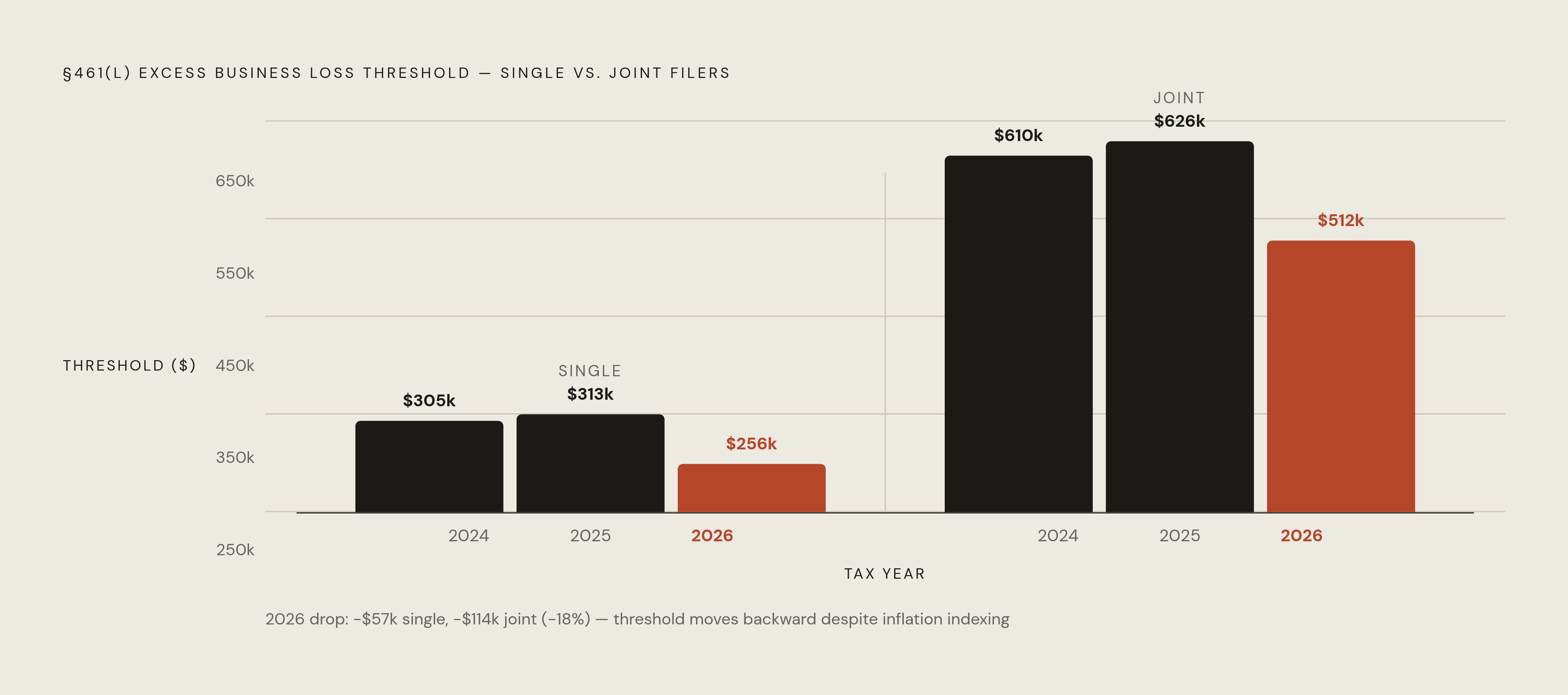
Inflation adjustments to the §461(l) threshold had been moving in one direction for years. The 2024 thresholds sat at $305,000 for single filers and $610,000 for joint filers. In 2025, those numbers rose again, to $313,000 and $626,000.
Then 2026 arrived and the thresholds fell, sharply, to $256,000 single and $512,000 joint. That's a drop of $57,000 for single filers and $114,000 for joint filers year over year, a reduction of roughly 18% in how much business loss a taxpayer can actually use. Thresholds don't typically move backward under an inflation-indexing mechanism, so the underlying statutory baseline is resetting under OBBBA. It's the underlying statutory baseline resetting under OBBBA, and it means taxpayers who planned a 2026 transaction using 2025 numbers are going to find less room than they expected, right when many of them are also staring down a much larger deduction from bonus depreciation. That collision gets its own treatment further down, but the threshold reset alone is enough to force a re-run of every projection built on last year's assumptions.
The four-layer loss limitation stack and the place of §461(l) within it
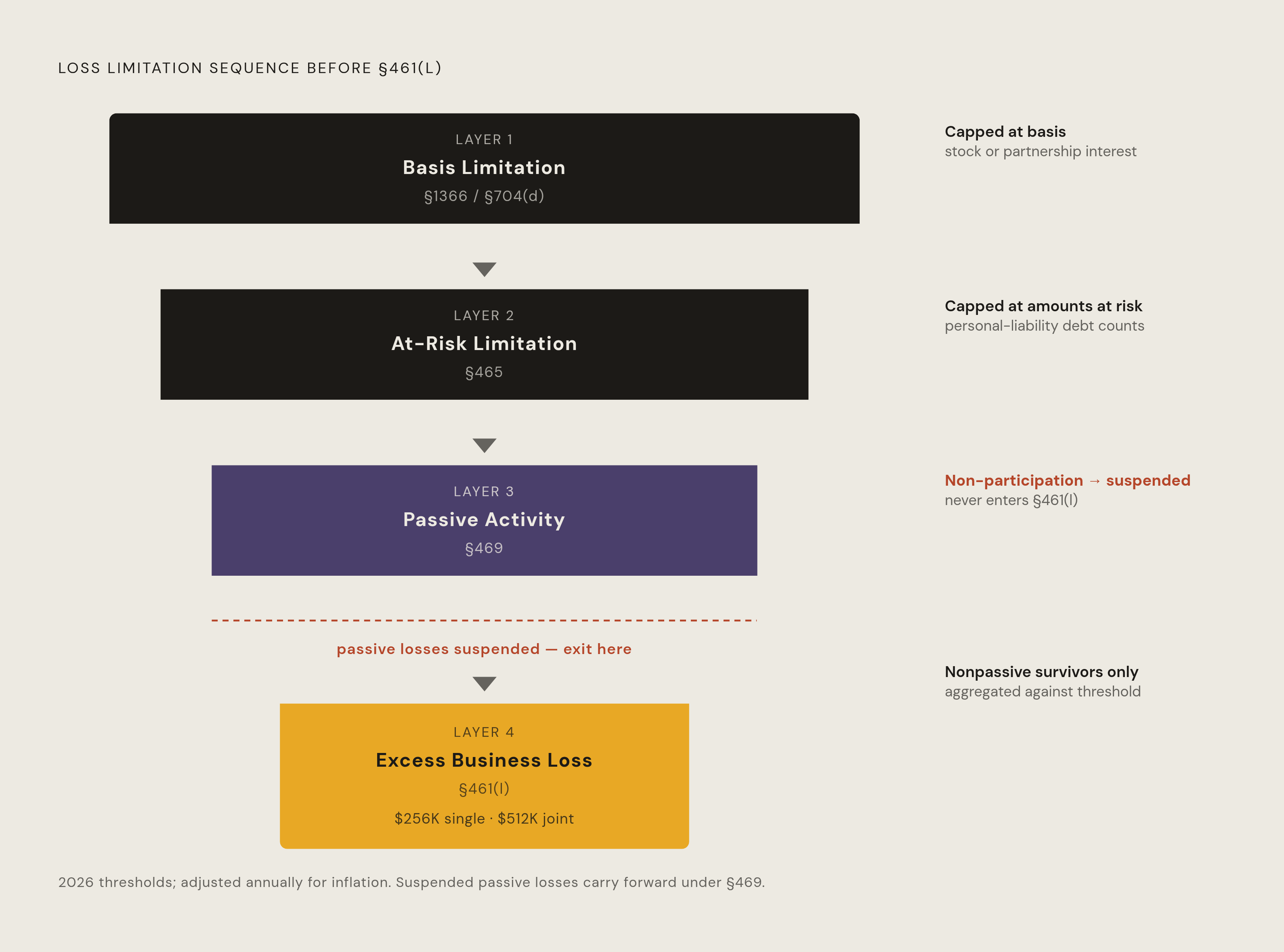
No dollar of business loss reaches Form 461 without first surviving three earlier gauntlets. Understanding the order matters as much as understanding each layer individually, because getting the sequence wrong is the single most common mistake practitioners make with this rule.
Layer one is the basis limitation: §1366 for S corporation shareholders, §704(d) for partners. A loss is only deductible up to the taxpayer's tax basis in the stock or partnership interest. No basis, no deduction, regardless of anything else going on.
Layer two is the at-risk limitation under §465, which further restricts losses to amounts the taxpayer actually has at risk, including cash invested, the basis of contributed property, and borrowed amounts where the taxpayer is personally liable or has pledged property as collateral. A loss can clear the basis test and still get stopped here if the financing behind it is nonrecourse and the taxpayer isn't personally on the hook.
Layer three is the passive activity loss regime under §469. Losses from activities where the taxpayer doesn't materially participate get suspended, full stop, until the activity produces passive income or gets disposed of. A suspended passive loss never reaches Form 461 at all, which matters most for sequencing purposes. It simply doesn't enter the §461(l) calculation. Applying §461(l) before running the passive activity analysis is the most common sequencing error practitioners make, and it tends to produce an EBL calculation that's wrong in either direction.
Layer four is §461(l) itself. Only losses that are nonpassive, within basis, and within the at-risk amount survive all three prior layers and get aggregated and subjected to the threshold cap.
Consider the short-term rental scenario that appears constantly in current planning conversations. If the taxpayer materially participates in that rental, the loss clears §469 as nonpassive activity and arrives, intact, at Layer 4. That's why cost segregation studies paired with short-term rentals have become the most common trigger for an excess business loss headache: the rental generates a large loss, material participation keeps it out of the passive bucket, and the full amount lands squarely on Form 461 with nothing left to soften the blow.
The sequencing has planning implications too. Material participation elections, decisions about how a deal gets financed to satisfy the at-risk rules, and basis management all shape how much loss actually reaches Layer 4. Advisors who only think about §461(l) in isolation are missing three earlier opportunities to influence the number that eventually hits the cap.
Excess Business Loss Calculation on Form 461
The statutory formula is straightforward on paper: total business deductions, excluding §172 net operating loss deductions and §199A deductions, minus total gross income and gains from trades or businesses, minus the applicable threshold. Whatever remains, if positive, is disallowed.
Form 461 runs the calculation in three parts. Part I aggregates every line of business income and loss on the return, Schedule C, Schedule E where the activity rises to the level of a trade or business rather than pure passive investment, Schedule F, and gains or losses from business property reported on Form 4797. Part II backs out everything that isn't attributable to a trade or business: capital gains and losses from investment assets like stocks and bonds, non-business interest, non-business dividends, and other portfolio income. What's left after Part II is the aggregate net business income or loss. Part III compares that number against the filing-status threshold, and whatever exceeds it gets disallowed, reported back on Form 1040 as positive income with the notation "ELA" for Excess Loss Adjustment.
A few inclusion and exclusion rules trip people up regularly. W-2 wages from an employer are not business income for this purpose, and they don't expand the taxpayer's capacity to absorb business losses; the threshold is a flat dollar figure that doesn't flex based on how much salary someone earns. Gains from selling business property, equipment, and business real estate reported on Form 4797 do count as business income and work to reduce the excess business loss. Capital gains from investment assets sit outside the business income category entirely and provide no offset. Section 199A and 172 deductions are excluded from the computation from the start.
Pass-through entities themselves don't compute §461(l). An S corporation doesn't run this calculation on its own return; the loss flows out to shareholders on Schedule K-1, and each individual shareholder aggregates it with everything else on their personal Form 461, after applying the basis, at-risk, and passive activity limitations first.
The math produces a result that surprises a lot of taxpayers the first time they see it. A taxpayer earning $1 million in salary and reporting a $1 million business loss does not net to zero taxable income, despite what intuition might suggest. Running that fact pattern for a married joint filer in 2026 leaves the taxpayer with roughly $488,000 of taxable income, with the disallowed portion of the loss shoved into a carryforward rather than offsetting the salary in the current year.
The disallowed amount: NOL carryforward mechanics and the OBBBA change
Before OBBBA, the disallowed excess business loss became part of the taxpayer's net operating loss carryforward under §461(l)(2). It carried forward as part of the taxpayer's net operating loss and could offset taxable income in a future year once it entered the NOL system. That was the release valve: lose the deduction this year, get it back eventually, against whatever income showed up down the road.
OBBBA made the §461(l) limitation permanent, removing the prior sunset date. Disallowed excess business losses continue to carry forward, though the mechanics of how those carryforwards interact with future-year §461(l) computations warrant close attention as guidance develops.
The practical consequence is that the loss can no longer convert into an NOL and then quietly offset non-business income once the calendar turns over. It stays trapped inside the business-income silo, unusable until the taxpayer actually generates enough business income to absorb it. Functionally, that's a permanent disallowance for taxpayers who don't have future business income lined up to soak up the carryforward, which is a very different outcome than the old system's promise of eventual relief.
Even for losses that do make it into the NOL system through other channels, the 80% limitation on post-2017 NOLs still applies: a carried-forward loss can only offset 80% of taxable income in any given future year, and carrybacks are generally unavailable for NOLs generated outside the CARES Act window covering 2018 through 2020.
State tax exposure: where federal and state rules diverge
The federal calculation is only half the picture. When a taxpayer has a disallowed excess business loss sitting alongside a large bonus depreciation deduction, the interaction between the two can push federal and state taxable income in noticeably different directions, because states don't uniformly conform to federal bonus depreciation provisions.
That divergence produces a specific and uncomfortable outcome: a taxpayer can show a federal loss, or close to it, and still owe real money to the state. The federal refund expectation and a state tax bill can exist side by side on the same return, and taxpayers who only look at the federal bottom line get blindsided when the state return comes back with tax due.
This shows up most often for real estate professionals who lean on cost segregation studies to accelerate depreciation and generate large federal deductions. Plenty of states don't conform to federal bonus depreciation rules, or conform only partially, so the deduction that shelters federal income does far less work, or none at all, on the state return. Any tax projection built federal-only will understate the client's combined tax burden by the amount the state fails to conform to federal bonus depreciation. State modifications need to sit in the same model as the federal EBL limitation from the start, not get bolted on afterward as an afterthought.
The 2026 collision: permanent bonus depreciation meets a lower EBL threshold
Two changes landed in the same year under OBBBA, and they pull against each other. Bonus depreciation returned to 100% and was made permanent, so the first-year deduction on qualifying property just got substantially larger for good. At the same time, the §461(l) threshold reset downward, from $313,000 and $626,000 in 2025 to $256,000 and $512,000 in 2026.
One change grows the size of the loss a taxpayer can generate. The other shrinks how much of that loss can actually offset non-business income. When these changes are combined, the gap between what a taxpayer expects to shelter and what the law actually allows widens considerably, right at the moment depreciation-heavy strategies became more attractive on paper.
The short-term rental example makes the arithmetic concrete. A single filer earning $500,000 in wages plus $100,000 in dividends and capital gains buys a short-term rental, runs a cost segregation study, and claims 100% bonus depreciation, generating a $400,000 loss. Because the taxpayer materially participates, the loss clears the passive activity rules as nonpassive and lands, in full, on Form 461. Running that same fact pattern through the 2025 threshold versus the 2026 threshold leaves the taxpayer with $57,000 more taxable income in 2026 purely because the threshold moved, nothing else about the deal has changed. At a 35% marginal rate, that's roughly $20,000 of additional tax owed in the exact year the deduction was supposed to deliver relief.
The bigger the depreciation-driven loss, the wider that gap gets. Advisors who model the bonus depreciation benefit without running it through the EBL cap in the same year are handing clients a projection that doesn't match what actually shows up on the return, and 2026 is the year that mismatch becomes expensive rather than theoretical.
Planning moves that remain viable under the permanent rule
Permanence changes the planning conversation from "how do we wait this out" to "how do we build around it every year." A few levers still work, even with a lower threshold and a changed carryforward regime.
Timing matters more now than it did when the rule was temporary. Spreading large cost segregation studies or major asset placements across multiple tax years, rather than concentrating a single enormous deduction in one year, keeps more of the loss under the annual threshold instead of pushing the excess into a carryforward that's now harder to use. Coordinating the timing of §1231 gains from selling business property against a year with a large loss also helps, since those gains count as business income and can absorb some of the loss before it ever reaches the Part III threshold comparison.
Managing basis and at-risk amounts earlier in the year, rather than after losses are already generated, gives practitioners a chance to shape how much loss survives Layers 1 and 2 before it ever becomes a §461(l) question. And because suspended passive losses never enter the EBL calculation at all, the material participation decision on a rental or other activity deserves scrutiny before the return is filed. Electing out of material participation isn't always the right call, since a nonpassive loss that clears the cap is usable immediately while a suspended passive loss sits and waits. But the decision needs to be made with full knowledge of where the loss ends up under either path, not by default.
State conformity also belongs in the initial structuring conversation. Given how differently states treat bonus depreciation, the jurisdiction where a property sits or a business operates can change the real, after-both-returns value of a depreciation strategy substantially. None of these moves make §461(l) disappear. They shift how much loss gets exposed to the cap and when, which, under a permanent rule with a lower threshold, is the only lever left to pull.
Sources
- Section 461(l) 2026 Limit: $128K/$256K for Pass-Through
- Excess Business Loss | OBBBA | Virginia CPA
- Excess Business Loss Limitation – Federal and State Considerations for Real Estate Professionals
- ourtaxpartner.com
- New limitation on excess business losses
- bakertilly.com
- Interaction of S shareholders’ loss limitations
- Excess Business Loss Limitation- What You Need to Know