Interaction Effects Between Energy Credits and Depreciation Recapture
Claiming both credits requires computing them in the right order, or the tax benefit collapses.
Practitioners tend to treat the energy investment tax credit and bonus depreciation as two separate wins on a project pro forma. They are not. Section 50(c) of the Internal Revenue Code creates a statutory dependency between them that makes the order of computation legally mandatory and the interaction economically consequential.
The instinct to model these incentives as stacked line items is understandable, because each is valuable on its own and each appears in a different part of the return. The ITC arrives as a dollar-for-dollar reduction in tax owed, while depreciation operates through the asset's cost basis. But claiming the §48E or legacy §48 credit on qualifying property triggers a mandatory adjustment to that basis: the depreciable amount falls by 50% of the credit before depreciation is calculated, not after and not alongside. This means the two benefits are not additive in the way a practitioner's intuition might suggest.
Consider a $1 million solar system claiming a 30% credit. Depreciation applies to the remaining $850,000, not the full $1 million. The error compounds when the credit rate rises above 30%, because the basis haircut grows in proportion.
The partial reduction, rather than a full offset, is a deliberate policy choice. The general ITC rule for rehabilitation property requires reducing basis by the entire credit amount, but §50(c) contains a special rule for energy credits that softens the haircut to 50%. The basis adjustment feeds the depreciation calculation, so reversing the sequence produces a Year 1 figure that is simply wrong.
How §50(c) basis reduction is computed under current law
The technology-neutral §48E credit, which replaced §48 for property placed in service after December 31, 2024, carries the same §50(c) basis-reduction rule as its predecessor. Only 50% of the credit is taken into account for the basis adjustment, but the credit's underlying rate determines how large that adjustment becomes. A practitioner cannot compute the depreciable basis until the final credit rate is known, including every adder the project qualifies for.
Section 48E operates on two tiers. Projects that fail prevailing wage and registered apprenticeship (PWA) requirements receive a 6% base credit, while those that meet PWA standards or are under 1 MW of capacity earn the full 30%. A project that qualifies for the maximum 50% credit loses 25% of its cost basis to the §50(c) reduction, not the 15% a 30% credit would produce. The practitioner who estimates the reduction using only the base rate will materially overstate the depreciable basis when adders apply, and that overstatement flows directly into the depreciation schedule.
The investment credit and the production credit produce fundamentally different tax assets. Section 50(c)(3)(A) applies to investment credits only, so a developer who elects §45Y instead of §48E avoids the basis reduction entirely. The election sits upstream of everything else in the model, and it should be made before any depreciation figures are computed.
What permanent 100% bonus depreciation does to a basis-reduced asset
The One Big Beautiful Bill, signed July 4, 2025, permanently restored 100% bonus depreciation for property generally acquired after January 19, 2025. This eliminated the phase-down schedule that had cut bonus depreciation to 40% in 2025 and was set to take it to zero. The restoration changes the stakes of the §50(c) interaction: the entire post-reduction basis can now be deducted in the year the asset is placed in service, concentrating the depreciation benefit into a single taxable year.
For a §48E project placed in service in 2026 at the 30% credit rate, the combined Year 1 position is striking. The taxpayer receives the upfront credit against tax owed, then immediately expenses the remaining 85% of cost. The benefit and the exposure are created simultaneously, and a practitioner who celebrates the Year 1 position without modeling what a sale in Year 3 would trigger has only done half the work.
A classification complication adds further uncertainty. The OBBB removes solar and wind energy property under Section 48 from the five-year MACRS designation where beginning of construction occurs on or after January 1, 2025, while §45Y and §48E property retains its five-year MACRS classification. Practitioners who prefer MACRS over bonus depreciation on a particular project face a planning question the legislation does not resolve on its face.
State taxation further complicates the picture. A project that looks highly efficient on a federal model can produce a materially different result when state ordinary-income rates are applied to the same recapture exposure. The federal and state pictures diverge and must be modeled separately, a point that returns at the end of the framework.
The two recapture clocks that run simultaneously on a sale within five years
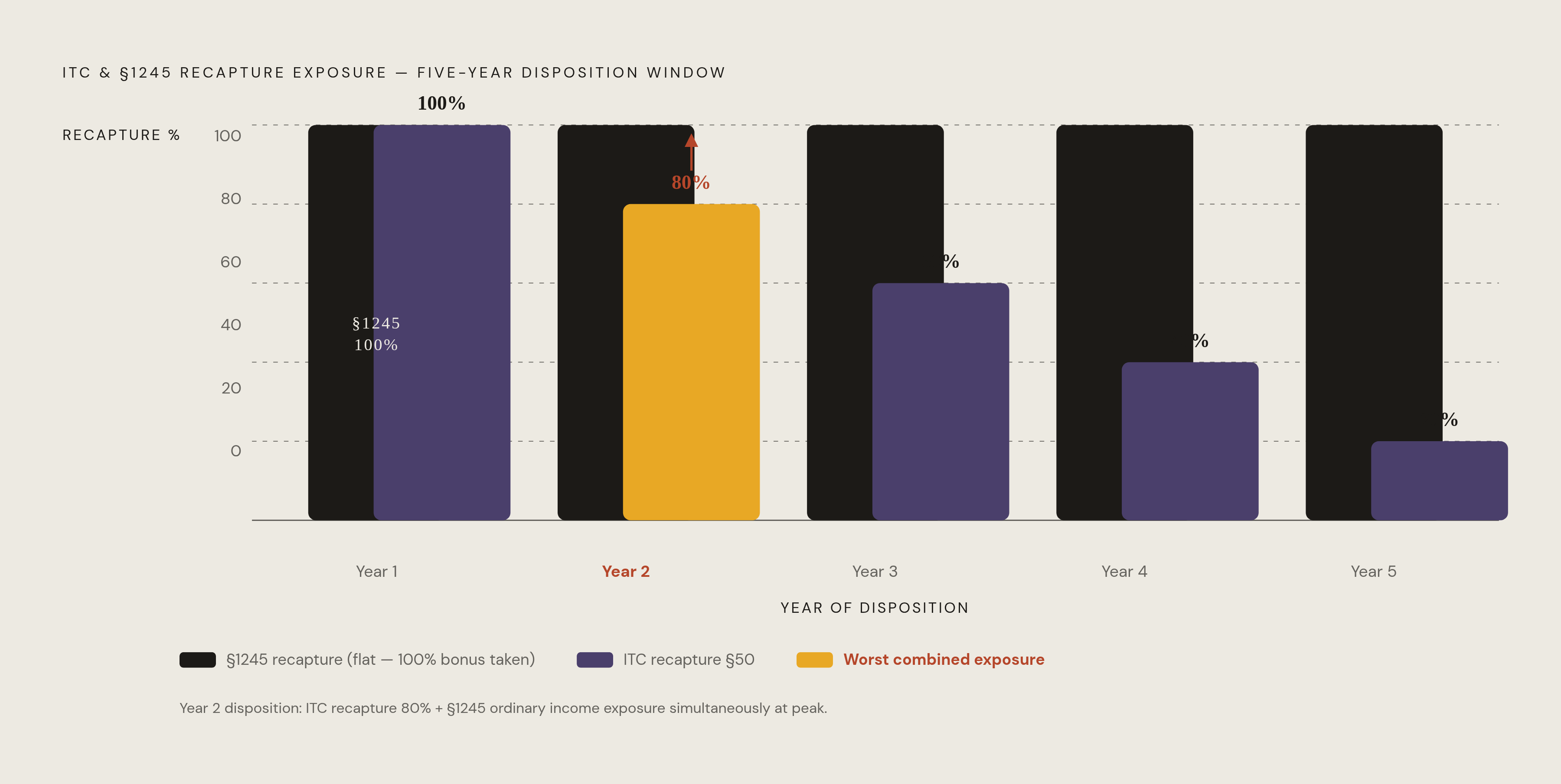
A disposition of energy property within five years of its placed-in-service date triggers two separate recapture regimes at once. The first is §1245 depreciation recapture. Solar and storage equipment qualifies as §1245 property, which means all accumulated depreciation is recaptured as ordinary income at marginal rates up to 37%, with no access to the 25% unrecaptured §1250 cap. The second is ITC recapture under §50, which claws back the credit on a sliding scale: 100% in Year 1, 80% in Year 2, 60% in Year 3, 40% in Year 4, and 20% in Year 5, with zero recapture after the window closes.
The two clocks do not run to the same schedule. ITC recapture declines on a straight-line 20% per year basis over the five-year window, while §1245 recapture is a function of how much depreciation was claimed and at what rate. With 100% bonus depreciation, the §1245 exposure is at its maximum from the outset, because the asset's adjusted basis is zero or near-zero after Year 1 expensing. The combined exposure therefore changes shape every year: a disposition in Year 2 produces a materially different tax outcome than one in Year 4, and both must be modeled before a transaction is signed, not after.
The §50(c) rule creates a subtle asymmetry in the recapture mechanics. This means the restoration only partially offsets the depreciation benefit lost when the basis was originally reduced, and the two adjustments do not fully cancel. A seller who assumes that recapture simply unwinds the original transaction will overstate the basis available to shelter the §1245 component of the gain.
Installment sales offer no refuge on the §1245 side. Section 1245 recapture is recognized in full in the year of sale regardless of the installment structure. Only the §1231 gain portion can be spread over the installment period. The recapture is a current-year event, and the practitioner must treat it as such from the outset of any disposition planning.
How the EFSC/Sunnova recapture case illustrates ownership-change triggers
The mechanics of recapture are not merely theoretical. The EFSC/Sunnova matter is one of the first publicly documented instances of IRS recapture of transferable clean energy tax credits, and the trigger was an ownership change caused by the seller's bankruptcy rather than any impairment of the underlying solar assets. The chronology is instructive. In September 2024, Enterprise Financial Services Corp. executed a tax credit purchase agreement with Sunnova Energy covering approximately $6 million of ITCs from 2023 and $26.4 million of ITCs from 2024. In June 2025, Sunnova filed for Chapter 11 bankruptcy in the U.S. Bankruptcy Court for the Southern District of Texas, and the resulting liquidation of the underlying project assets constituted a recapture-triggering ownership change. Because the projects had been placed in service in 2023 and 2024, the applicable recapture percentage fell between 60% and 80%, and $24.1 million in ITCs were recaptured. EFSC anticipated an insurance payout expected to fully offset the economic impact and characterized the event as nonrecurring, but the episode exposed the structural risks that transferable credit buyers assume.
The partnership angle matters for practitioners who structure transactions carefully. Treasury Regulation § 1.47-6 provides that ownership-change recapture triggered by a reduction in a partner's interest is assessed at the partner level rather than the partnership level, though a direct disposition by the partnership can still trigger partnership-level recapture. The structure through which a credit is held determines who bears the risk when the trigger fires.
The planning implication is clear and runs in one direction. A buyer acquiring transferable credits years after project completion inherits the remaining exposure, which must be priced into the purchase and insured against. Counterparty credit risk, bankruptcy remoteness of project SPVs, and representations-and-warranties insurance are now standard due-diligence items precisely because the EFSC/Sunnova episode demonstrated that the exposure is real and quantifiable, and that it can arrive through a channel the buyer does not control.
Partnership flip and lease-pass-through structures as recapture management tools
The recapture mechanics described above are not merely risks to be catalogued. A traditional tax equity partnership flip illustrates the point. Tax benefits are allocated to the investor during the credit period before the sponsor repurchases the interest. The partnership form then interacts with the recapture rules: because ownership-change recapture is allocated at the partner level, a properly maintained partnership structure can shield the tax equity investor from a recapture event caused by changes at the project level, as the EFSC/Sunnova matter demonstrated.
Lease-pass-through structures split the ITC and depreciation between two parties and create a different exposure profile. In a two-tier pass-through, the landlord passes the renewable energy credits to the tenant while retaining the depreciation deductions. Instead, the tenant recognizes what the statute calls §50(d) income, equal to the credit claimed divided by the shortest depreciable life of the facility. This is a hidden cost that must be modeled explicitly: it does not appear on the face of the credit calculation but effectively converts part of the ITC into ordinary income for the tenant, and it alters the economics of the arrangement in ways a surface-level review will miss.
Transferable credit transactions, introduced by the IRA and left largely intact by the OBBB, offer a faster and lower-transaction-cost alternative to tax equity partnerships. In a direct transfer, the developer retains the project and the buyer acquires only the credit. The OBBB preserved the §6418 transferability provisions while adding restrictions that prohibit credit transfers to specified foreign entities, which are now part of the transaction due-diligence checklist.
New recapture triggers introduced by the OBBB that extend beyond the five-year window
The OBBB did not merely preserve the existing recapture framework. It introduced a new category of recapture trigger tied to foreign-entity payments, and this one runs twice as long as the standard ITC window. The provision applies to the clean electricity ITC under §48E and requires 100% recapture of the credit if an "applicable payment," defined as a payment to a specified foreign entity pursuant to an agreement entitling that entity to exercise effective control over the facility, is made by a specified taxpayer during the ten-year window beginning with the placed-in-service date.
The old recapture risk is triggered by disposition. This new risk is triggered by who controls or receives payments from the project, and the monitoring posture must change accordingly. Projects placed in service after that date must maintain FEOC-compliant ownership and control arrangements for a decade, not five years.
The prohibited foreign entity framework defines "specified foreign entity" broadly. It includes entities identified as national security risks under specified statutes, foreign-controlled entities with ties to China, North Korea, Russia, or Iran, including entities more than 50% owned by such governments or nationals, and "foreign-influenced entities" where a specified foreign entity can appoint a covered officer, owns at least 25% of the entity, or holds at least 15% of its debt. The Effective Control Payment Test captures entities over which a specified foreign entity exercises effective control through payment arrangements, which is the mechanism the new recapture provision targets directly.
The compliance burden tightens over time. Chapman and Cutler note that a July 7, 2025 executive order directed Treasury to "strictly enforce" the termination of tax credits for wind and solar projects and to issue guidance by August 18, 2025 restricting safe harbors for beginning-of-construction determinations. Projects relying on the physical work test or the 5% safe harbor face additional compliance risk that a standard five-year recapture analysis does not capture.
The battery energy storage context sharpens the point. But the asymmetry cuts in a dangerous direction: when the ITC was claimed, the depreciable basis was already reduced under §50(c), and a FEOC-triggered ITC loss does not restore the original basis. The taxpayer loses the credit and keeps the reduced basis, a double consequence that must be anticipated when the project's FEOC compliance plan is first assembled.
The sequence a practitioner must follow to model true after-tax economics
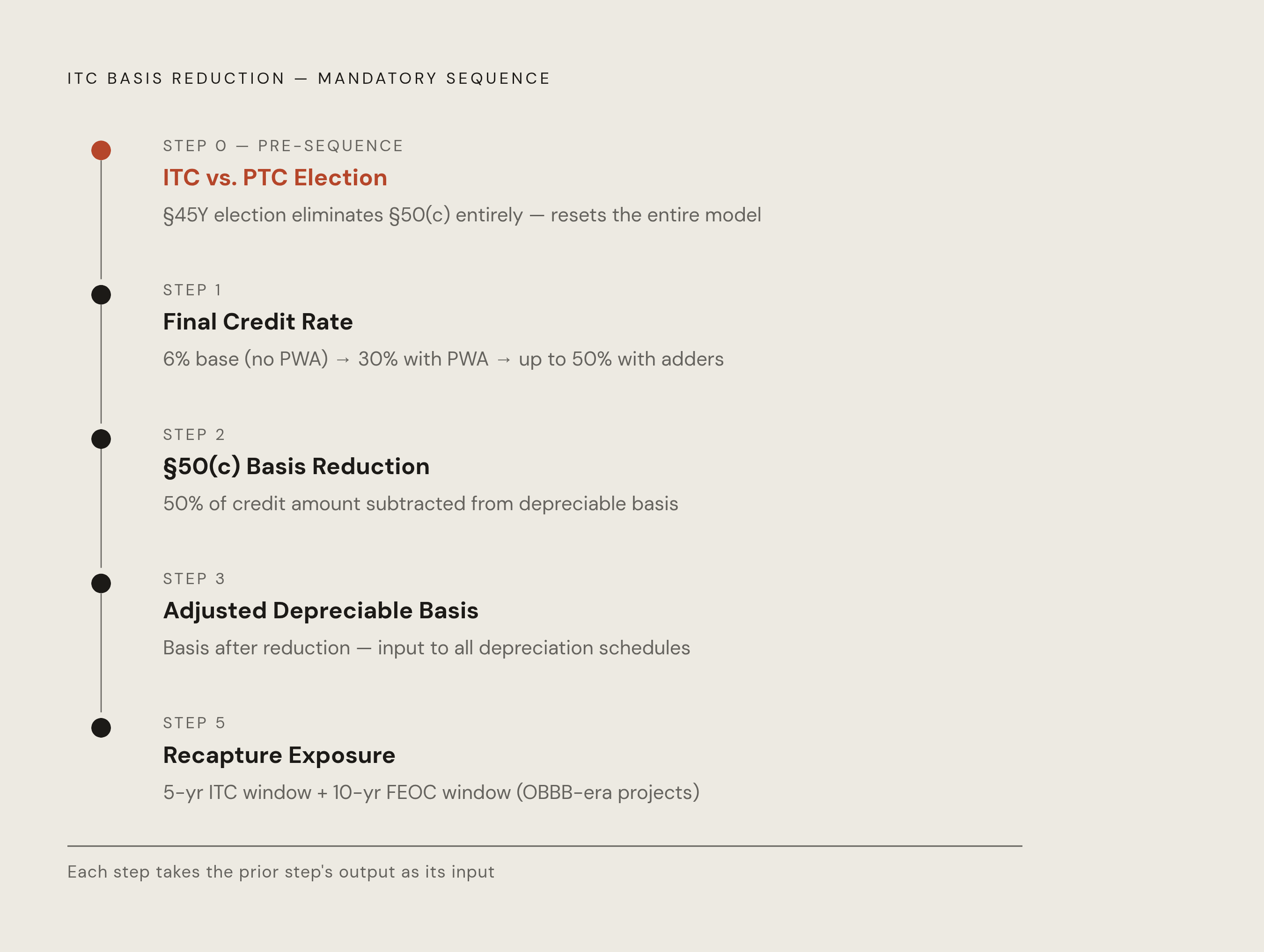
The mechanical sequence is legally mandatory and cannot be reordered. First, determine the final credit rate including all adders. Second, compute the §50(c) basis reduction at 50% of the credit amount. Third, compute the adjusted depreciable basis. Fifth, model the recapture exposure at each potential disposition date within the five-year ITC window and separately across the ten-year FEOC window for OBBB-era projects. Each step takes the prior step's output as its input, which is why the order is not a matter of preference.
The ITC/PTC election sits before Step 1. Choosing §45Y eliminates the §50(c) reduction entirely and changes the depreciation input that flows into Step 3, but defers the credit benefit over ten years. The election is not a minor preference. It is a structural decision that resets the entire model, and it must be made before any of the downstream arithmetic can be trusted.
The recapture modeling deserves its own emphasis. A disposition in Year 2 produces a materially different tax outcome than one in Year 4, and both must be modeled prospectively, before a transaction is signed. Partnership structure choice, meanwhile, is a Step 0 decision: the identity of the party bearing the §50(c) basis reduction, the §1245 recapture, and the ITC recapture depends on whether the project uses a P-flip, a lease-pass-through, or a direct transferable credit sale, and those allocations must be established before the project is placed in service. The volume and simultaneity of these calculations is considerable: credit rate, basis adjustment, depreciation schedule, recapture curves at multiple disposition dates, state decoupling, and FEOC compliance monitoring all interact. State decoupling is the final reminder that the federal model is a starting point, not the final answer: many states decouple from federal bonus depreciation, so the blended federal and state after-tax return can diverge significantly from the federal-only figure, and a project that appears efficient on one basis may look materially different when state ordinary-income rates are applied to the same recapture exposure.