
Pillar Two Global Minimum Tax Interaction With U.S. Federal Law
U.S. minimum tax rules clash with Pillar Two's jurisdiction-by-jurisdiction approach.
U.S.-parented multinational groups have a Pillar Two problem that has nothing to do with whether the United States has adopted the OECD's rules. The three domestic regimes doing similar work, GILTI (now NCTI), BEAT, and CAMT, were each built around worldwide-blended math, while GloBE tests a company one country at a time. A company can pass that test easily on a global average and still fail it in one country where a subsidiary sits on thin substance and a low local rate. GILTI/NCTI taxes foreign earnings through a CFC income inclusion mechanism, and it blends results across the whole foreign footprint instead of applying a top-up jurisdiction by jurisdiction. CAMT sets a 15% floor on adjusted financial-statement income, but it treats foreign taxes paid as a deduction rather than a credit, and it aggregates the whole company worldwide instead of testing each country on its own. A U.S. parent can clear NCTI's blended hurdle, pay its CAMT bill in full, and still leave a subsidiary in a low-tax country exposed to a foreign QDMTT or top-up charge, because none of these three regimes talk to each other or to GloBE in a way that cancels out the exposure.
How GloBE's three-tier collection hierarchy works
GloBE collects its minimum tax through an ordered sequence of three mechanisms, built so the same underpaid dollar of tax does not get collected twice. The United States takes the position that GILTI/NCTI effectively performs this IIR function, but the OECD has not formally granted GILTI/NCTI qualified IIR status. The third tier, the Undertaxed Profits Rule or UTPR, is the backstop: if neither a QDMTT nor a qualified IIR captures the shortfall, any other implementing jurisdiction can step in and collect the residual amount. The UTPR is the mechanism that poses the most direct threat to a U.S. group without a qualified IIR, since it allows other countries to reach into the parent's structure. Calculation rules matter as much as the collection order and produce their own exposure: GloBE income starts from financial-accounting income rather than domestic taxable income and runs through its own set of adjustments; the substance-based income exclusion shields a portion of payroll costs and tangible-asset returns before any top-up is computed, narrowing but not erasing exposure for groups with real operations on the ground; and a country's own label of "minimum tax" carries no guarantee that the regime qualifies as a QDMTT under GloBE's rules for a given fiscal year.
Where GILTI/NCTI's blended structure diverges from the IIR it approximates
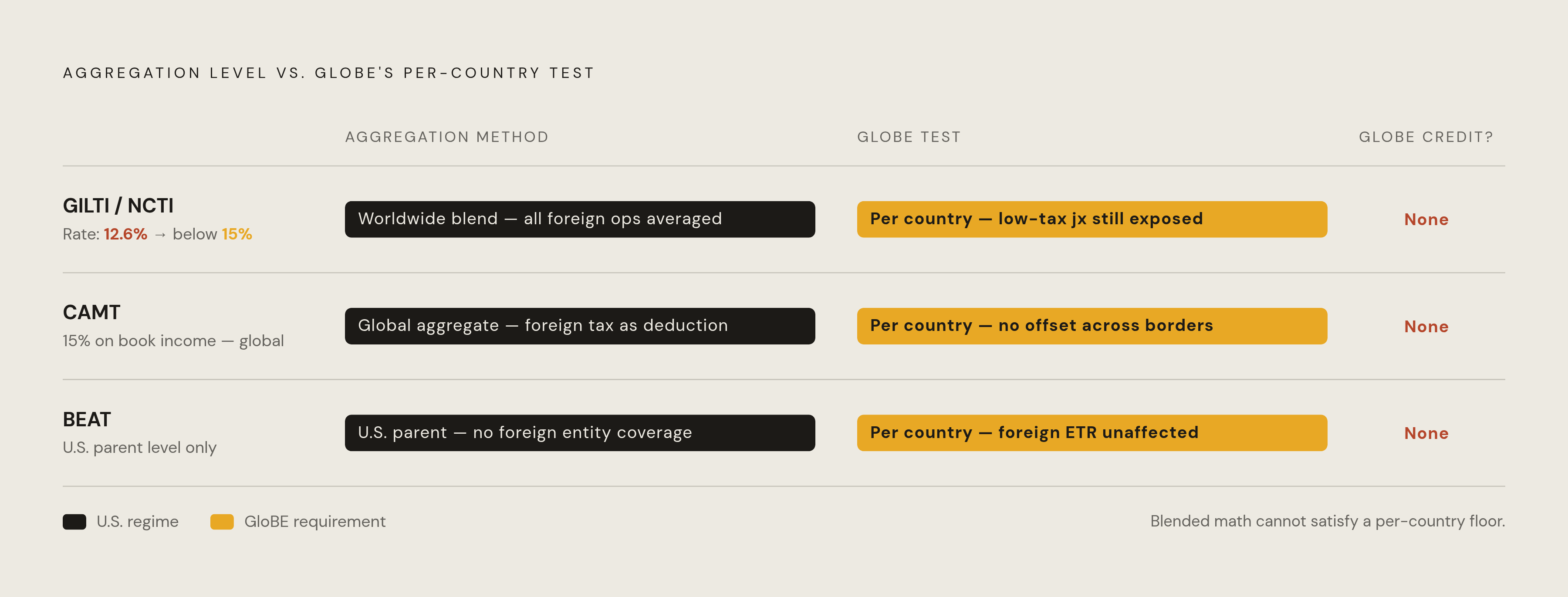
GILTI, now renamed NCTI under the One Big Beautiful Bill Act, produces a single worldwide-average rate across a company's foreign operations, and that average can hide a badly undertaxed subsidiary sitting right next to a well-taxed one. The Congressional Research Service has described the core of the gap: GILTI calculates liability through global averaging rather than country by country, so a U.S. parent can blend high-tax income from one jurisdiction against low-tax income from another and still carry low-taxed subsidiaries capable of triggering a foreign IIR or UTPR claim. The One Big Beautiful Bill Act renamed GILTI as NCTI and raised its effective rate from 10.5% to 12.6%, effective January 1, 2026, a rate that still sits below the 15% GloBE minimum. Compounding the issue is a recognition problem: the OECD has not formally granted GILTI/NCTI "qualified IIR" status, so outside the protection the side-by-side safe harbor provides, other jurisdictions retain the legal authority to apply their own Pillar Two top-up taxes to the same income a U.S. parent already reported under NCTI. Layered on top of all this are the mechanical seams between NCTI and the rest of the U.S. international tax system: Subpart F inclusions, Section 951A, and foreign tax credit computations each run on their own timing rules and their own tax base, none of which match GloBE's covered-taxes definitions. A practitioner reconciling these regimes is not adjusting one number for another; the same stream of foreign income has to be run through several frameworks that were not designed to agree with each other.
Why CAMT does not function as a QDMTT
A company can meet CAMT's 15% floor on its worldwide financial-statement income and still owe Pillar Two top-up tax in a specific foreign jurisdiction, because the two regimes are measuring different things at different levels of aggregation. CAMT's starting point is adjusted financial-statement income computed under U.S. GAAP or IFRS, following the applicable financial statement hierarchy, while GloBE builds its own income figure using a distinct set of adjustments, so the two calculations diverge well before either produces a rate. The One Big Beautiful Bill Act kept CAMT in place, added an oil-and-gas carve-out for intangible drilling costs, and through other provisions indirectly raised CAMT exposure for a number of corporations, so CAMT and GloBE have to be computed as two separate, parallel exercises. QDMTT exposure in the jurisdictions where the subsidiaries actually sit remains fully live no matter what the CAMT bill looks like back home.
How BEAT interacts with Pillar Two's covered-taxes framework
BEAT sits furthest outside the Pillar Two conversation of the three U.S. regimes, and it generates no covered-taxes credit that would reduce a foreign entity's GloBE top-up liability. The practical consequence is straightforward: a U.S. parent paying BEAT on a royalty stream to a foreign affiliate cannot apply that payment against the GloBE effective tax rate calculated for the foreign affiliate receiving it, since BEAT is assessed at the U.S. parent level on a U.S. tax base, while the foreign entity's GloBE covered taxes are computed entirely on their own. Groups with significant royalty or interest flows running from a U.S. parent into a low-tax foreign affiliate end up carrying a compound exposure, BEAT on the U.S. side and QDMTT or IIR top-up on the foreign side, with no offset running between the two.
What the January 2026 side-by-side agreement covers and leaves open
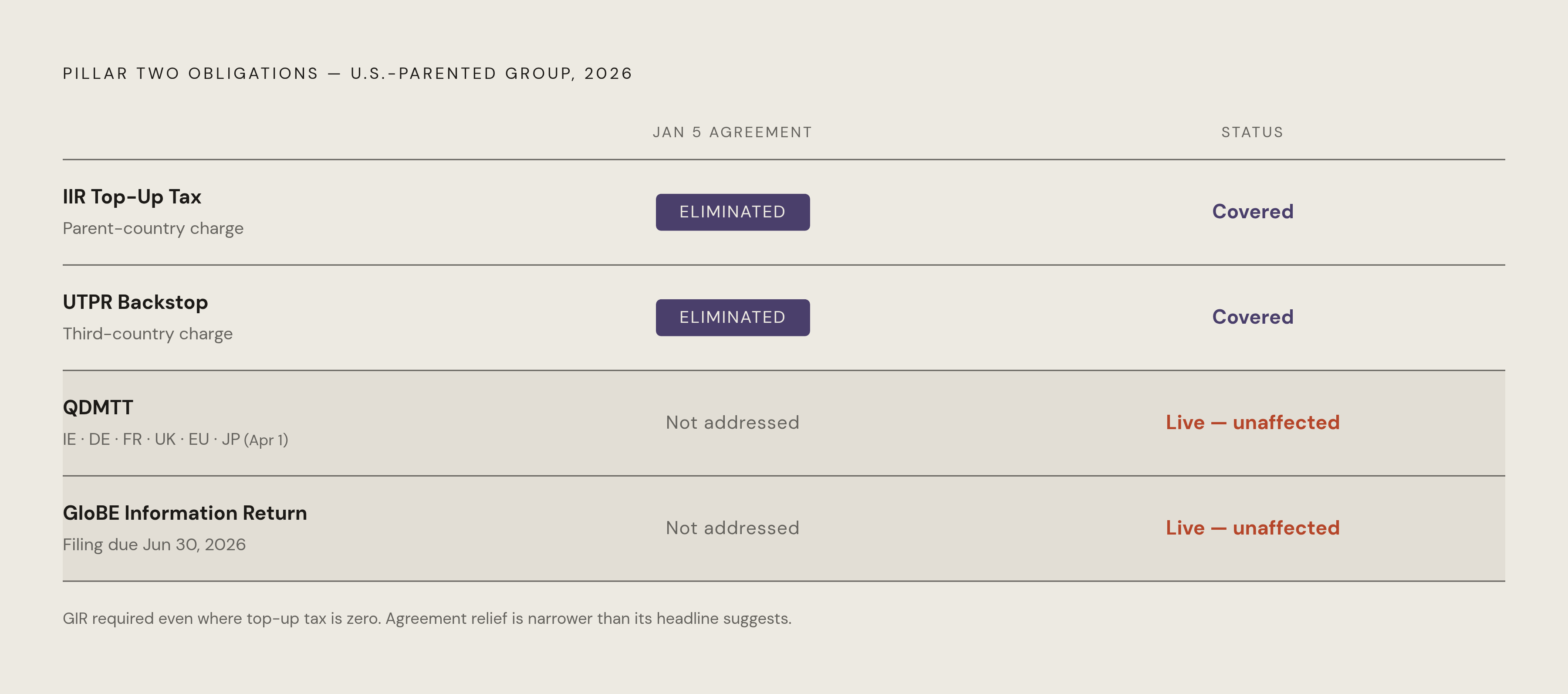
The January 5, 2026 side-by-side agreement removes IIR and UTPR exposure for U.S.-parented groups operating in cooperating jurisdictions. It does not touch QDMTT obligations, and it does not touch GIR filing requirements. The mismatches described in the three sections above do not disappear under this agreement; they get rerouted around one specific collection channel. Treasury announced on January 5, 2026 that, working with more than 145 countries in the OECD/G20 Inclusive Framework, U.S.-headquartered companies will remain subject only to U.S. global minimum taxes and will be exempt from Pillar Two's IIR and UTPR obligations, while remaining subject to Qualified Domestic Minimum Top-up Tax obligations in the foreign jurisdictions where they operate. The mechanism doing the work is a safe harbor under which an MNE group with its ultimate parent entity in a jurisdiction recognized as having a qualifying regime can elect a deemed top-up tax of zero under both IIR and UTPR across its domestic and foreign operations. Four limits qualify that relief, and each narrows its practical scope. The agreement does not apply retroactively to fiscal years 2024 or 2025, so full GloBE compliance obligations stood in those years wherever other jurisdictions' rules were already in effect. It does not eliminate QDMTT obligations in jurisdictions that have already enacted one: Ireland, Germany, France, the UK, and most EU member states continue to enforce their QDMTTs independently, Japan's QDMTT entered into force on April 1, 2026, and Estonia, Latvia, Lithuania, and Malta have deferred Pillar Two implementation. And it does not resolve the underlying legal fact that the OECD has not recognized GILTI/NCTI as a qualified IIR; the side-by-side agreement suspends the practical consequence of that gap. The agreement also protects the value of the U.S. R&D credit and other federal incentives, which had been at risk of being treated as reductions to covered taxes under GloBE's credit-interaction rules.
QDMTT obligations in major jurisdictions as live compliance issues
QDMTTs operate entirely at the source-country level, independent of the IIR and UTPR machinery the side-by-side agreement addresses, so relief from parent-level top-up collection does nothing to reduce the subsidiary-level QDMTT bill in any country that has one. Most EU member states enforce a QDMTT under Directive 2022/2523, with Estonia, Latvia, Lithuania, and Malta carrying a deferral under Article 50. A U.S. group with a subsidiary in Ireland can be taxed at Ireland's headline corporate rate and still owe an Irish QDMTT top-up if that subsidiary's GloBE effective tax rate, after GloBE's own adjustments, lands below 15%. A local regime calling itself a "minimum tax" also needs individual verification: qualification as a true QDMTT, along with the relevant OECD peer-review outcome, has to be checked jurisdiction by jurisdiction and year by year before anyone assumes the safe harbor applies. Italy illustrates how this plays out in practice. Legislative Decree 209/2023 implemented EU Directive 2022/2523 through three parallel instruments, the imposta minima integrativa standing in for the IIR, the imposta minima suppletiva standing in for the UTPR, and the imposta minima nazionale standing in for the QDMTT, and Italian constituent entities have to map their financial-accounting data into the GloBE framework on top of, not instead of, their existing IRES and IRAP obligations. All of this feeds directly into a filing obligation that runs whether or not any tax is actually owed.
GloBE Information Return obligations and the transitional safe harbor window closing in 2027
A U.S.-parented group that owes zero top-up tax under the side-by-side safe harbor still has to file the GloBE Information Return, and the data pipeline it needs to do that accurately is the same work it needs to handle QDMTT compliance in every jurisdiction where it operates. For calendar-year taxpayers, the first GIR filings are due by June 30, 2026, under a 15-month standard deadline that stretches to 18 months for the first transition year, measured from fiscal year end in each jurisdiction carrying a constituent entity. The deeper issue is architectural. A group that treats the side-by-side agreement as a reason to delay building this infrastructure will find the 2027 safe harbor window closing on a reporting system that was never built to produce the numbers GloBE demands.
The political instability of the side-by-side arrangement
The side-by-side arrangement resolves the immediate IIR and UTPR exposure for U.S.-parented groups, but it rests on a political consensus that a meaningful bloc of OECD member states has already contested, which makes it a thin foundation for long-term compliance planning. More than two dozen countries raised objections during OECD discussions, and several European jurisdictions criticized the arrangement publicly as granting undue preference to U.S. entities while constraining their own tax sovereignty. The structural objection animating the critics is straightforward: if the U.S. framework gets side-by-side recognition despite not meeting GloBE's technical standards, other jurisdictions have grounds to demand comparable treatment for their own regimes, and the level playing field Pillar Two was built to create starts to look selective. The speed with which this political terrain can shift is not theoretical. Early in 2025, the Trump administration backed a "revenge tax" under Section 899 that would have raised U.S. taxes on companies from countries imposing Pillar Two-style top-up taxes on U.S. multinationals. The planning conclusion follows directly: QDMTT exposure should be modeled as a durable obligation that survives regardless of how the IIR and UTPR politics evolve, while IIR and UTPR relief should be treated as conditional on a political consensus that could narrow or collapse. Scenario planning for in-scope clients should include a baseline in which one or more major implementing jurisdictions challenges or limits the side-by-side arrangement.
A practitioner framework for mapping which obligations survive for in-scope clients
For each in-scope U.S.-parented group, the compliance picture for 2026 and beyond breaks into three tiers that have to be assessed independently rather than treated as alternatives to one another: QDMTT liability in every implementing jurisdiction where the group operates, GIR filing obligations in every jurisdiction holding a constituent entity, and the residual uncertainty around IIR and UTPR exposure if the political consensus behind the side-by-side arrangement narrows. GloBE applies to groups with consolidated revenues of €750 million or more in at least two of the four preceding fiscal years, tested against the ultimate parent's consolidated financial statements, and clients sitting near that line need active monitoring, particularly where M&A activity or a restructuring could push them across it in either direction. From there, the work moves jurisdiction by jurisdiction: for each country where the group has a constituent entity, confirm whether a qualified QDMTT is actually in force for the relevant fiscal year, compute the GloBE effective tax rate for that specific jurisdiction rather than relying on the domestic rate or the NCTI blended figure, and apply the substance-based income exclusion for payroll and tangible assets before the top-up base is finalized. Check, separately, whether a transitional safe harbor, whether the existing CbCR-based version or the simplified ETR safe harbor available from 2026, removes the need for a full GloBE computation in that jurisdiction for the year in question. None of this screening replaces the GIR itself: the filing obligation runs independently of whether any top-up tax is actually owed, so a client with zero liability under the side-by-side safe harbor still owes a GIR filing built on the same underlying data a full GloBE computation would require. Fiscal years 2024 and 2025 sit outside the side-by-side arrangement entirely, so any open positions from those years carry full GloBE compliance obligations in the jurisdictions where other countries' rules were already in effect, and you need to review them on their own terms. The entity mapping, the GloBE income adjustments, the covered-taxes allocation, and the GIR data assembly across dozens of jurisdictions amount to a high volume of structured, repeatable work, and purpose-built tax automation handles that kind of work more reliably than manual spreadsheets or general-purpose accounting software, which frees practitioner time for the judgment calls, the effective-rate modeling, and the scenario planning that the political uncertainty around the side-by-side arrangement makes genuinely necessary.
Sources
- The Pillar 2 Global Minimum Tax: Implications for U.S. Tax Policy
- Treasury Secures Agreement to Exempt U.S.-Headquartered Companies from Biden Global Tax Plan
- International Tax Policy: Where the U.S. Stands and What's Ahead in 2026 • Bipartisan Policy Center
- HOW PILLAR 2 AND INTERNATIONAL TAX REFORMS AFFECT US MULTINATIONAL TAXES
- What are the OECD Pillar 1 and Pillar 2 international taxation reforms?