Corporate Alternative Minimum Tax Under the Inflation Reduction Act
A new 15% minimum tax on large corporations closes the gap between reported profits and tax bills.
For decades, a familiar pattern shaped the tax landscape: very large corporations reported substantial profits to shareholders while disclosing far lower, sometimes zero, taxable income to the IRS. The Corporate Alternative Minimum Tax, enacted as part of the Inflation Reduction Act of 2022, was Congress's direct response to that divergence. The mechanism enabling this outcome was straightforward. CAMT addresses the gap by imposing a 15% minimum tax on adjusted financial statement income, the income a corporation reports to shareholders, rather than on taxable income. The statute amended Section 55(a) to make CAMT effective for tax years beginning after December 31, 2022.
Congress's fairness rationale was explicit. Large corporations use complex strategies to lower their tax bill, which gives them an edge over small businesses that can't afford the same planning, and Treasury's September 2024 notice of proposed rulemaking made this leveling intent clear. Understanding why the statute exists matters for applying it correctly: every adjustment and threshold in the CAMT regime traces back to the book-to-tax divergence it targets.
How CAMT is structured: the 15% floor, the backstop relationship to regular tax, and the credit carryforward
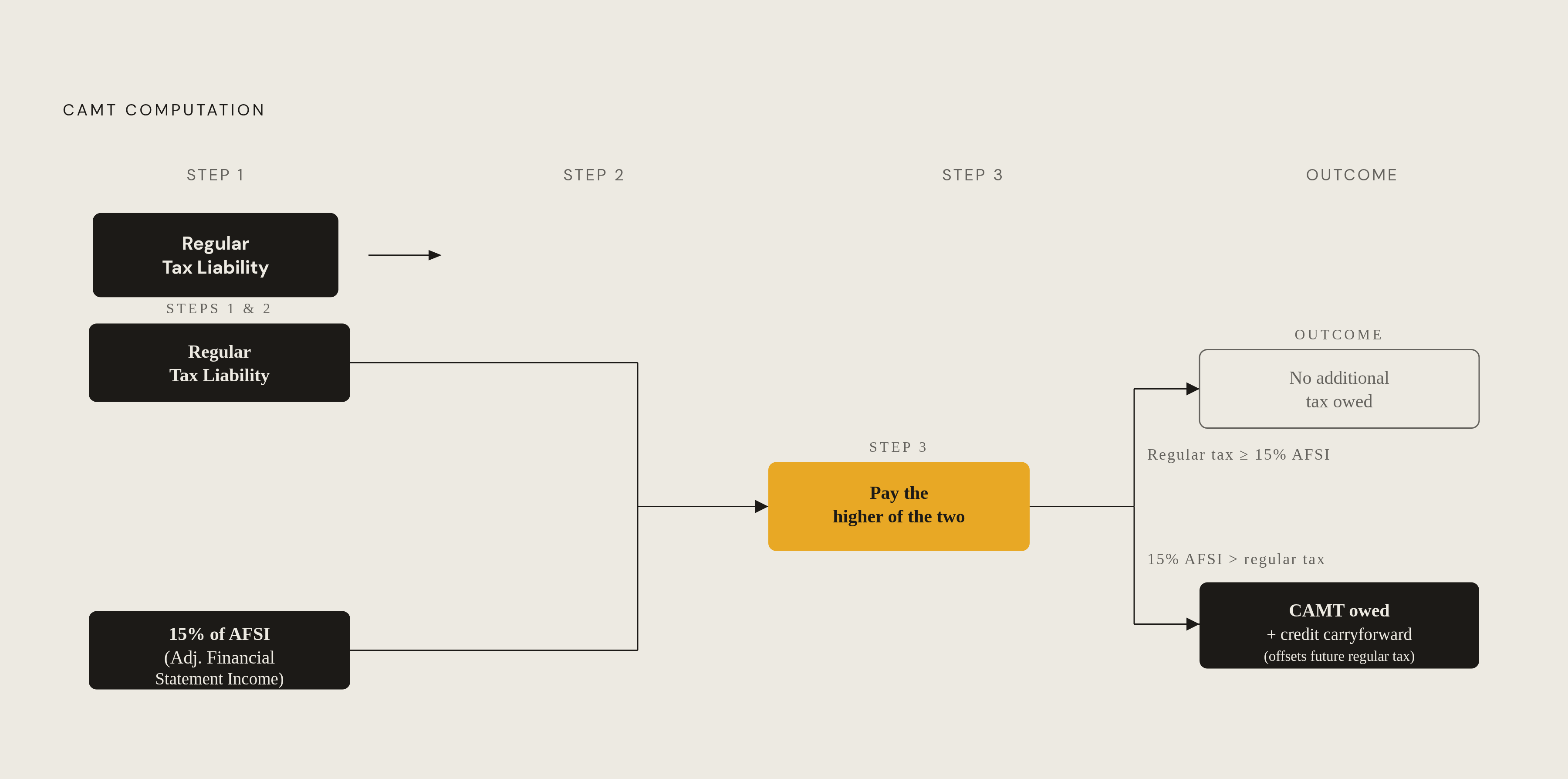
CAMT functions as a floor, not a replacement. A corporation computes its regular tax liability, then computes 15% of its AFSI, and pays the higher of the two figures. When 15% of AFSI exceeds the regular tax liability, the excess amount is the CAMT owed. Treasury's press release accompanying the September 2024 proposed rules states the point directly: corporations paying their full share under regular tax owe nothing additional.
The minimum tax credit keeps this from becoming a permanent second tax. When CAMT paid exceeds regular tax liability, it creates a credit that carries forward indefinitely, so you can offset future regular tax in years when regular tax exceeds CAMT. General business credits interact with CAMT credits in ways that can restrict both, with consequences for cash flow and financial reporting that Deloitte identifies as a distinct complexity layer.
The foreign tax credit adds another variable. US-consolidated-group income taxes are generally fully creditable against CAMT, while CFC-level taxes are creditable only up to 15% of the CFC's AFSI, with excess amounts carrying forward for up to five years. If you advise applicable corporations, you can use AI-powered tax research and drafting assistants like Marble to keep searchable access to regulatory guidance and draft memos documenting the credit carryforward analysis, so the ordering rules and cash-flow implications stay clearly documented for each client.
Which corporations are subject to CAMT: the $1 billion AFSI threshold and how it is measured
CAMT applies only to applicable corporations, defined as those averaging more than $1 billion in net financial statement income over the three preceding tax years. The threshold measures profit, not revenue, a distinction that concentrates the tax on a small number of very large companies. Treasury estimated in September 2024 that roughly 100 of the largest and most profitable companies would pay CAMT annually.
The three-year averaging period requires annual recalculation. The sectors most exposed are utilities and other capital-intensive industries, where large book-to-tax depreciation differences keep taxable income low while book income remains high. American Water Works publicly determined it is an applicable corporation subject to CAMT beginning in 2024 and expects CAMT to exceed its regular tax liability.
Notice 2025-27 provides a practical compliance lever for near-threshold clients. The notice offers an optional interim simplified screening method that lowers the screening thresholds to $800 million and $80 million, from the statutory $1 billion and $100 million, to exclude corporations that would exceed the raw threshold test but are not actually applicable corporations. Searchable regulatory libraries and memo-drafting tools help practitioners efficiently document the AFSI averaging analysis and maintain audit-ready records of the applicability determination across multiple years and client engagements.
Calculating AFSI: what adjustments the statute requires and where the complexity lives
AFSI starts with net financial statement income, and then you apply a targeted set of statutory adjustments. The starting point is the corporation's applicable financial statement, typically the audited GAAP financial statements filed with the SEC or used for reporting to shareholders, net of intercompany eliminations for consolidated groups. The complexity lies not in the 15% rate but in tracing exactly which book items are modified and which pass through unchanged.
The categories of adjustment addressed in IRS guidance to date fall into a recognizable pattern. Depreciation gets substantial attention: the treatment of embedded depreciation deductions and the differing treatment of MACRS versus book depreciation is a major driver of book-tax differences for capital-intensive companies. Eligible goodwill amortization is addressed in the same notice, and the issue matters because book goodwill is not amortized under GAAP but may be deductible for tax purposes, creating a divergence.
Notice 2025-49 also covers nonlife insurance company NOL carrybacks and provides rules for how accounting principle changes and restatements flow into AFSI. Notice 2025-46 addresses domestic corporate transactions, troubled companies, and tax consolidated groups, with Notice 2026-7 clarifying and modifying the troubled-company treatment. The AICPA's September 24 letter focused on financial-distress applications, signaling where practitioners see the most acute open questions.
What CAMT does not adjust is equally important. The statute and proposed regulations generally do not create adjustments to the tax base beyond those Congress specified. How a corporation assesses the realizability of deferred tax assets when it expects to be a perpetual CAMT payer can affect reported earnings in the period that includes CAMT enactment or rate changes, a financial reporting consideration distinct from the tax compliance question.
Partnership income under CAMT: why it is the hardest piece and what Notice 2025-28 changed
Corporations that own partnership interests face the most difficult AFSI calculation under CAMT. The statute's book-income logic does not map cleanly onto pass-through reporting. A corporate partner's share of partnership income may not be reported in the same financial statement line that regular tax uses, creating ambiguity about how much of the partnership's book income flows into the corporate partner's AFSI.
IRS Notice 2025-28 introduced new elections that reduce CAMT liability on partnership income, but they add significant complexity. The political dimension came quickly. The Senate voted 47–51 on February 10, 2026 to reject the resolution, with Senator Susan Collins of Maine the only Republican supporting it.
The practical upshot is settled enough for planning. The elections exist, they reduce CAMT liability, and they survived the CRA challenge, but they also add complexity, require consistency, and may be revisited in revised proposed regulations. Deloitte's October 2025 guide advises evaluating elections and methods in the context of the corporation's overall tax strategy, not in isolation.
How OBBBA's new deduction options create unexpected CAMT exposure
Several of OBBBA's most valuable tax benefits carry a structural tension Congress did not resolve. Immediate R&E expensing, expanded interest deductions, and FDDEI changes can push regular taxable income below 15% of AFSI and trigger CAMT liability that partially or fully offsets those benefits. Section 174 on R&E expenditures illustrates the trade-off. OBBBA allows corporations to choose between immediately expensing domestic R&E costs or capitalizing and amortizing them. A company that elects to capitalize R&E to avoid CAMT may forgo the cash-tax benefit of immediate expensing, a genuine trade-off requiring modeling.
Section 163(j) interest limitation changes point in the same direction. OBBBA subjects foreign-derived deduction-eligible income to a 14% rate and removes R&E and interest deductions from the FDDEI expense allocation, increasing the FDDEI base and the Section 250 deduction. Deloitte's October 2025 guide walks through this interaction in detail.
The advisory implication is direct: tax teams must model CAMT alongside OBBBA elections, not as a separate calculation. Tax minimization under regular tax rules can inadvertently maximize CAMT exposure. The political baseline is that CAMT survives but is being narrowed through administrative guidance and targeted legislative carve-outs, such as the oil and gas IDC exclusion, rather than through repeal.
What the patchwork of interim guidance means for compliance right now

Final CAMT regulations remain pending, and the IRS has said it intends to partially withdraw the 2024 proposed rules. You must navigate at least five interim notices with staggered applicability dates, consistency requirements, and reliance conditions. The environment rewards proactive tracking and punishes passive waiting.
The regulatory timeline tells the story. September 2024 brought the first comprehensive rulemaking in the form of proposed regulations REG-112129-23. Notice 2025-27, issued June 2, 2025, provided the simplified applicable-corporation screening method and the penalty waiver for 2025 tax years. Notice 2025-28, issued July 29, 2025, introduced the partnership elections and signaled the partial withdrawal of the 2024 proposals. Notice 2025-46 provided interim guidance on domestic corporate transactions, troubled companies, and tax consolidated groups. Notice 2025-49 covered eligible regulatory assets, fair value items, the tonnage tax regime, embedded depreciation, nonlife insurance company NOL carrybacks, goodwill amortization, accounting principle changes, and restatements. Notice 2026-7, issued February 18, 2026, clarified and modified troubled-company treatment from Notice 2025-46.
Each notice carries its own applicability date and reliance conditions. The forthcoming revised proposed regulations will set the final applicability date, and until then the patchwork applies. The AICPA has actively commented on the guidance, signaling that the profession views the current state as inadequate for confident compliance.
The revenue picture adds a sobering dimension. An examination of CAMT-related disclosures in 2024 Form 10-K filings found that only a small number of public companies reported paying CAMT, and the combined total paid was a fraction of what the Joint Committee on Taxation projected. Sector-specific exposure remains real regardless of aggregate revenue. Utilities, capital-intensive manufacturers, leveraged companies, and multinationals with CFC structures each face distinct AFSI adjustment issues that require active monitoring even if the population of CAMT payers is smaller than projected.
How practitioners can manage CAMT compliance systematically across a large-corporation client base
CAMT compliance for large-corporation clients requires a repeatable, document-intensive process that connects book financial data to tax calculations across multiple legal entities. The workflow has several distinct stages that must run in sequence. Each year requires an applicable-corporation determination: pull three years of net financial statement income, apply the simplified screening method from Notice 2025-27 where available, and flag clients approaching the threshold for early attention. Then comes AFSI adjustment mapping: identify which notice-based adjustments apply to each client's industry and entity structure, whether utility, manufacturer, multinational, or partnership investor, and document the basis for each adjustment taken. Regular tax and CAMT must be modeled side by side, including the effect of OBBBA elections on regular taxable income and the corresponding AFSI impact. Credit carryforward tracking requires a running schedule of minimum tax credits, monitoring of ordering against general business credits, and projections of when credits are likely to be used. Guidance monitoring rounds out the process: each new IRS notice may change applicability, add elections, or modify consistency requirements, and a practice without systematic tracking will miss changes between filing seasons.
The document-handling burden is substantial. CAMT computations draw on audited financial statements, consolidating schedules, partnership K-1s, CFC earnings data, and depreciation schedules simultaneously. The intake and organization of these materials is a significant friction point before analysis even begins. Marble is purpose-built for this kind of multi-document, multi-entity tax workflow. It automates client intake, document review, and routine compliance checks that would otherwise require a practitioner to manually cross-reference book financials against tax schedules across dozens of clients, freeing the tax professional to focus on the judgment-intensive work of AFSI adjustment analysis and OBBBA election modeling where expertise moves the needle. Unlike generic accounting software retrofitted for tax use, it is designed around the practitioner's workflow, not the accountant's general ledger, a material difference when the compliance task is tracing book-to-tax differences rather than recording transactions. The repeatable, document-heavy nature of applicable-corporation determinations and AFSI adjustment tracking suits structured backend tools, so practitioners spend their time on the advisory layer: which elections to make, how to model OBBBA interactions, and how to explain CAMT exposure to the board or CFO.
If you advise clients near the $1 billion threshold, the simplified screening method and penalty waiver in Notice 2025-27 reduce immediate exposure, but you should monitor the threshold annually. If a client crosses into applicable-corporation status without a compliance process in place, they face both tax liability and underpayment risk. The evolving guidance environment means the compliance process itself must be version-controlled: what applied for a 2023 tax year may differ from what applies for 2025, and the revised proposed regulations will reset some of those positions again. CAMT's complexity rewards practitioners who build a repeatable process now, before final regulations add further requirements.
Sources
- [2026-02-09] Fact Sheet on Corporate Alternative Minimum Tax CRA Resolution
- U.S. Department of the Treasury Releases Proposed Rules for Corporate Alternative Minimum Tax to Address Significant Corporate Tax Avoidance By Companies with $1 Billion Or More In Annual Profit
- Corporate Alternative Minimum Tax Guide
- IRS should simplify corporate alternative minimum tax rules, CPAs say - Financial Planning & Analysis - Tax, Audit & Acctg - Thomson Reuters Community
- Additional Interim Guidance Regarding the Application of ...