Entity Classification Elections and the Check-the-Box Regulations for Domestic Entities
How the IRS lets businesses choose their tax classification on a form.
Entity classification used to hinge on a multi-factor test decided case by case. Since 1997, it hinges on a form. That shift, from the Kintner regulations to the check-the-box system, remains one of the cleanest examples in the tax code of a genuinely simplifying reform, and understanding how it works, mechanically and strategically, is essential for anyone advising a domestic entity on how it wants to be taxed.
Entity classification before 1997 and its replacement
Before 1997, the IRS used rules tracing back to United States v. Kintner, a 1954 case from a federal appeals court. The Treasury responded in 1960 with regulations built around the Morrissey corporate-resemblance test, which measured an entity against several corporate characteristics, later trimmed to four for unincorporated entities, covering continuity of life, centralized management, free transferability of interests, and limited liability. Score enough points on that checklist, and the IRS treated you as a corporation regardless of what your formation documents said.
The trouble was that lawyers got good at gaming the checklist. As LLCs spread through the latter decades of the twentieth century, practitioners learned to draft operating agreements that dodged just enough Kintner factors to land on partnership treatment while the entity still functioned, in every practical sense, like a corporation. The IRS itself admitted the system had become elective in substance without being elective in name, just dressed up in drafting formalities that cost clients money to execute and cost the government resources to police. Notice 95-14 was the tell: Treasury and the IRS used it to say that the Kintner framework had become obsolete and expensive for everyone involved, and that something more direct was coming. The check-the-box regulations, finalized and made effective within a year of each other, were that replacement. They swapped the multi-factor guessing game for an actual election, filed on a form, with default rules for anyone who doesn't bother to file.
Entity eligibility and statutory exclusions
Not every entity gets to choose. Eligible entity status under the check-the-box regulations requires three things: the entity can't be an individual, it can't already be classified as a corporation by operation of law, and it has to qualify as a business entity. Trusts, for instance, generally fall outside this framework entirely and are taxed under their own separate set of rules.
Entities that Treasury Regulation Section 301.7701-2(b) labels "per se corporations" are excluded. There's no election available to them, full stop. That list covers entities incorporated under a federal statute or under the corporation statute of any state or a similarly situated federal district. The label is what matters here, not the underlying economics. A domestic entity is a per se corporation if it was organized as a "corporation" or "incorporated" under a federal or state statute, and that's true even if the entity operates in a way that looks nothing like a traditional corporation.
For practitioners, the practical upshot is that most LLCs, limited liability partnerships, and similar state-law flow-through vehicles fall on the eligible side of the line. They're the norm here. Genuine per se corporations, the entities statutorily locked into corporate treatment with no way out, are comparatively rare among the domestic business forms clients actually show up with.
Default classifications for domestic entities absent an election
Absent a filing, the default rule for a domestic eligible entity turns entirely on how many owners it has. The classification follows automatically from the number of members.
An eligible entity with a single owner defaults to disregarded entity status. The entity is ignored for federal income tax purposes, and its income, deductions, and credits flow straight onto the owner's own return as if the entity didn't exist, at least for tax purposes. An eligible entity with two or more owners defaults to partnership classification, with income and loss allocated among the owners according to their interests.
No form is required to sit inside either default. Form 8832 exists for the client who wants something other than what the default already provides. If the default happens to match the desired outcome, and for a lot of single-member LLCs and multi-member operating businesses, it does, there's nothing to file and nothing for the IRS to acknowledge. The election only enters the picture when someone wants to override the automatic result.
The three classification options Form 8832 makes available
Form 8832 gives an eligible entity exactly three choices, though which ones are actually available depends on ownership structure.
The first is association taxable as a corporation, sometimes called electing C corporation status. The entity pays tax at the entity level, and any distributions to owners get taxed again at the shareholder level, the classic two-layer structure. In the flow-through-versus-blocker framing, common in fund and holding-company structuring, this election is what turns an entity into a blocker.
The second is partnership classification, available only where there are two or more owners. Income, losses, deductions, and credits pass through to the owners in proportion to their interests, and the entity itself owes no federal income tax.
The third is disregarded entity status, available only to single-owner entities. The IRS ignores the entity for federal income tax purposes and the owner reports everything directly. That word "disregarded" deserves scrutiny, though, because it's doing less work than it sounds like. The entity remains a fully separate legal entity under state law for every non-tax purpose: contracts, tort liability, asset protection. Disregard is a federal income tax fiction; the entity remains a fully separate legal entity under state law for every non-tax purpose.
That distinction has teeth. A single-member LLC that's disregarded for income tax still has to get its own EIN and file employment tax returns in its own name if it has employees, Employment tax filings go under the LLC's identity, not the owner's individual taxpayer identifier. The owner, meanwhile, isn't an employee of the disregarded entity and can't be treated as one; instead, the owner pays self-employment tax on the entity's net income. And a wrinkle that's easy to miss: foreign-owned disregarded entities have been subject to Form 5472 filing requirements since Treasury regulations issued in 2017, a compliance obligation that trips up plenty of otherwise careful advisors because "disregarded" sounds like it should mean "nothing to file."
Form 8832 mechanics: filing, effective dates, and the 60-month lock
The form itself asks for the basics: the entity's EIN, its name and address, its principal business activity, its current classification, and the classification it wants instead. Filing is entirely optional. An entity satisfied with its default classification never has to touch Form 8832, and the IRS doesn't require any kind of acknowledgment that a default applies.
The effective date rules give practitioners some room to maneuver but not unlimited room. An election can be made retroactive by up to 75 days before the date it's filed, or it can be made prospective by up to 12 months after the filing date. If nobody specifies a date on the form, the filing date itself becomes the effective date by default.
The 75-day retroactive window is where practitioners most often get burned. If a taxpayer tries to backdate further than 75 days, the requested effective date will not be honored as submitted, and the resulting effective date can differ from what was intended. Filing late without knowing this creates a trap: the form doesn't fail, but it also doesn't do what was asked, and the resulting effective date can land somewhere the client never intended.
Once an election takes effect, the entity is locked in. It cannot make another classification change for 60 months from the effective date of the change just made. That lock is the single most important planning constraint in the entire framework, and it shapes almost everything discussed in the sections that follow.
The tax consequences embedded in a classification change, deemed transactions practitioners must anticipate
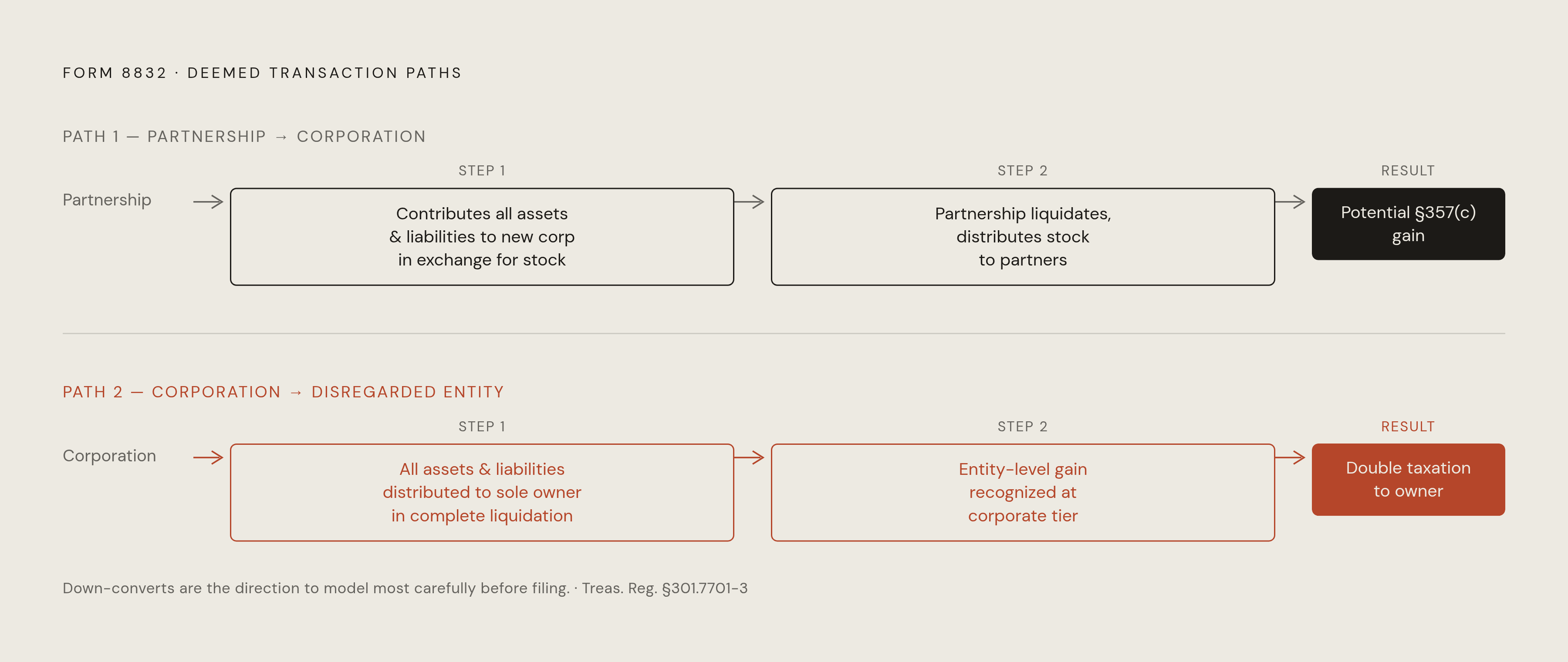
Changing an entity's classification is never a paperwork-only event. The regulations treat a reclassification as a deemed transaction: the IRS analyzes it as though the parties had actually gone through the motions of a real-world restructuring, even though nothing has physically happened beyond filing a form.
When a partnership elects to become an association taxable as a corporation, The regulations deem the partnership to have contributed all of its assets and liabilities to a newly formed corporation in exchange for stock. Immediately afterward, the partnership is deemed to have liquidated, distributing that stock out to the partners. Even when Section 351's nonrecognition treatment applies cleanly, Section 357(c) can still force gain recognition if the liabilities contributed exceed the contributor's basis in the assets, a result that catches people off guard because it doesn't feel like anyone actually sold anything. The fix, where it's available, is straightforward: if a new entity is going to elect corporate status anyway, file the election before any assets get contributed to it. That preserves initial-classification treatment from day one and sidesteps the deemed-transaction machinery.
When an association elects disregarded entity status, the regulations deem all of the entity's assets and liabilities distributed to the single owner in complete liquidation. That triggers the ordinary corporate liquidation rules: gain recognized at the entity level, and the distribution taxed again to the owner.
Converting a corporation down into a partnership or a disregarded entity is generally the costliest move on the board. It's treated as a taxable corporate liquidation, full stop, with gain recognized at the corporate level and the distribution taxed to shareholders on top of that. Practitioners widely regard the down-convert as the direction to model most carefully before filing anything, because unwinding corporate status tends to be far more expensive than entering it.
Late election relief for missed timely filings
Missing the filing window isn't automatically fatal. Revenue Procedure 2009-41 lays out the relief mechanism for eligible entities that intended a particular classification but never got the Form 8832 filed on time.
That guidance expanded what came before it. Prior relief mechanisms were narrower in scope. Revenue Procedure 2009-41 covers late elections for changes in classification too, which matters a great deal for entities that already had one classification and simply missed the deadline for switching.
Relief under a numbered administrative procedure. Proc. 2009-41 comes with conditions, and all of them have to be met. The failure to get the intended classification has to trace solely to the late filing, not to any underlying ineligibility or defect in the election itself. Either no federal return or information return has been filed yet for the first year the election would have covered, because the due date hasn't arrived, or every federal return filed since the intended effective date has been consistent with the classification the entity meant to have all along. The whole relief request has to go in within three years and 75 days of the intended effective date.
If an entity can't clear those requirements, the door isn't fully closed, it's just a different door. Other IRS relief mechanisms may remain available as a fallback when the revenue procedure's conditions cannot be met.
The S corporation pathway as an extension of the check-the-box framework
Form 8832 does not produce S corporation status. It requires a separate filing, Form 2553, Election by a Small Business Corporation, made under a section of the federal tax code.
For a single-member LLC that wants S corporation treatment, the sequence runs through two forms rather than one. Form 8832 first elects corporate classification for the entity, and then Form 2553 layers the S election on top of that. Two filings, one deliberate outcome.
The appeal is combining flow-through taxation with a corporate legal structure: income, losses, and credits pass through to shareholders, and the entity itself owes no federal income tax on its operating income, all while the entity retains a corporate form. The tradeoff is a real constraint on flexibility. S corporations can only have one class of stock: every share has to carry identical rights to liquidation and distribution proceeds. Differences in voting rights alone don't violate that rule, so a corporation can still have voting and non-voting shares, but differences in economic rights attached to different shares can jeopardize the single-class requirement.
Timing an election strategically, where practitioner judgment determines the outcome
Everything above points toward one conclusion: the moment an election gets filed matters as much as which classification gets chosen.
Formation is the highest-leverage moment available. An election that takes effect on the date an entity is formed counts as an initial classification, not a change, and initial classifications carry none of the baggage discussed earlier. No deemed contribution, no deemed liquidation, no Section 351 analysis, no 60-month lock starting to run. A newly formed entity that wants corporate treatment from day one avoids the entire deemed-transaction framework simply by filing before it ever holds assets under a different classification.
The 75-day retroactive window is the next-best tool, and it's a real one, just narrower. An entity that's already been formed but hasn't yet filed its election can still reach back and align the effective date with formation, or with some other date that matters commercially, as long as that date falls within 75 days of the filing. Missing that window triggers the IRS's automatic 75-day override, which may leave the entity classified one way for a stretch of time nobody actually wanted.
Because the 60-month lock attaches to whatever change happens first, the direction of that first move carries outsized weight. An advisor who moves a client into corporate status immediately after formation, before any operating history accumulates, preserves the most future flexibility, since there's no deemed transaction sitting behind that election waiting to complicate a later switch. An advisor who lets the default classification ride for a while and then files a change later starts the 60-month clock at that point, and everything downstream, including any future reversal, has to wait out that period or clear the deemed-transaction consequences described above. Down-converts remain the scenario demanding the most modeling before a single form goes in the mail, precisely because the corporate liquidation treatment and the 60-month lock compound each other, and reversing course after the fact tends to cost far more than getting the sequence right the first time.
Sources
- The Flexible U.S. Tax Entity Classification Election System
- The final "check the box" regulations.
- Classification of Entities for Tax Purposes
- Entity classification election - Wikipedia
- 26 CFR § 301.7701-3 - Classification of certain business entities.
- thetaxadviser.com
- law.cornell.edu
- eisneramper.com