Estate Tax Exemption Sunset in 2026 and Pre-Sunset Transfer Strategies
The exemption jumps to $15 million per person, but Congress could cut it again.
Estate Tax Exemption Sunset in 2026 and Pre-Sunset Transfer Strategies.
The cliff that never arrived: what the One Big Beautiful Bill Act did
The backstory matters, because it explains why the anxiety was so acute. But the TCJA doubling carried a built-in expiration date. Absent new legislation, the exemption would have reverted to roughly $7 million per person on January 1, 2026, dragging a far larger population of estates into the 40% federal tax Mercer Advisors. The stakes were not abstract: a married couple sitting on a $20 million estate would have gone from owing nothing to owing roughly $2.4 million, once about $6 million of their estate fell above the reduced threshold.
That looming deadline produced the predictable rush. Families who suspected they'd be caught by the reversion spent 2024 and 2025 setting up spousal lifetime access trusts, irrevocable life insurance trusts, and dynasty trusts at a pace not seen in over a decade. The OBBBA ended that particular urgency. What remains, though, is the planning logic that produced the surge in trust formation, and that logic didn't expire along with the deadline. 1, P.L.. Unlike TCJA, OBBBA contains no expiration date, with no new sunset, and inflation indexing beginning in 2027.
The New Numbers: Exemptions, Rates, and the Figures That Didn't Change
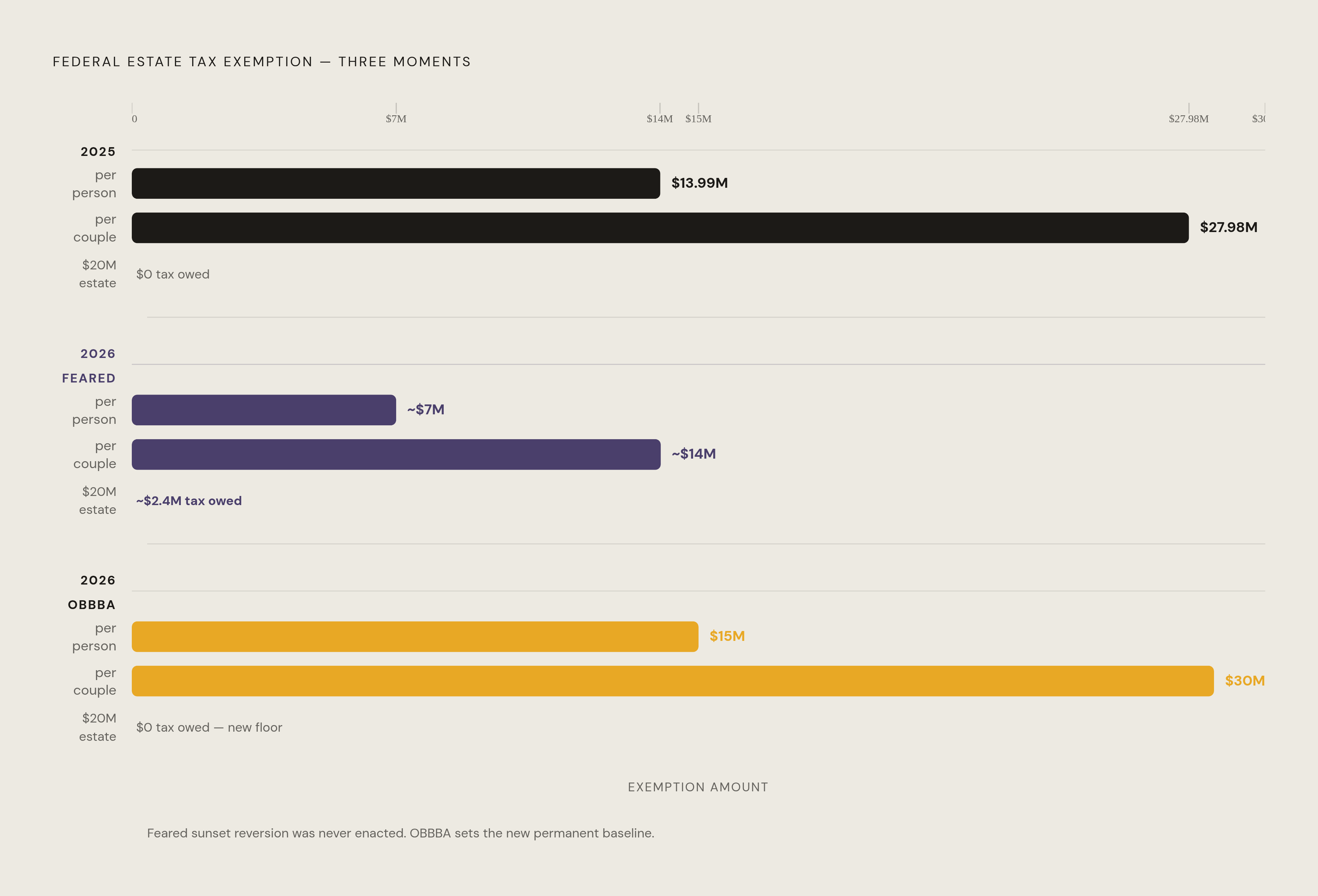
Running the numbers shows the shift looks modest on paper, even though its political weight was enormous. The per-person exemption rises from $13.99 million in 2025 to $15 million in 2026, an increase of $1.01 million per person, or $2.02 million per married couple. Combined with portability, a married couple's shelter moves from $27.98 million to a round $30 million. The generation-skipping transfer tax exemption rises in lockstep, also reaching $15 million per person, keeping it in parity with the estate and gift exemption.
Some figures didn't move at all, and that stability is arguably as important as what changed. The annual gift tax exclusion holds at $19,000 per recipient, or $38,000 for married couples who elect gift-splitting, and this amount never touches the lifetime exemption regardless of how many recipients a donor uses it on. The top federal estate tax rate remains 40% on everything above the exemption, and that rate, more than any exemption figure, is the reason planning still matters for estates with real exposure.
One number surprises people who assume the whole system got friendlier: the income tax brackets that apply to estates and non-grantor trusts remain extremely compressed. The top 37% marginal rate, stacked with the 3.8% net investment income tax, kicks in on trust income above just $16,250 in 2026 Nelson Mullins. A trust doesn't need to hold much in the way of assets before its retained income starts getting taxed at the highest marginal rate in the code, which is one reason so many trust structures are designed to distribute income out to beneficiaries rather than accumulate it.
For families who used up their exemption during the 2024 rush, the increases restore some capacity. Someone who exhausted the 2024 exemption of $13.61 million picked up $380,000 of new headroom in 2025 and gains another $1.01 million in 2026. For non-U.S. individuals not domiciled in the U.S., the exemption remains fixed at $60,000, as OBBBA did not extend the increase to this group, making proper structuring critical for international families Nelson Mullins.
Why "permanent" is a planning assumption, not a guarantee
"Permanent," in the language of federal tax law, means only that no expiration date is written into the statute. It says nothing about what a future Congress might do with a pen and a simple majority. Advisory firms have been blunt about this distinction since the ink dried on the bill. Davis+Gilbert noted in July 2025 that clients may still want to use exemption capacity sooner rather than later, in case a future administration reduces or eliminates OBBBA's increases, and Mercer Advisors said the permanence of these provisions is only as secure as the political climate allows, since Congress retains full authority to amend or repeal them.
History backs up the caution. The estate tax exemption has been pushed up, cut down, and frozen in place multiple times since 2001, and the TCJA itself was marketed in some corners as a permanent reform before it turned out to carry a built-in sunset. Calling something permanent has not, historically, made it so.
A fiscal argument also supports this point. OBBBA's major tax provisions are projected to reduce federal revenue by nearly $5.2 trillion between 2025 and 2034 on a conventional accounting basis. A revenue hole of that size does not sit quietly. It creates pressure that has, in past decades, brought Congress back to the estate tax code looking for money.
One protection does exist for families who act now and see the exemption cut later. The IRS finalized an anti-clawback rule in 2019 (Treasury Decision 9884, now codified at Treas. Reg. § 20.2010-1(c)) confirming that gifts made under a higher exemption won't be retroactively penalized if a future law lowers the exemption before the donor's death. The regulation works by using whichever exclusion amount is higher, the one in effect on the date of the gift or the one in effect on the date of death, when calculating the estate tax. That protection is less urgent today than it was in 2024, simply because the sunset it was built to guard against didn't happen. But it remains the operative safeguard if a future Congress ever brings the exemption back down below $15 million. A wrinkle is that proposed amendments circulating since April 2022 would narrow which gifts qualify for anti-clawback treatment, specifically carving out gifts where the donor retains meaningful control or interest over the transferred asset. Gifts structured with strings attached may not get the same protection as clean, complete transfers.
State estate taxes: where the exemption cliff still exists
OBBBA is a federal statute, and it left state death taxes completely untouched.
New York offers the clearest illustration Mercer Advisors. Its estate tax exemption for individuals dying in 2026 is $7.35 million Mercer Advisors. A married couple with a $20 million estate might owe zero federal estate tax and still face meaningful New York exposure Mercer Advisors. New York's tax also behaves differently than the federal version in a way that catches people off guard: rather than taxing only the amount above the threshold, it applies to the entire estate once that estate exceeds a certain percentage of the exemption. That structural feature, often called a cliff in its own right, makes New York planning a distinct discipline from federal planning.
Lifetime gifting still has a role to play here, even for families with no federal exposure. Citizens Private Bank guidance says strategic gifting during life can reduce state estate tax exposure specifically, because assets given away during life are generally outside the reach of a state estate tax assessed at death. State-level planning deserves its own dedicated analysis, run alongside any federal strategy rather than as an afterthought to it. Note for the writer: source material names New York specifically with a figure; treat other states qualitatively (many states, some states) unless a sourced figure is available.
The basis step-up tradeoff: the planning tension that outlasts any exemption level
Every transfer tax strategy involving lifetime gifts runs into the same tradeoff, and no exemption increase makes it go away. Gifting an asset during life removes its future appreciation from the taxable estate, which is the entire point of the exercise. But it also forfeits something valuable: heirs who inherit an asset at death receive a basis step-up to fair market value, erasing any embedded capital gain that built up over the donor's lifetime. Heirs who receive the same asset as a lifetime gift instead inherit the donor's original, often much lower, cost basis, carrying that embedded gain forward with them.
For families whose estates will not exceed the $15 million exemption, retaining appreciated assets until death is often preferable (the estate tax savings from gifting are zero, but the capital gains cost of gifting is real). The math simply doesn't favor it.
The calculation flips for families holding large, concentrated positions such as closely held business equity, a real estate portfolio, or a block of appreciated stock. For them, removing future appreciation before it compounds further can outweigh the lost step-up, though that determination has to be made asset by asset rather than applied as a blanket rule. Inflation adjustments built into the exemption help close some of the gap, but they may not keep pace with the growth rate of a concentrated or high-growth portfolio, per Mercer Advisors. That mismatch, between how fast exemptions grow and how fast certain assets appreciate, is the reason this tension never fully resolves itself, regardless of where Congress sets the exemption in any given year.
Grantor trust structures offer a partial bridge across this divide, and they show up repeatedly in the strategies below, precisely because they let a donor remove appreciation from the estate while the donor, not the trust, keeps paying the income tax bill on the assets inside it.
Core transfer strategies that remain effective after the OBBBA
The strategies that took shape during the 2024-2025 rush were built around removing future appreciation from a taxable estate, leveraging exemption capacity efficiently, and creating shelter that lasts across multiple generations. None of that rationale expired when the sunset did. It simply applies to a smaller population of families now, those with material exposure above the new, higher threshold.
Annual exclusion gifting remains the simplest tool in the kit. At $19,000 per recipient, or $38,000 for a gift-splitting couple, these gifts require no gift tax return and consume none of the lifetime exemption. It's a tool advisors mention less often than they should.
Spousal Lifetime Access Trusts remain a workhorse for larger estates. A trust of this kind removes assets from the donor's taxable estate while letting the donor's spouse remain a beneficiary, preserving indirect family access to the funds. Most SLATs are deliberately structured as Intentionally Defective Grantor Trusts, so the trust sits outside the donor's estate for estate tax purposes while the donor keeps paying the income tax on whatever the trust earns. That arrangement turns every tax payment into an additional transfer to the trust, one that doesn't count as a taxable gift. The risk sits on the family side rather than the tax side: if both spouses die or the marriage ends, the indirect access the surviving spouse relied on disappears. Careful drafting and an independent trustee matter as much as the tax mechanics.
Grantor Retained Annuity Trusts work on a different principle. The donor transfers an appreciating asset into the GRAT and retains a fixed annuity for a set term, with any appreciation above a hurdle rate passing to the remainder beneficiaries free of transfer tax. That's a meaningfully higher bar than the near-zero rates that made GRATs so lucrative a decade ago, and it reduces the leverage the strategy can generate. Even so, GRATs remain effective for assets expected to outperform that hurdle by a wide margin, private equity stakes and concentrated single-stock positions among them.
A sale to an Intentionally Defective Grantor Trust follows a related but distinct mechanic. The grantor sells an asset to the trust in exchange for a promissory note, and because the trust is disregarded for income tax purposes, the sale triggers no capital gains recognition. Appreciation above the applicable federal rate then accrues entirely outside the donor's estate, while interest payments on the note circulate within the grantor trust structure without generating income tax consequences. Good practice calls for seeding the trust with equity equal to at least 10% of the post-sale trust value, to support the transaction's economic substance. The strategy is especially suited to business owners: selling closely held equity into an IDGT at today's fair market value freezes the estate's value at the sale date and shifts every dollar of future growth to the trust's beneficiaries.
Dynasty trusts extend the horizon further still. Assets held inside a properly funded dynasty trust escape estate and GST tax at every subsequent generation's death, letting compound growth accumulate free of transfer tax for a century or more in states that permit it, South Dakota, Nevada, Delaware, and Wyoming among the ones most commonly used. The GST exemption of $15 million per person applies here, but it carries a limitation that catches families off guard: unlike the estate tax exemption, GST exemption is not portable between spouses, and a deceased spouse's unused GST exemption simply disappears if it isn't allocated during life or through the estate tax return. That non-portability creates urgency even for families with no federal estate tax exposure whatsoever, because failing to allocate both spouses' GST exemptions can leave transfers to grandchildren facing a 40% tax that better paperwork would have avoided entirely.
Charitable structures round out the toolkit. Charitable Lead Trusts and Charitable Remainder Trusts reduce estate and gift tax exposure while directing assets toward philanthropic goals, though OBBBA added a wrinkle: individual charitable deductions are now subject to a 0.5% of AGI floor, and contributions only become deductible once they exceed that threshold Nelson Mullins. High-income donors running charitable trusts need to account for that floor when modeling the deduction, since it shaves value off contributions that would previously have been fully deductible from the first dollar.
For families who've already committed most of their exemption to earlier strategies, asset swaps and intra-family loans offer a way to keep adjusting the plan without triggering new gift tax. Exchanging a low-basis asset sitting inside a trust for a higher-basis asset held outside it, or extending an intra-family loan at the applicable federal rate, lets a family rebalance without touching remaining exemption capacity, and both tools pair naturally with the trust structures already in place. Direct payments to medical providers or educational institutions (IRC Sec.. 2503(e)) are fully excluded from gift tax and do not count against the annual exclusion or lifetime exemption, an often-overlooked tool. Continuing relevance post-OBBBA shows that estates above $30 million still face a 40% tax on the excess, so a family with a $50 million net worth has $20 million above the combined couples' exemption. Zeroed-out GRATs can be structured to use essentially none of the $15 million lifetime exemption, making them effective even for clients who have already used their exemption. The benchmark rate shows that the April 2026 §7520 rate is 4.6%, meaning assets must outperform this hurdle rate for the strategy to succeed, as higher rates reduce leverage compared to near-zero rate environments.
Portability: what it solves and cannot fix
Portability lets a surviving spouse claim whatever estate and gift tax exemption the deceased spouse didn't use, and it's the mechanism that makes the combined $30 million couple's figure real rather than theoretical. But it only works if someone actually elects it.
The election isn't automatic. The estate's executor has to file IRS Form 706 and affirmatively elect portability within nine months of death, with a six-month extension available through Form 4768, and this filing is required even when the estate owes no estate tax at all. Plenty of executors skip it precisely because no tax is due, forfeiting exemption capacity the surviving spouse might need later. Revenue Procedure 2022-32 offers some relief here, extending the window for a late portability election out to five years after death, which has become a meaningful safety net for families who didn't file in time.
GST exemption is not portable, and no late-election procedure changes that fact. A family relying on portability to preserve estate tax exemption while assuming GST exemption works the same way is making an expensive assumption.
Sources
- Estate Tax and Gift Tax Exemption to Sunset in 2026 | Citizens Private Bank
- Estate Tax Exemption 2026 Changes Require Planning | Mercer Advisors
- Nelson Mullins - 2026 Estate and Gift Tax Update
- Estate Tax Exemption 2026: $15M Per Person Made Permanent | Lawvex
- After the One Big Beautiful Bill: Estate Tax Updates - Davis+Gilbert LLP