Conservation Easement Litigation and the IRS Syndicated Shelter Campaign
Tax courts are demolishing syndicated conservation easement valuations with a 94% disallowance rate.
Congress built the conservation easement deduction to protect land and historic buildings, not to produce investment returns, and that distinction now separates legitimate donations from a decade of abusive tax shelters. Under Sec. 170(h), a property owner who gives up certain rights over land or a building, permanently and for conservation purposes, can claim a charitable deduction tied to the value of what was given up. The IRS describes a legitimate transaction in plain terms: an owner who has held the property for a meaningful stretch of time, an appraisal grounded in the property's actual, specific characteristics, and a donation that follows the statute's rules on perpetuity and qualified organizations.
Syndicated conservation easements took that framework and ran it in reverse. Instead of starting with land someone already owned and wanted to protect, a promoter would assemble a group of investors into a partnership built for the sole purpose of buying land, commissioning an appraisal based on a hypothetical development that was never going to happen, donating an easement over that land, and then allocating a deduction to the partners that often dwarfed what they had actually put in. Every step of the transaction, land acquisition, appraisal, and partnership structure, was designed around the size of the deduction rather than any interest in preserving the property.
The clearest description of what this became came from the Senate Finance Committee itself, in a bipartisan report. The committee called syndicated conservation easements "nothing more than retail tax shelters that let taxpayers buy tax deductions," and it reached for an analogy that has stuck: a "Dollar Machine," in which promoters told investors they could expect roughly two dollars back from the government for every dollar they paid into the deal. Historic preservation easements carried inflated valuations as well, complicated further by the fact that many of the properties were already bound by local preservation laws or zoning restrictions, which raised the question of whether taxpayers were donating rights they held to begin with. That framing, a shelter sold on the promise of a government-funded markup, is what eventually pulled the IRS, Congress, and the courts into a sustained fight over these transactions.
What courts found when they examined these transactions
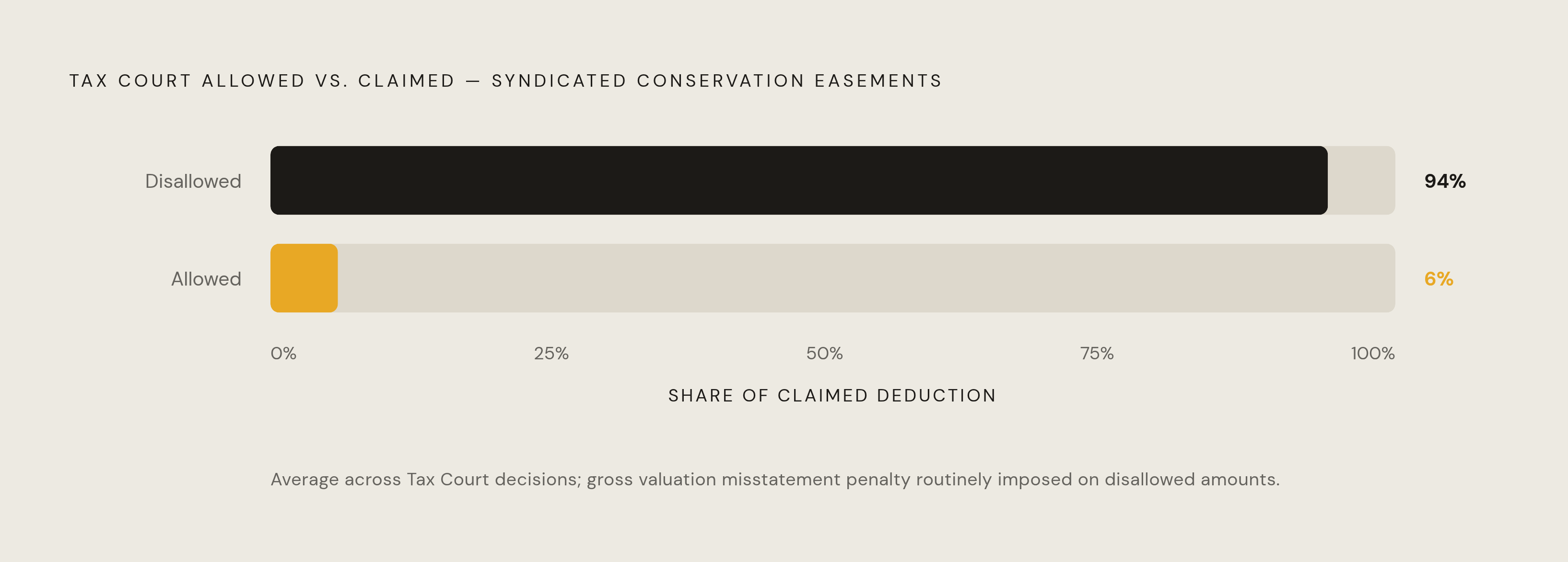
Once these transactions reached the Tax Court, the valuations behind them did not hold up, and the government's win rate reflects a factual record, not a judicial preference for one side. The IRS reports that on average, the Tax Court has allowed only about 6% of the claimed deduction in these cases and has gone on to impose the gross valuation misstatement penalty, a pattern steady enough that the IRS now tells taxpayers not to expect a different outcome in cases still working through litigation. The court's own language captures how far these appraisals strayed from anything defensible: judges have called the valuations "ludicrous," "laughable," "exorbitantly high," "baseless," "wholly implausible," "firmly planted somewhere in the realm of fantasy," "outrageous," and "wholly untethered from reality." The IRS now quotes that language directly on its public enforcement page, which says something about how confident the agency is in the record it has built.
Individual cases bear this out. In Oconee Landing Property, LLC v. Commissioner, the court disallowed the deduction. In Buckelew Farm, LLC v. Commissioner, the assessed value came in at a fraction of what the taxpayer had claimed. These are not outliers in a mixed record; they are representative of how the valuations have fared once an adversarial process tested them against the facts on the ground.
Appellate review has not given these partnerships a second chance to win on valuation. In a March 2026 opinion, the Eleventh Circuit affirmed in full a Tax Court ruling that had sustained both a substantial reduction in the claimed deduction and the gross valuation misstatement penalty, in a case involving tens of millions of dollars in claimed deductions. The Eleventh Circuit noted that valuation disputes in these cases turn on fact-finding, reviewed only for clear error, so if the Tax Court credits the IRS's expert evidence, reversal on appeal becomes difficult to achieve. The criminal system reached the same conclusion from a different angle: in 2023, a federal jury convicted promoters Jack Fisher and James Sinnott of conspiracy to defraud the United States, along with related offenses. That conviction marks the point where the most extreme conduct in this space stopped looking like aggressive tax planning and started looking like fraud.
The IRS's Logjam Despite Winning in Court
Winning cases and clearing a docket are not the same thing, and the gap between them is what shaped the IRS's strategy from here forward. As of May 2026, more than 1,100 cases were docketed in Tax Court or sitting in IRS Examination, and that volume was large enough to strain the court's capacity and tie up enforcement resources the IRS needed elsewhere. These cases make up a significant share of the Tax Court's active docket, which put real pressure on the IRS to find a way to resolve disputes that did not require trying each one to a verdict.
Litigation is not free for the taxpayers on the other side of these cases either. Every year a case sits unresolved, interest keeps accruing, legal fees keep mounting, and penalty exposure keeps compounding, so even an investor convinced their facts are distinguishable from the ones courts have already rejected pays a real cost for waiting. Some taxpayers could not have settled even if they wanted to. Many investors in these deals hold tax result insurance policies that include litigation conditions, requiring them to contest the IRS's position through trial as a condition of keeping their coverage. That clause binds some taxpayers to litigate a case they might otherwise settle, regardless of what the economics say.
A handful of taxpayers also found genuine procedural leverage, separate from the merits of their valuations. In the LakePoint Land II case, the court found a real factual dispute over whether the IRS had followed the statutory requirement that a supervisor sign off on penalties before they are assessed, and it sanctioned the IRS for submitting a backdated document along with a false declaration. The Tax Court found that the IRS had backdated its approval in that case, and the Treasury Inspector General for Tax Administration later found the same pattern, backdated approvals used to get around the sign-off requirement, in seven additional cases. That finding gave some taxpayers a procedural argument for resisting settlement even where the underlying valuation was indefensible, and it is the reason the insurance and procedural complications carried forward into how the IRS eventually designed its settlement offers.
Three Rounds of Settlement Initiatives Before 2026
Starting in 2020, the IRS turned to settlement as a way to manage volume rather than litigate every case to conclusion, and it ran three separate initiatives before 2026. Each one used the same basic terms: the charitable deduction would be disallowed, the partnership would be allowed an "other deduction" roughly equal to its out-of-pocket costs, and penalties on any underpayment would still apply.
The terms themselves were not the obstacle. The structural requirement attached to them was: the IRS required full payment of tax, penalty, and interest at the moment a taxpayer accepted the settlement, and that upfront payment demand kept otherwise willing participants out of the program. Layered on top of that was an insurance complication already in play across the broader dispute: taxpayers bound by litigation conditions in their tax result insurance policies risked losing their coverage if they accepted a settlement. The combined effect left a large population of cases unresolved because the settlement terms on offer were structurally out of reach for taxpayers, even those who did not expect to prevail at trial. That gap, between an outcome most participants would have accepted and a payment structure that blocked them from accepting it, is what the next settlement initiative was built to close.
The May 2026 Settlement Initiative
On May 13, 2026, the IRS announced a new settlement initiative aimed directly at the barrier that had undercut the three prior rounds. Eligible partnerships would no longer need to pay the full amount of tax, penalty, and interest at the time they accepted the offer; instead, those payments would move through the IRS's ordinary post-settlement collection procedures. The core outcome stayed the same as before: the charitable deduction is disallowed, and the partnership receives an "other deduction" generally equal to its approximate out-of-pocket costs, often calculated from the cash contributions shown on Schedule M-2.
The mechanics mattered as much as the terms. Eligible partnerships received individualized settlement letters issued on a rolling basis, and the deadline printed in each letter was enforced strictly, with no extensions granted. Not every case qualified: the IRS excluded cases that had already gone to trial and were awaiting decision, as well as cases already on appeal, and it kept discretion to judge eligibility on other case-specific facts beyond those two categories. The resolution document differed by posture. Non-docketed cases, governed by the Bipartisan Budget Act of 2015, were typically closed out through a closing agreement or a similar document, while docketed Tax Court cases were resolved by stipulated decision. Partnerships that let the deadline pass or turned down the offer were left with no alternative off-ramp. Their cases would run through ordinary litigation, with interest continuing to accrue the entire time as required by law.
The initiative also arrived with political backing that distinguished it from the three before it. Their letter went further than endorsing this particular settlement, urging the IRS to deter "similar schemes moving forward," a sign that congressional interest in this issue extends past conservation easements specifically.
For practitioners advising clients who received one of these letters, the analysis comes down to a direct comparison: the total cost of settling, the disallowed deduction, a reduced penalty, and interest, against a realistic trial-loss scenario that includes full interest accrual, litigation costs, and a penalty outcome likely to be worse than what settlement offers. Acting IRS Chief Counsel Kenneth Kies stated the agency's view of that comparison without much room for interpretation: "These are not close calls." His point was that taxpayers who decline the offer face years of additional interest and real litigation costs stacked on top of a penalty outcome that is already likely to be harsher than what settlement provides.
The insurance issue from earlier in this dispute resurfaces here with sharper stakes. Accepting a settlement can count as a voluntary concession under some tax result insurance policies, and that concession can void coverage. Any client holding one of these policies needs that policy reviewed as a distinct legal question before deciding whether to sign a settlement letter, because the savings from settling could be erased by a forfeited insurance claim.
The End of the Uniform Settlement Program
The IRS ended the May 2026 uniform settlement initiative effective August 19, 2026, a little over three months after it began, and the reason had nothing to do with the terms failing on their merits. The agency's own explanation points to a mismatch between the format and the caseload: "standardized, unsolicited settlement letters on a rolling basis, each with a fixed response period, are not well suited to the full range of conservation easement cases." Partnership agreements, insurance arrangements, and procedural posture varied too much from case to case for one uniform letter, with one uniform deadline, to fit them all.
Starting August 19, the IRS stopped sending new settlement letters under the May framework, and it withdrew the deadlines attached to letters it had already issued. Taxpayers who had already elected to participate under the May terms kept that election in place, and those cases will be processed according to the terms they agreed to. For everyone else, the uniform, letter-based phase of this enforcement campaign is over, and what comes next will need to account for the differences among cases that the May initiative treated as interchangeable.
Sources
- Conservation easements
- IRS shifts approach to conservation easement disputes
- IRS announces terms of a time-limited settlement opportunity for eligible taxpayers involved in conservation easement disputes
- Another settlement offer planned in IRS conservation easement cases
- Office of Public Affairs
- Settlement offers to be sent on syndicated conservation easements
- IRS announces new settlement offer for certain conservation easement disputes
- IRS announces new Office of Conservation Easements and ends uniform settlement initiative