
Economic Substance Doctrine After Section 7701(o) Codification
Codification rewrote the doctrine's structure while leaving its most contested question unanswered.
Section 7701(o) was supposed to settle the economic substance doctrine by writing it into the Code. Instead, it rewrote the doctrine's internal structure in ways Congress did not advertise and most practitioners have not fully absorbed: a mandatory conjunctive test, a relevance threshold left without a definition, and a strict-liability penalty with no reasonable-cause escape. What follows traces what changed, what didn't, and where courts are now splitting on the question that matters most: whether the doctrine applies.
What the economic substance doctrine was before Congress touched it
The economic substance doctrine traces to Gregory v. Helvering in the 1930s, and for most of its life it was a judge-made tool rather than a statutory one. Courts used it to disregard transactions that complied with the literal text of the Code but produced a tax benefit with no meaningful economic purpose behind it. The doctrine functions as an anti-abuse backstop: a taxpayer can satisfy every requirement written into the Code and regulations and still lose the benefit, if a court concludes the result goes beyond what Congress intended when it wrote the provision.
Before codification, the doctrine did not look the same from one circuit to the next. Some courts applied it disjunctively: a transaction could survive if it showed either a real change in the taxpayer's economic position (the objective prong) or a genuine non-tax business purpose (the subjective prong). Other circuits required both. That split was not a minor technicality. It was itself a planning variable, something tax advisors factored into where and how a transaction was structured. In practice, the two prongs often collapsed into each other anyway, since both tended to turn on whether the taxpayer had a reasonable expectation of profit, and courts tended to lean harder on the objective prong when the two diverged. No statutory penalty attached to any of this. The doctrine's consequence was benefit disallowance, layered with whatever accuracy-related penalty already applied under general rules. When Congress enacted Section 7701(o) in 2010, it described the goal as standardizing the conjunctive test across circuits and clarifying a doctrine that had grown too inconsistent to administer fairly.
What Section 7701(o) Did to the Doctrine's Structure
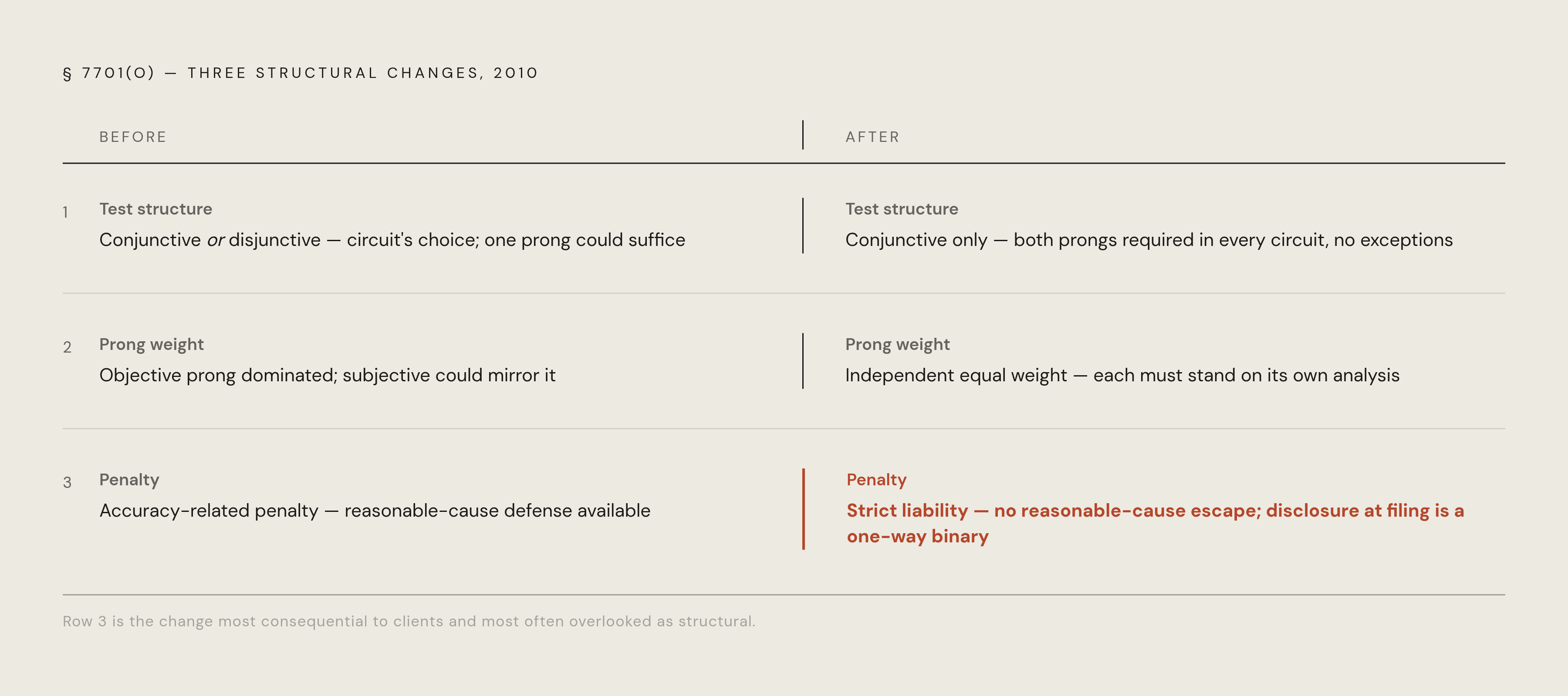
Rebecca Rosenberg looked at this in 2019 and found Congress did more than just standardize an existing test. It changed how the test works internally, and the consequences have mostly gone unnoticed by practitioners who assumed codification was just a formality.
The first change is the easiest to state. Section 7701(o) made the conjunctive test mandatory nationwide. Both the objective prong (did the transaction meaningfully change the taxpayer's economic position) and the subjective prong (did the taxpayer have a substantial non-tax purpose) must now be satisfied, in every circuit, with no exceptions for jurisdictions that previously allowed a disjunctive showing. For a taxpayer who once could structure around the more lenient standard of a particular circuit, that option is gone. This is a real substantive change.
The second change is more technical, and it is where Rosenberg's argument does its heaviest lifting. Ordinary rules of statutory interpretation hold that when a statute sets out two distinct requirements, courts should read them as carrying independent weight and should avoid interpretations that make one redundant with the other. Applied to Section 7701(o), that principle means the objective and subjective prongs must now be treated as equal in weight and distinct in content. Before codification, courts routinely let the two prongs blur together, because both asked whether the taxpayer expected to profit, and when the two pointed in different directions, the objective prong usually won out. Rosenberg argues the statute forecloses that practice going forward: a court can no longer satisfy the subjective inquiry by simply repeating the objective analysis in different words. Each prong has to do its own independent work.
The third change is the one that now drives the most contested litigation. So Section 7701(o) did not make the doctrine apply to every transaction with a tax benefit attached. It preserved a gateway question: is the doctrine even relevant to this transaction? Congress left that question open, without specifying what should trigger it or what should exempt a transaction from it. That silence has become the doctrine's most litigated fault line, a point developed later in this piece.
One thing codification left untouched matters just as much as what it changed. The power to define the unit of analysis, meaning whether a court examines a single discrete step or an entire integrated series of transactions as one whole, remained exactly where it was before 2010, in the hands of the IRS and the courts. That framing power can be outcome-determinative: the same facts can produce opposite results depending on whether a transaction is examined step by step or as an integrated whole.
The Penalty Regime That Codification Attached
For most clients, the single most consequential change codification brought was the penalty, not doctrine. It was the penalty. Section 7701(o) carries a strict-liability penalty, and unlike the general accuracy-related penalty regime, there is no reasonable-cause defense attached to it. A taxpayer cannot avoid the penalty by showing good-faith reliance on professional advice, which is the standard escape valve available almost everywhere else in the penalty structure.
That absence of an exit turns disclosure timing into a binary decision made once, at the moment of filing. Adequate disclosure on the return can reduce penalty exposure, but the choice to disclose or not has to be made before the return goes out the door. There is no way to go back and fix that choice after the fact.
The IRS's own staffing constraints have pushed audit rates down in recent years, but that has not translated into retreat on this specific penalty. Crowe's practitioners report the agency continues to defend the economic substance penalty in litigation even as the overall number of exams falls, which tells practitioners that reduced audit volume is not the same thing as reduced enforcement appetite on this issue. Compounding the uncertainty, the "angel list" that taxpayers and advisors have requested for years, a published roster of transaction types the IRS considers outside the doctrine's reach, has never been issued. The Joint Committee on Taxation's Technical Explanation to the 2010 Act offers a non-exhaustive illustrative list, but it is not a safe harbor, and practitioners have nothing official to point clients toward with confidence.
How the IRS initially pulled back and why that restraint is ending
Congress wrote Section 7701(o) to strengthen the economic substance doctrine. For years afterward, the IRS appeared to use it less. Rosenberg's earlier analysis for the William & Mary Business Law Review documents this directly: internal agency directives required executive-level approval before an examiner could invoke the doctrine, and those same directives described categories of situations where raising it was likely inappropriate. The practical effect was an agency that treated its newly codified, supposedly stronger tool with more caution than it had shown the judicial version.
The irony runs through the whole episode. Congress imported judicial principles into the statute specifically to give the doctrine more force, and the result was an agency that read the new formality as reason for more top-down caution rather than more aggressive use. That amounts to the IRS exercising real administrative discretion over when to deploy a tool Congress had just told it to use more, a dynamic that touches on broader questions of agency discretion that go beyond the scope of any one practitioner's return.
That period of restraint is ending. Crowe reports that IRS disallowance of tax benefits under the codified doctrine appears to be climbing. The agency's Large Business and International Division has said it will consider the doctrine more often in transfer pricing audits, a context where it was rarely invoked before. Holly Paz, Acting Commissioner of the IRS's Large Business and International Division, told the American Bar Association's Section of Taxation at its Philadelphia Tax Conference that this shift will bring sharper scrutiny of "sham" transactions and more aggressive penalty assertions in transfer pricing cases specifically. Related-party partnership basis-shifting transactions are now explicitly on the IRS's target list as well, with the agency stating the transaction types it is pursuing cut across a wide range of industries and individuals. Practitioners who grew accustomed to an agency that rarely raised the doctrine outside a narrow set of facts are now operating in a different enforcement climate, and the shift is recent enough that case law has not caught up with it.
Three cases that show where the doctrine is being pushed in practice
Litigation now underway shows the codified doctrine reaching exactly the kinds of multi-step, technically compliant transactions Section 7701(o) was built to catch, and the outcomes are still being contested at the appellate level.
Liberty Global, Inc. v. United States, decided by the Tenth Circuit, involves a multinational consolidated group whose tax advisors identified what they called a "last day of year rule/mismatch" in the TCJA's international tax provisions, a structural gap in the statute. The company executed a coordinated series of transactions, internally named "Project Soy," over four days to exploit it. Liberty Global first won summary judgment at the district court, because the court found that the Treasury regulation blocking the transaction was procedurally invalid for lack of notice and comment. But the district court still ruled against the company on economic substance grounds, and the Tenth Circuit affirmed: it held that the four-day series was the correct unit of analysis, and that letting the company point to economically substantive elements in individual steps to immunize the scheme would gut the doctrine.
Patel v. Commissioner, decided by the Tax Court, took head-on the question of whether a standalone relevance threshold exists. The IRS argued it does not, that the doctrine applies based on the facts and circumstances of every case with no separate gateway inquiry. The Tax Court rejected that position, a holding that sets up the direct conflict with the Tenth Circuit's approach discussed below.
Kadau v. Commissioner, also decided in the Tax Court, moved the doctrine into new territory entirely: a microcaptive-type insurance arrangement. The case involved a closely held business that took part in a captive insurance structure promoted for the federal income tax benefits tied to deductible premiums and favorable treatment at the captive level. The case shows the doctrine is no longer confined to international tax structures or large corporate restructurings. It reaches risk-transfer arrangements used by closely held businesses, so more practitioners now need to track it.
Commissioner, remains pending. The IRS has asked the Tax Court to recharacterize a series of monetized installment sale transactions, arguing they were designed to delay recognition of gain without actually delaying receipt of the sales proceeds, so they lack economic substance. The case signals the doctrine's push into domestic transaction types where it has historically been used sparingly, not only the cross-border structures that have dominated economic substance litigation for decades. A separate Tax Court opinion, Otay Project LP v. Commissioner, addressed pre-codification transactions and applied the doctrine to a transaction governed by a mechanical Code provision without first asking whether relevance was even in play. Baker McKenzie points to Otay as an example of courts broadening the doctrine's reach even in situations where a close look at relevance might have cut the other way.
The Unsettled Relevance Threshold
The hardest open question left after codification is not how a transaction satisfies the two-prong test once the doctrine applies to it, but whether the doctrine applies to it in the first place, and Patel and Liberty Global point in opposite directions on that question.
In Patel, the Tax Court treats the statute as preserving a genuine relevance threshold. So under that reading, a court cannot use the doctrine as a free-floating override to disallow any technically compliant tax result it just happens to dislike. Relevance is a real, separate inquiry into whether the type of transaction at issue has historically warranted economic substance review at all, and that inquiry has to be resolved before the two-prong test even comes into play.
The Tenth Circuit's approach in Liberty Global reads very differently. Baker McKenzie's analysis describes the court as effectively collapsing the relevance threshold into a purposive inquiry: the doctrine becomes relevant whenever a taxpayer claims a tax benefit the court concludes Congress did not intend, even where the taxpayer followed the literal mechanics of the Code exactly as written. Mere compliance with the statute's text is not enough to escape the doctrine under this standard, but the standard itself offers little guidance on what would be enough.
That is the practical problem with the Tenth Circuit's formulation: it ties relevance to a court's after-the-fact reading of what Congress meant to allow, rather than to any fixed category of transaction. Judge Eid's dissent captured the stakes directly, describing the majority's approach as giving the government, in her words, effectively "a blank check to declare any transactions it does not like" to fall within the doctrine's reach. The dissent concluded that Liberty Global's formal transaction structure did not fail to reflect its underlying economic reality, which the dissent viewed as the proper scope of the inquiry, and argued that courts should not use the doctrine to rescue Congress from its own drafting gaps in the TCJA.
That conflict is not confined to the Tenth Circuit's jurisdiction. The relevance question remains open across the federal courts, and until it is resolved, nationally, any taxpayer relying on literal compliance with the Code's text as a defense faces a standard that one court will treat as a real screening device and another may treat as barely a speed bump.
Sources
- Codification of the Economic Substance Doctrine: Substantive Impact and Unintended Consequences
- Codification of the Economic Substance Doctrine: Agency Response and Certain Other Unforeseen Consequences
- Codification of the Economic Substance Doctrine
- The Common Law Economic Substance Doctrine and Its ...
- Divided 10th Circuit affirms District Court on economic substance doctrine in Liberty Global
- Tax Court Decision in Patel Clarifies Scope of the Economic Substance Doctrine
- U.S. Tax Court Holds that § 7701(o) Requires Threshold Relevancy Determination Before Applying Two-Prong Economic Substance Test
- Tax Court to Consider Relevancy Threshold for Economic ...