Tax Court Deficiency Procedure Versus Refund Suit Jurisdiction
Taxpayers have two mutually exclusive paths to court, each with its own jurisdictional rules.
A taxpayer who wants to fight the IRS in court has exactly two paths available, and those paths do not connect. One is the Tax Court deficiency procedure; the other is the refund suit. The rules governing each track decide whether a taxpayer can litigate at all, not simply which building the case gets filed in.
Tax Court holds only the authority Congress has given it, nothing more. In a deficiency case, that authority rests on two things happening in sequence: the Commissioner must issue a valid Notice of Deficiency under I.R.C. § 6212, and the taxpayer must file a timely petition under I.R.C. § 6213(a). Missing either one leaves no case.
Refund suits run through different courthouses. A taxpayer can sue in U.S. District Court, in the district where he resides or has his principal place of business, or in the U.S. Court of Federal Claims in Washington, D.C. That choice of forum is a decision made inside the refund track. It has nothing to do with Tax Court, which operates under its own, separate set of rules.
The asymmetry between the two tracks is the single most important fact in federal tax controversy practice. Tax Court is the only forum where a taxpayer can contest a tax liability before paying a dollar of it. The refund track runs the other direction: it requires the taxpayer to pay the full disputed amount first, then sue to get it back. Everything that follows, who can realistically access which forum, what each track demands procedurally, and what happens when a taxpayer stumbles on a deadline, traces back to this one structural fork.
What Tax Court jurisdiction actually requires and how it can fail
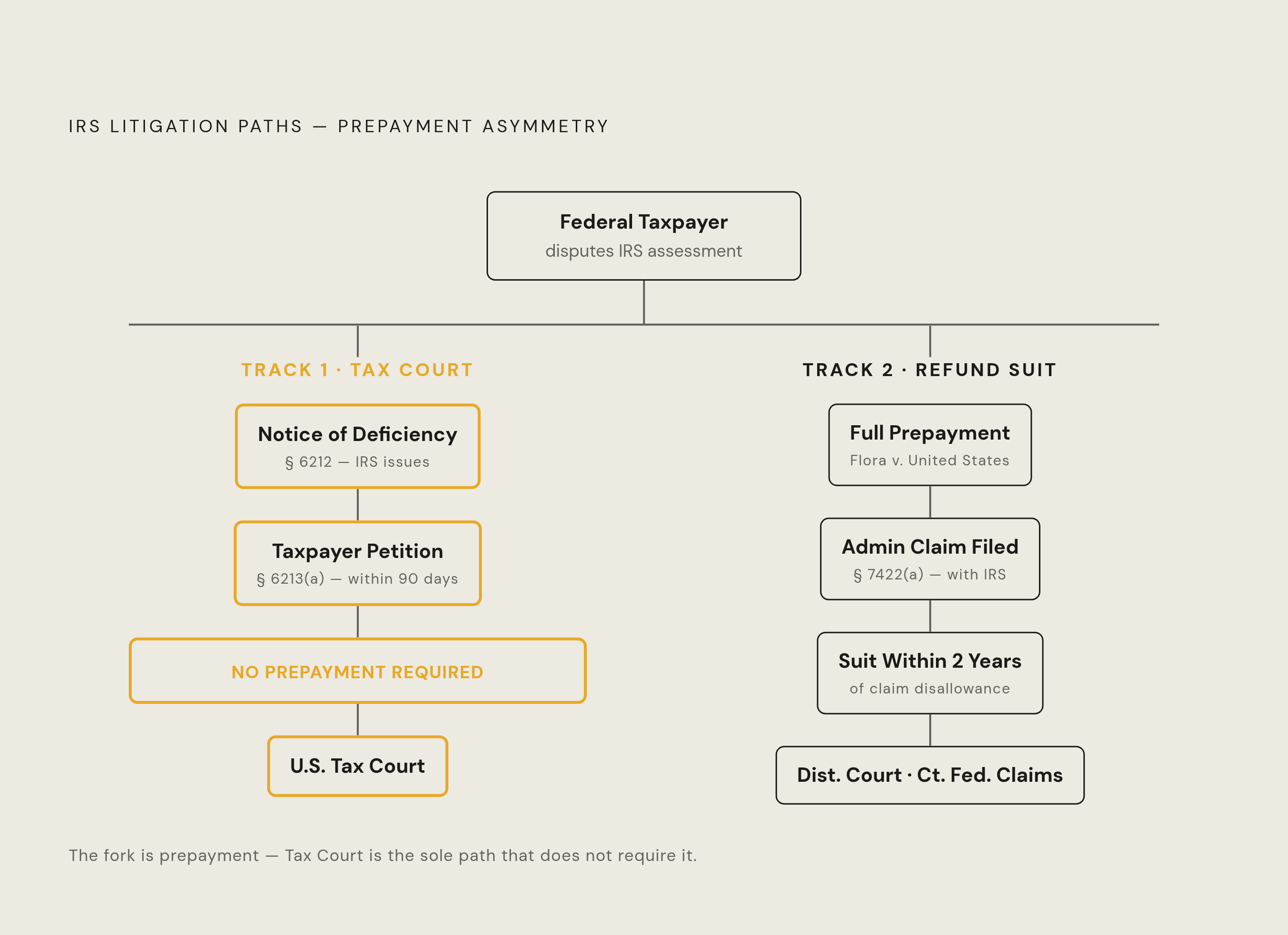
Tax Court jurisdiction in a deficiency case can fail at either of its two statutory predicates, and a defect in the notice or a late petition each independently kills the case. Neither failure is partial. The court does not weigh equities when a predicate is missing; it simply has no power to hear the dispute.
Start with the notice. The IRS has historically relied on Form 3877, a certified-mail log, to establish that it mailed a valid Notice of Deficiency. When that form is defective, the agency loses the presumption that mailing occurred correctly, and it has to rebuild the record using other evidence: USPS tracking data, internal system timestamps, and contemporaneous database entries. This is what happened in Lindsey v. Commissioner, T.C. Memo. 2026-94, decided September 24, 2026. The Tax Court resolved the mailing dispute in the Commissioner's favor there, accepting the IRS's reconstructed proof of mailing despite the flawed Form 3877. Commissioner, T.C. Memo. 2025-49, where a defective Form 3877 again cost the IRS its mailing presumption, and the agency again saved its case using USPS tracking and internal records. Both cases carry the same lesson for anyone contesting a notice's validity: the fight is over the IRS's circumstantial evidence file, not simply whether the Form 3877 itself looks right on its face.
The second predicate belongs to the taxpayer, not the IRS. A taxpayer has 90 days from the date the notice was mailed to file a petition, with an extended period for addresses outside the United States, and the petition-filing obligation falls on the taxpayer and its counsel, not the court. The court does not extend it, track it, or remind anyone that it is running.
Lindsey illustrates how these two predicates can collide in a single case. The Tax Court dismissed for lack of jurisdiction because the taxpayer's petition arrived late, regardless of which predicate failed; only the stated ground for dismissal changes. The outcome would have been the same dismissal had the mailing proof failed instead. Whichever predicate gives way, the result for the taxpayer is identical: the court lacks jurisdiction, and only the stated reason for dismissal changes.
Prerequisites of the Refund Track
The refund track's prerequisites, full prepayment, a properly filed administrative claim, and a suit filed within two years of disallowance, together form a sequential gauntlet that filters out most taxpayers who cannot pay before litigating.
The organizing rule here comes from Flora v. United States: a taxpayer must pay the entire assessed tax before any federal court has subject-matter jurisdiction over a refund suit. Flora is a line, not a standard a judge balances against other factors, and a taxpayer is either on the correct side of it or the case does not proceed.
Two recent cases show how unforgiving that line is. In Dicks v. United States, decided in a federal district court in March 2026, Michael Dicks sued claiming the IRS had improperly withheld refunds for tax years 2013 through 2015. The court dismissed for lack of subject-matter jurisdiction because he had not satisfied the full-payment rule. In Williams v. United States, decided by the Federal Circuit on March 10, 2026, Geoffrey Williams had actually paid the assessed amounts for tax years 2006 and 2010, then sent the IRS letters demanding a refund. That still was not enough. The Court of Federal Claims dismissed for lack of subject-matter jurisdiction, and the Federal Circuit affirmed, because informal letters do not satisfy the formal administrative claim procedure that I.R.C. § 7422(a) requires. Payment alone does not open the courthouse door; a properly filed administrative claim has to accompany it.
A narrow exception exists for divisible taxes and penalties, such as employment taxes, trust-fund recovery penalties, and certain assessable penalties, where a taxpayer may litigate after paying only the divisible portion rather than the full amount. That carve-out applies to a specific category of liability structured in separable pieces, without loosening Flora generally.
Once the IRS disallows a refund claim, the clock starts on a second deadline: two years to file suit. If that period lapses without a suit filed, and without the IRS executing an extension, the refund right disappears permanently. Making matters worse, the IRS has no clear standardized process by which a taxpayer can request that extension for most refund claims, though a streamlined process arrived in April 2026 specifically for ERC disallowances. Outside that narrow fix, the absence of a clear extension procedure means a taxpayer can lose a valid refund claim simply by not knowing how to ask for more time.
Choice of Refund Forum: District Court Versus Court of Federal Claims
Clearing Flora and filing a proper administrative claim does not end the forum decisions a taxpayer has to make. Choosing between district court and the Court of Federal Claims is itself a strategic call, because the two forums differ on jury availability and on how accessible they are in practice.
District court offers something the Court of Federal Claims does not: either party can demand a jury trial. For a taxpayer who believes a jury will respond better to the facts than a judge will, district court is the only one of the two refund forums where that option exists.
The Court of Federal Claims sits in Washington, D.C., and does not offer jury trials at all. What it does offer is national reach: a taxpayer can bring a claim there regardless of where he lives, while district court requires filing in the district of residence or principal place of business. For a taxpayer whose home district carries an unfavorable body of case law, or whose facts travel better in a single national court, that reach can secure a forum even when it means giving up the jury option.
Neither forum comes free of risk for a taxpayer proceeding without counsel. Pellegrino v. United States, No. 1:26-cv-00403, decided by the Court of Federal Claims on August 20, 2026, shows what that risk looks like in practice: Judge Philip S. Hadji dismissed a pro se tax-refund action on jurisdictional grounds, even though the taxpayer had presumably cleared Flora to get that far. Clearing the full-payment rule does not guarantee a court will reach the merits of a case. The procedural requirements layered on top of Flora can still end it.
Both refund forums also lack what Tax Court has built in: judges with dedicated tax expertise. That raises the practical cost of representing oneself in either forum, a cost that becomes central to the structural argument in the next section.
The Two-Track Structure's Disadvantage for Taxpayers Who Cannot Prepay
The two tracks, taken together, sort taxpayers by wealth rather than by the merits of their disputes. The structural effect of the two tracks is that taxpayers who cannot prepay are funneled into Tax Court as the only realistic forum, while those who can prepay but miss the Tax Court window face a refund track that is procedurally and financially out of reach for most individuals.
Tax Court earns its volume honestly: a low filing fee, procedural rules that are less formal than those governing district court or the Court of Federal Claims, and a bench of judges who specialize in tax law make it realistic for a taxpayer to represent himself there. None of those advantages exist on the refund track, where full prepayment alone screens out most individuals before procedure even enters the picture.
The National Taxpayer Advocate has put the consequence in blunt terms: requiring refund claims to be litigated in district court or the Court of Federal Claims effectively denies many taxpayers judicial review of an IRS refund disallowance, and the overwhelming share of tax-related litigation ends up in the Tax Court as a result.
That concentration produces a trap for a specific kind of taxpayer: someone who misses the 90-day Tax Court deadline and cannot prepay the assessment has no viable court left to go to. If the two-year refund suit window also runs out before he finds a way to pay and sue, the refund right is gone permanently. This is not a hypothetical constructed to make a procedural point sound graver than it is. The taxpayers in Culp, Lindsey, and Buller and Beatty were individuals contesting modest amounts, the kind of amounts where full prepayment would have settled the jurisdictional dispute before it ever began.
That gap, between what the system demands and what an ordinary individual taxpayer can actually do, is precisely what the circuit split described next is now fighting over.
The live circuit split over whether the 90-day Tax Court deadline can be equitably tolled
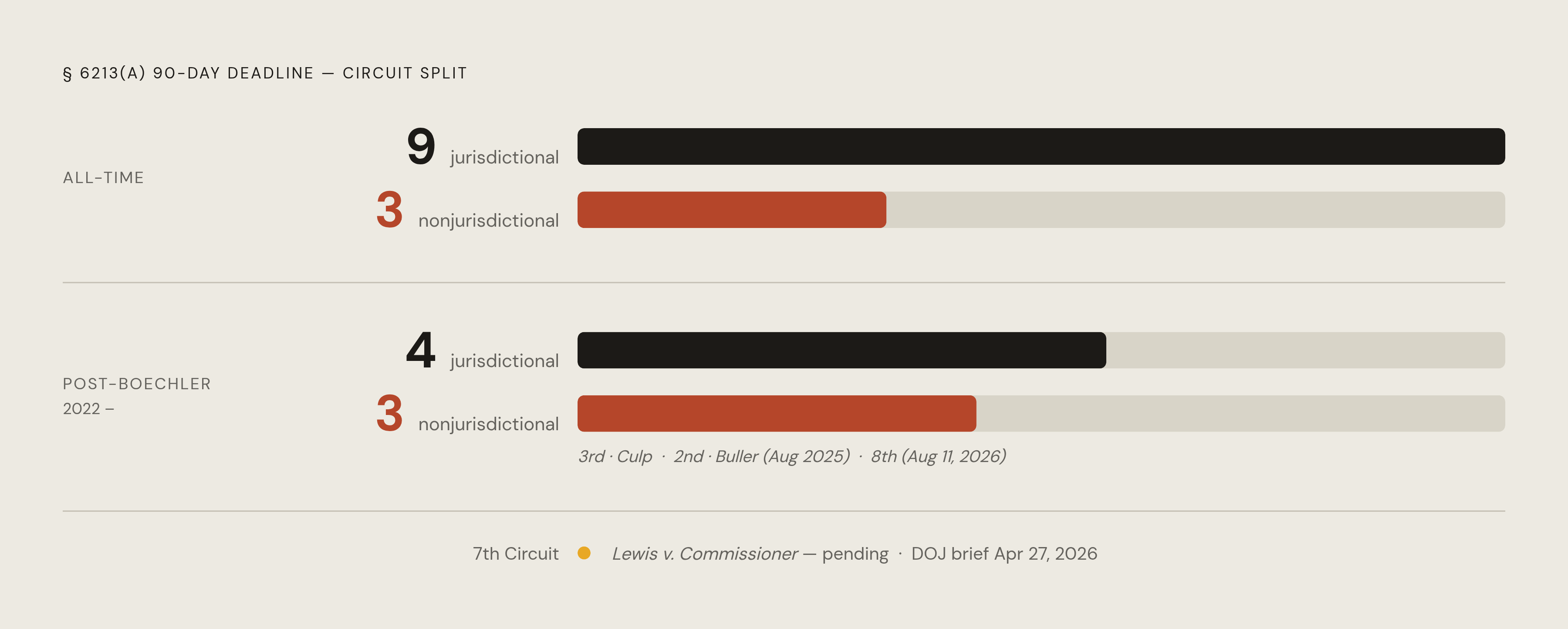
Whether the 90-day petition deadline is a hard jurisdictional bar or a nonjurisdictional claims-processing rule subject to equitable tolling is the most contested procedural question in current federal tax litigation, and courts of appeals have reached opposite conclusions.
The dispute traces to Boechler, P.C. v. Commissioner, 596 U.S. 199, decided by the Supreme Court in 2022. There, the Court held that the 30-day deadline under I.R.C. § 6330(d)(1), governing petitions for Tax Court review of a Collection Due Process determination, is a nonjurisdictional limitations period, and therefore one that equitable tolling can reach. Boechler did not address § 6213(a) directly, and courts have fought since over whether its logic carries over.
The count currently stands at nine circuits holding the § 6213(a) deadline jurisdictional against three holding it nonjurisdictional, counting across all circuits that have ruled. Narrowing to circuits that have ruled since Boechler specifically, four have gone jurisdictional and three nonjurisdictional, which shows the post-Boechler landscape is far closer than the all-time tally suggests.
Three circuits anchor the nonjurisdictional position. The Third Circuit got there first, in Culp v. Commissioner. Judge Ambro's opinion found nothing in § 6213(a)'s text tying the deadline to the court's jurisdiction, noting that the statute simply says a taxpayer "may file a petition," language that carries no jurisdictional freight, and reasoning that nonjurisdictional deadlines are presumptively open to equitable tolling. The Second Circuit followed in August 2025 in Buller v. Commissioner, reversing a Tax Court dismissal of a petition filed nine days late. The court found Congress had never clearly attached jurisdictional consequences to the deadline, describing § 6213(a) as language that "speaks to a claim's timeliness, not to a court's power" and as a provision "directed at the taxpayer, rather than the court". The Eighth Circuit joined them on August 11, 2026, in Commissioner, the most recent appellate ruling on the question, holding the § 6213(a) deadline a nonjurisdictional claims-processing rule subject to equitable tolling.
The government has pressed the opposite argument, laid out in a DOJ brief filed April 27, 2026, in Lewis v. Commissioner, now pending before the Seventh Circuit. Congress placed the jurisdictional grant and the filing deadline in the same sentence of § 6213(a), the government argues, and that placement is not an accident of drafting; the deadline is not free-floating text sitting apart from the grant of power. If no timely petition is filed, § 6213(c) activates, triggering a major shift to an assessment-and-collection phase, a structural pivot the government reads as proof the deadline limits the court's power, not merely a party's procedural obligations. It adds that Congress wrote specific statutory provisions allowing later filing in limited situations, provisions that would serve no purpose if equitable tolling were already generally available. And it warns that treating dismissals as nonjurisdictional would collide with § 7459(d), which deems a dismissal a decision on the merits, a result that would seriously prejudice the very taxpayers a tolling rule is meant to help.
The Seventh Circuit has not yet ruled in Lewis, and nothing in the current record points to which way it will go. What the split does confirm is that this is not a settled area of law, and a taxpayer who files late cannot assume any particular circuit's precedent will travel with the case.
How courts assess equitable tolling claims
Even in the circuits that treat § 6213(a)'s deadline as nonjurisdictional, equitable tolling is not a rubber stamp. On remand in Boechler itself, the Tax Court held that the taxpayer was not entitled to equitable tolling because the requirements were not met and entered decision for the Commissioner, showing that tolling is not a general safety net.
That distinction matters most for a taxpayer counting on the Culp or Buller/Beatty line to save a late petition, since those taxpayers were individuals contesting modest amounts where full prepayment would have been dispositive. A nonjurisdictional ruling opens the door to an equitable tolling argument. It does not walk the taxpayer through it. The requirements still have to be met on the specific facts of the case, and the Tax Court's own post-Boechler conduct shows a willingness to deny tolling even where the legal framework permits it in principle.
The circuit split may eventually resolve in the taxpayer's favor nationwide, and the Seventh Circuit's pending decision in Lewis may add a fifth voice to either side of that count. Until a taxpayer knows for certain which rule governs his circuit, and until he has reason to believe his specific facts would satisfy tolling's requirements even then, the only safe course is to file on time.
Sources
- Second Circuit reverses Tax Court’s dismissal of deficiency petition
- Deficiencies, Defective USPS Form 3877, and the Limits of Tax Court Jurisdiction: Analysis of Lindsey v. Commissioner — Current Federal Tax Developments
- The Full Payment Requirement and the Presumption of Correctness: Jurisdictional Lessons from Pellegrino v. United States — Current Federal Tax Developments
- Culp v. Commissioner and Tax Court Access for Low-Income Litigants Harvard Law Review
- FLORA v. UNITED STATES, 362 U.S. 145 (1958)
- Tax Court Deficiency Filing Deadline Is Jurisdictional, DOJ Says
- Sixth Circuit Realigns on Tax Court Jurisdiction and Equitable Tolling, Becomes Third Circuit to Hold 90-Day Deadline is Not Jurisdictional — Current Federal Tax Developments
- Restrictions applicable to deficiencies; petition to Tax Court