
The Compliance Workflow Stack Mid-Size CPA Firms Are Actually Rebuilding Around Tax-Native AI
Tax-native AI automates intake and prep so CPAs can focus on advisory work.
Purpose-built AI for tax document analysis and compliance automation links intake, preparation, and review so it can automate work across those steps as well as individual tasks. Basis and Accrual address multistep preparation workflows, while Thomson Reuters’ Additive converts unstructured Schedule K-1 data into usable information. For mid-size CPA firms, the advantage comes from rebuilding these layers in sequence around shared client data, tax-specific controls, and professional review, then redirecting freed capacity into advisory work.
Why mid-size CPA firms are rebuilding compliance stacks rather than patching them
Legacy desktop-centric workflows put senior CPAs in the wrong role. When CRM, document management, compliance logs, and the tax engine operate in isolation, experienced staff become the connection between them. They assemble documents, move information, reconcile inputs, and establish what is ready for review. Those hours are unavailable for planning and advisory work. The bottleneck is therefore architectural.
A tool may process a document faster, but the engagement still depends on someone moving information into the next system and establishing its context. The handoff remains manual. Because an isolated tool cannot reason across the full engagement lifecycle, improvements at one node do not necessarily accelerate the return as a whole. Automating review, for example, does not save the time spent asking for and organizing source documents.
Agentic workflows change the scope of what software can initiate. Systems now collect documents, extract data, validate completeness, flag exceptions, and produce review-ready outputs without waiting for staff to direct every step. That changes the unit of automation from an individual task to a connected sequence. Depending on the order of the rebuild, one improvement can enable the next or merely shift the queue.
How do firms stop manually extracting and organizing client tax documents?
Intake establishes the quality of every downstream input. In a legacy workflow, staff request documents, chase clients by email, and sort what arrives during the same weeks they must prepare returns. Missing information therefore becomes a preparation problem before anyone has established that the file is incomplete. Tax-native intake uses prior-year return context to work out which documents to expect, sends structured follow-up requests, and flags what is missing before a preparer touches the file. It automates the collection logic and the upload.
Accrual links that intake work to preparing the return. The system reads client inputs, identifies missing information, sends follow-up requests autonomously, and produces draft returns for professional review. The CPA evaluates exceptions and signs off. This needs a client record that brings the information together so prior-year context can guide what the firm collects now. Consolidating CRM, document management, and tax-engine data is therefore a prerequisite for this approach.
Jessie Kanter, a partner at Citrin Cooperman leading audit innovation, is developing standardized workpapers, layout, and functionality to support agentic AI across varied engagements. The same principle applies at intake. A consistent knowledge base gives automation a common structure in which to find the information it needs. Without it, a firm can modernize the client-facing portal while leaving staff responsible for deciding what is expected and what is missing.
Consent is also an intake design requirement. IRC Section 7216 restricts the disclosure and use of tax return information, so moving that information into third-party tools requires a compliant framework. Violations can bring substantial per-violation penalties and up to one year in prison. Tax-native tools embed §7216 consent workflows, while generic tools require firms to construct that layer separately. Even with collection and consent addressed, however, the preparation layer remains the heavier consumer of senior staff time.
What tax-native preparation engines actually do differently from retrofitted software
Tax-native preparation engines turn source documents into a draft that is ready for review. They ingest W-2s, 1099s, K-1s, brokerage 8949s, and prior returns, apply prior-year context, cross-check inputs against expected values, and flag anomalies. Staff no longer have to execute each transition manually. The distinction from retrofitted software is not simply stronger extraction, but tax logic that links extraction, validation, and preparation. That connection reduces the assembly work that otherwise competes with evaluating unusual items.
Crowe LLP adopted Thomson Reuters’ Additive to convert unstructured Schedule K-1 data into structured, usable information, eliminating hours of manual data entry per return. Basis, founded in 2023, addresses a broader sequence through an agent-based architecture combining large language models, rules-based controls, and domain-specific accounting logic. Its processes cover document review, reconciliation, and tax preparation. Basis counts roughly a third of the Top 25 accounting firms as customers, with customers including Boulay PLLP, Clark Nuber PS, MarksNelson LLC, Pinion LLC, and UHY LLC.
Accrual launched February 5, 2026, with $75 million from General Catalyst and targets preparation and review across the return mix handled by mid-market and regional firms. That mix includes 1040s with income from more than one source, S-corps, partnerships, and multi-entity situations. Accrual benchmarks every 50 complex returns handled as equivalent to the capacity of one additional accountant. H&R Block, Armanino, and Creative Planning are among its early production partners. These are deployments at real client volume.
DASG LLC, a Dallas-based tax and accounting firm, uses AI across federal tax preparation and compliance, including calculation accuracy, deduction and credit identification, rule monitoring, and quarterly liability forecasting. Thomson Reuters’ Checkpoint Edge with CoCounsel supports research inside established tax workflows, while CoCounsel Tax provides drafting and document analysis as a separately purchased add-on. These capabilities serve different functions, so a product’s research support should not be confused with autonomous preparation.
Why the review layer is where the rebuilt stack either holds or breaks
The CPA signing the return remains responsible for it, and AI functions as an assistant under Circular 230. Review cannot be automated end to end. Section 10.36 requires those with principal authority to take reasonable steps to establish adequate firm procedures for compliance. It does not enumerate AI-specific requirements such as training on AI risks, secure data handling, or third-party tool vetting, so those operational decisions cannot be treated as a checklist supplied by the provision itself.
The Clinco case illustrates the consequences of unsupported authorities reaching professional work. The Tax Court found that cited authorities either did not exist as cited or did not support the argument. Judge Mark Holmes stated that three of the four cited authorities appeared to be hallucinations generated by a large language model AI, while noting that the record did not definitively establish AI use. That qualification is important to the case. It does not diminish the review failure demonstrated by authorities that could not support the position advanced.
A well-designed review layer routes uncertainty to qualified people. Tax-native review tools flag year-over-year changes, values above thresholds, and positions that lack support, leaving the draft open for review. Their outputs enter the firm’s quality control system. Exception-focused review changes where a partner spends time, but it does not make unflagged content inherently reliable or remove the need for qualified review at every stage. Complex multi-state filings, entity elections, and treaty positions remain areas where human judgment is indispensable.
Disclosure requirements also need to be applied within their scope. Colorado’s replacement AI law takes effect January 1, 2027, while Illinois requires disclosure when AI is used in employment-related decisions such as hiring and promotion. The Illinois requirement is not a general written-disclosure mandate for accounting engagements. Firms therefore need procedures that document AI’s role without collapsing distinct state rules into a single assumed obligation. That combination of exception routing, professional judgment, and properly scoped controls makes preparation capacity gains durable.
How the rebuilt stack changes the economics of the firm, and what that requires beyond tool adoption
Saved compliance hours do not automatically become profit. AI agents take over tasks such as data entry, document processing, and drafting the initial return, while practitioners are still responsible for review and signing. To earn more from the time saved, firms need to put it toward judgment, planning, and client advisory. Without that practice redesign, a firm has reduced the labor required for an existing service without necessarily creating another use for the released time. A technology purchase alone cannot complete that change.
Fee pressure makes the distinction commercially significant. General counsel already ask outside counsel to reflect AI savings in fees, and the same dynamic is moving into accounting. Clients who read about automated preparation will ask what their fee reflects. Firms that expand advisory work have a basis for retaining fee levels through a broader service offering. Firms that continue to sell primarily mechanical preparation face margin pressure as that work becomes commoditized.
Kanter’s standardization work illustrates why this transition requires infrastructure as well as software. When workpapers, layout, and functionality are consistent, automation can work across engagements as well as in a carefully controlled pilot. The staffing model must change with it. Emerging “digital seniors” combine accounting expertise with process awareness and technology fluency, overseeing workflows and explaining AI-surfaced insights to clients. Hands-on, scenario-based training supports that role, whereas tool adoption without applied learning limits the return on the investment.
Embedded compliance logic, exception routing, and prior-year context reduce the configuration work that generic software leaves to the firm. When the layers share a common data model, those features work together and spare firms the work of maintaining each one separately. This gives freed hours a better chance of reaching advisory work. Firms rebuilding in 2026 are consequently positioning for a fee structure and service model that can sustain margin as preparation becomes more widely automated.
What a fully rebuilt compliance stack actually looks like end to end, and where firms stall
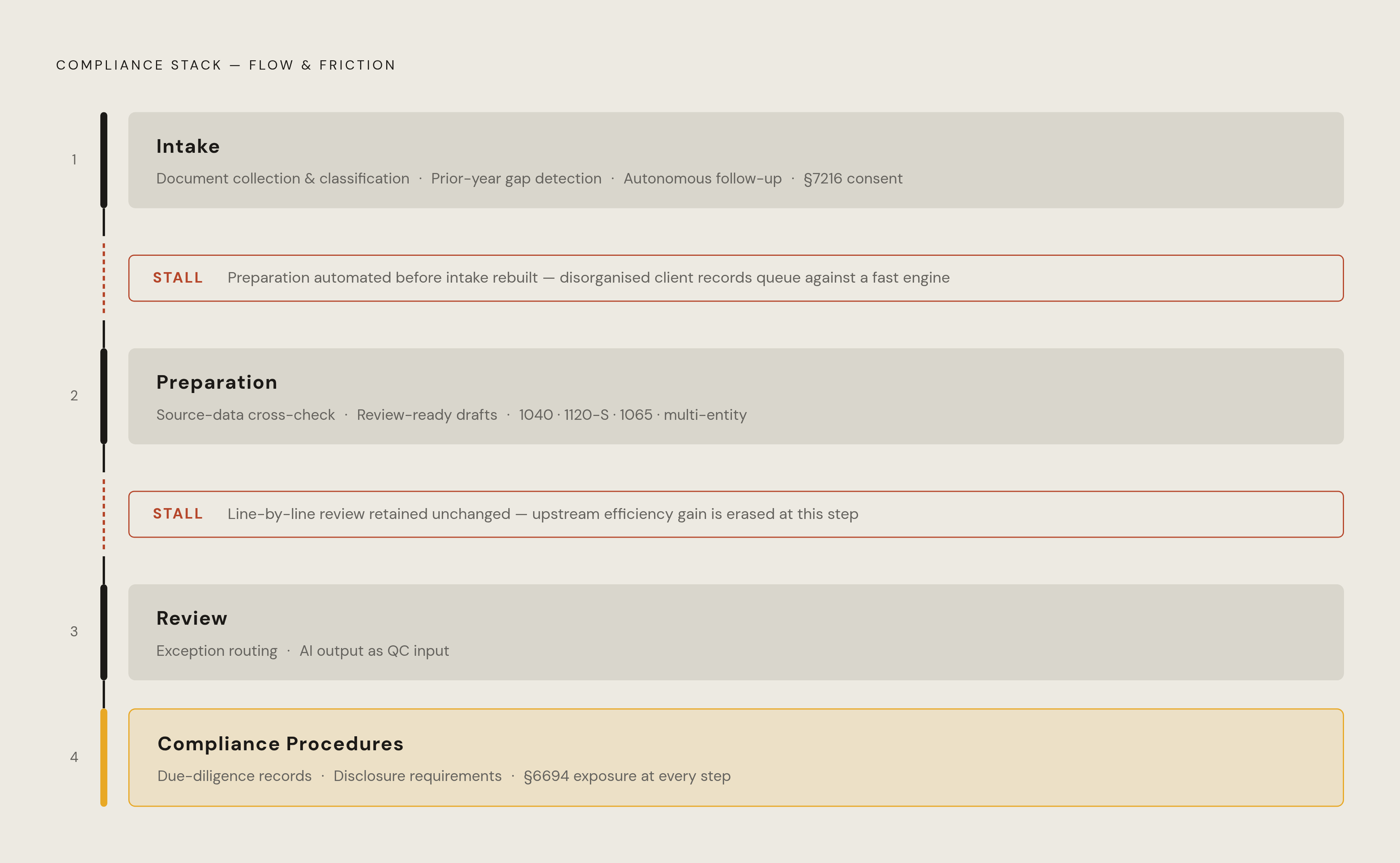
Intake collects and classifies documents, uses the prior year to find gaps, follows up on its own, and has §7216 consent workflows built in. Preparation builds on that work to cross-check source data and create drafts ready for review across 1040s, 1120-S, 1065, and multi-entity situations. Review routes exceptions to the responsible professional and treats AI output as an input to quality control before signing and filing. Compliance procedures apply at every step and cover records of due diligence, disclosure requirements that apply, and §6694 preparer-penalty exposure.
The most common stalls occur between those layers. A firm that automates preparation before intake still waits for manually organized documents, while one that retains unchanged line-by-line review fails to capture much of the potential gain downstream. Tool sprawl creates another constraint. Each system operates on a partial engagement record when the underlying data environment remains fragmented, and inconsistent workpapers prevent automation from generalizing across engagements. Generic AI can add recurring configuration costs for compliance rules, exception thresholds, and prior-year context.
Firms need to know where client data goes, how long it is retained, and how generated outputs can be reviewed and explained. Clients, regulators, and insurers expect firms to show that their controls work and to back up what their policies say. For practitioners evaluating their own stack, the practical test is therefore whether each handoff preserves the information and oversight needed by the next layer. A fast preparation engine cannot compensate for an incomplete client record or an unexplained review output.
Basis and Accrual together represent $175 million in investor conviction that mechanical preparation can be automated. Competitive pressure can arrive as larger firms automate enough preparation to serve clients previously too small to be profitable, narrowing the mid-size firm’s market while fee pressure works from below. The strongest position will not necessarily belong to the first firm that buys an AI tool. It will belong to firms that rebuild in the right order, make governance operational, and deliberately turn released compliance hours into advisory capacity.

