
How Tax Document Analysis Software Handles Unstructured Source Documents
AI-native systems handle tax documents by adapting to format variations without templates.
Tax document analysis software handles unstructured source documents through ingestion, classification, extraction, and validation, with reconciliation connecting evidence across documents and the completed return. Purpose-built AI for tax document analysis and compliance automation does more than read fields. Its advantage over legacy OCR and template-based IDP is its ability to handle changing formats while preserving the source evidence practitioners need for review.
Why tax source documents resist conventional processing
Scanned PDFs, email attachments, assessor website exports, handwritten forms, brokerage statements, and multi-page K-1 packages can arrive together. Their differences extend beyond file format to the way each source organizes and describes information. Parcel numbers, taxable values, exemptions, and assessment dates vary in label, position, and format across counties and states. A field that appears in a familiar location on one document may appear under a different heading on another.
The problem also extends across documents within an engagement. Tax bills, assessor reports, and broker pro formas can use non-standard or contradictory terminology for the same underlying value. Even when each source is read correctly, the figures in the engagement may still disagree.
A county assessor may reformat its PDF mid-year, or a broker may change its statement layout, silently invalidating rules that worked the month before. This is not simply a problem of poor scans. It combines variation in appearance, terminology, structure, and relationships between sources. That combination makes a layered pipeline necessary because recognizing text alone cannot resolve all four.
What legacy OCR and template-based IDP were actually built to do
Template-based OCR and early Intelligent Document Processing were built to handle large numbers of documents of predictable types. OCR addressed the conversion of document images into readable text. IDP added workflow rules, document-specific extraction models, and template marketplaces, improving results for common business documents with stable layouts. These systems solved a genuine operational problem. For truly standardized forms at high volume, template-based extraction can be fast, cheap, and auditable.
The difficulty begins when layout stability disappears. Each new document variation requires engineering time to write rules and retrain templates, making ongoing maintenance part of the architecture. A tax engagement adds to that work because standardized forms come with statements, exports, and supporting schedules that follow different rules. Successful processing of the standardized portion does not establish coverage of the rest.
AI-native systems therefore differ in their design assumptions, while OCR remains useful. A fixed template depends on a known arrangement of information, while schema-guided extraction defines the information required without prescribing where it must appear.
How a modern AI-native pipeline is structured, stage by stage
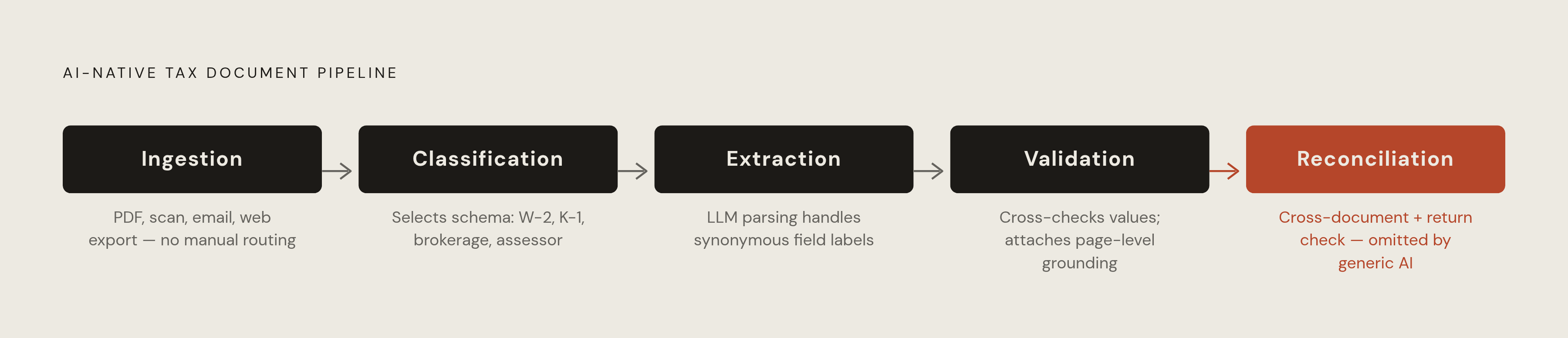
A production AI-native pipeline separates ingestion, classification, extraction, and validation because each stage addresses a different kind of variability. Ingestion accepts native and scanned PDFs, images, email attachments, and web-sourced exports through the same pipeline without manual routing or preprocessing requirements. It is also the stage for handling poor scans, handwriting, and multi-page continuation rather than treating them automatically as human-triage cases. Document structure must survive this first step. ExtractBench lists scan or handwriting noise, hierarchical headers, cross-page continuation, and large or irregular tables as separate problems in perception and table-structure.
Classification then determines what the document is so that the system can select the appropriate extraction schema. A W-2, brokerage statement, county assessor export, and K-1 call for different structured outputs. For example, one invoice schema can cover invoices from different vendors without a separate template for each. ExtractBench formalizes this approach as a document and user-defined schema producing schema-valid JSON with source evidence.
Extraction applies that schema to the document’s content. LLM-powered extraction can recognize that “Total Due,” “Amount Payable,” and “Final Balance” may refer to the same entity despite differences in wording and placement. An orchestration layer can route tables to layout-aware extractors, images to vision-language models, and handwriting to models trained on noisy inputs. However, correctly reading individual values does not guarantee that the system preserves every row in a long schedule.
Retrieval architecture offers another way to organize this work. AnnoRetrieve replaces vector embeddings with structured annotations and lightweight SQL-based retrieval for unstructured document analysis. Its research reports better precision than embedding-based vector search for attribute-value extraction and table generation, with fewer LLM calls and lower cost than graph-based and full-LLM baselines. This is an alternative architectural approach whose adoption across tax platforms remains unestablished here.
Validation checks whether the extracted output can be used. It can compare taxable value in an assessor’s report with the tax bill, check parcel numbers against property records, and flag discrepancies for human review before they reach the return. These checks are different from model confidence scores. A confidence score reflects the probability assigned during inference.
For validation to be auditable, each extracted field needs grounding metadata that links it to word- and page-level evidence and its pixel region in the source. A reviewer can then inspect the basis for a value. The same evidence helps the reviewer locate failures such as truncated schedules.
Where the pipeline fails in practice and why accuracy claims require scrutiny
ExtractBench evaluates 370 real enterprise documents and 67 document types across 22 challenge tags. Those tags distinguish the perception and table-structure problems that affect different documents in different ways. A headline score hides which documents fail and how. Good results on clean, short forms do not show how well the system handles irregular tables or cross-page schedules.
The benchmark finds that commercial vision-language models perform well on short documents but often truncate long record lists, while coding agents retain higher accuracy on long records at higher cost per page. In tax work, the corresponding risk is missing rows from a brokerage statement or schedules from a K-1 package. The retained values may all look plausible. Separately, an extraction can be numerically correct yet lack the source location needed to audit it, so value accuracy and grounding require distinct scrutiny.
Black Ore’s Tax Autopilot reported over 99% accuracy and high autonomy rates across tens of thousands of returns in its April 2026 early-access launch announcement. Those results come from company reporting alone, and marketed time savings must be assessed against per-return time that includes reviewer corrections.
A fabricated citation supporting a tax position can expose a preparer to penalties under IRC Section 6694. The statute does not distinguish suggestions by their source, although the reasonable cause and good faith exception considers the nature of the error and the preparer’s circumstances.
How tax-specific platforms address reconciliation as a separate layer from extraction
General document AI is designed to extract information accurately from an individual document. Tax workflows also require checking whether that information agrees with a second or third source and whether it reaches the return correctly. Reconciliation is therefore a separate task from recognition. Purpose-built platforms address this gap through cross-document checks, source-to-return traceability, or completed-return review rather than assuming that accurate extraction settles the engagement.
Juno automates data entry across more than 100 document types while maintaining a “clear box” model. Its side-by-side source-to-return traceability shows where data originated, while prior-year changes and inconsistencies are flagged for human validation. Freedom Accounting and Tax, a firm with multiple offices in southwest Missouri, uses Juno’s return preparation in Verito’s hosted environment across those offices during the 2026 tax season. That deployment places the traceability model in active multi-site production. It is not, by itself, an independent measure of extraction accuracy.
Tax Autopilot accepts W-2s, 1099s, K-1s, brokerage statements, bank records, and other document types in any format. It classifies documents, extracts data, resolves discrepancies, and prepares the complete return for delivery into the CPA’s existing tax software. Final sign-off remains with the practitioner. This connects document processing to return preparation without treating automation as a replacement for review.
Filed’s Reviewer module handles reconciliation once the return is complete. It checks the return against the original source documents to catch transposed numbers, missing K-1s, and dropped schedules. Its Tax Planner then evaluates 120+ strategies against the completed return and generates a client-ready advisory plan with citations attached. These capabilities extend beyond field extraction. Architecturally, reconciliation requires multiple document representations to remain available for reasoning across sources, which explains the move from a single extraction engine toward composable, agent-based systems.
What grounding and traceability requirements mean for compliance and audit readiness
A source-to-return connection gives the practitioner evidence for explaining a filed figure. Visual grounding makes that connection inspectable by linking an extracted field to its word-level location in the original document. Without it, a numerically correct output still leaves an evidentiary gap. ExtractBench treats word- and page-level grounding F1 as first-class metrics alongside value accuracy because regulated workflows have their own needs.
The scrutiny applied to returns is also becoming more automated. The GAO’s March 2026 report found that the IRS had 126 active AI applications as of June 2025, up from 10 in August 2022. Of those applications, 27 focused on enforcement and automated audit selection. This makes source evidence especially consequential for AI-assisted preparation. Automated preparation does not remove the need to explain anomalies identified during review.
Data handling imposes constraints independent of extraction quality. A platform used with real client data must not store that data for model training, must maintain clear data terms compatible with IRC §7216 and Circular 230, and should carry SOC 2 compliance. Audit history introduces a further requirement. Most AI OCR systems do not log model versions or data provenance in a tamper-proof way, leaving a gap between extracted output and a defensible audit trail. Traceability must be built into the pipeline’s architecture from the start, beyond what an added reporting feature can do.
What should practitioners evaluate in AI tax document analysis software?
A platform that excels at W-2 extraction does not automatically handle brokerage statements spanning dozens of pages, detailed K-1 packages, or assessor exports with mid-year format changes. The evaluation should begin with the firm’s actual bottleneck. Firms that struggle to enter data by hand from many document types have different needs from firms that spend most of their time on post-preparation review and planning.
Practitioners should test the kinds of source documents they work with, including the messiest examples, and measure how long it takes to correct AI output as well as extraction speed. Long-record completeness deserves an explicit check for truncated rows and missing items in multi-page tables. Every extracted value should also be linkable to its original source location. The benchmark’s combination of value F1, word- and page-level grounding F1, and challenge-specific testing provides a template for separating these dimensions. A good value score should not conceal missing records or absent evidence.
Practitioners should test how well reconciliation works separately from how well extraction works. The relevant questions are whether the platform cross-checks values across sources, routes discrepancies to human review, and provides a clear audit trail. Purpose-built tax platforms address document-type variability and reconciliation as core design goals, while generic tools optimized for invoices or receipts do not share those priorities. Category alignment, however, does not replace testing against the firm’s workflow. Understanding ingestion, classification, extraction, validation, and reconciliation is what allows a practitioner to ask the right questions of any vendor.