SECURE 2.0 Phase-In Schedule for Retirement Plan Sponsors
Plan sponsors must track SECURE 2.0 compliance year by year through 2032.
SECURE 2.0 is a sequence of obligations spread across more than a decade, with some provisions reaching into 2032, and that structure is itself the central challenge plan sponsors face. There is no moment at which a plan sponsor can declare the law "done." Compliance is a rolling obligation that has to be tracked provision by provision, year by year, rather than treated as one project with a finish line.
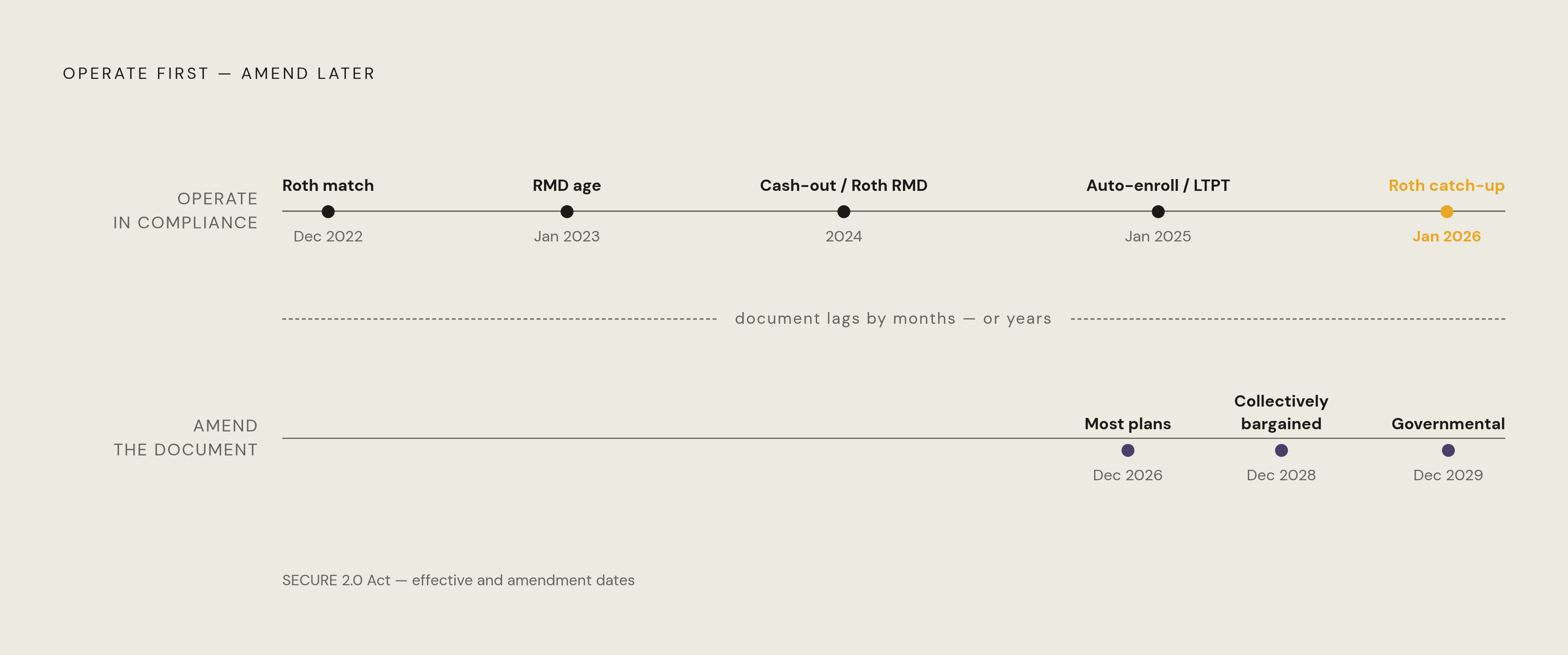
That structure creates two risks that compound each other. The first is missing a mandatory deadline because attention was fixed on the wrong year, treating 2026 as the horizon while a 2025 requirement quietly became operational. The second, more subtle risk is assuming that a future amendment deadline means a provision is not yet active. Greenleaf Trust has noted that the law carries a long tail, with provisions phasing in all the way through 2032, and that plan sponsors must comply operationally with each provision as of its effective date, well before the plan document is formally amended to reflect it. The IRS has extended the deadline for formal plan document amendments for most qualified plans (those that are neither governmental nor collectively bargained) to December 31, 2026, for discretionary changes, with required amendments following the separate Required Amendments List process and some provisions carrying later dates still. That extension covers paperwork. It does not touch the operational deadline. A plan has to run in good-faith compliance with each provision starting the day it takes effect, regardless of when the written document catches up. Given that split between operational effect and document amendment, plan sponsors need a provision-by-provision timeline, not a summary of what the law is trying to accomplish, if they want to avoid scrambling every December.
What plan sponsors were required to implement at enactment and through 2023
SECURE 2.0 became law on December 29, 2022, and that is when the compliance clock started, with several obligations taking hold immediately or within the following year. Plan sponsors who still talk about SECURE 2.0 as something coming down the road are, in some respects, already behind on requirements that have been operational for roughly two years.
The required minimum distribution age rose as of January 1, 2023. Anyone who turned 72 during the prior year was the last group required to begin RMDs at the age that applied before the change, making 2023 a genuine cutover point for that provision. Separately, employers gained the option, not the obligation, to offer small financial incentives, such as low-dollar gift cards, to encourage plan participation, effective for plan years beginning after December 29, 2022. And as of the enactment date itself, employers could choose to allow Roth employer matching contributions inside their plans. That option requires plan amendments and payroll coordination for any sponsor that wants to use it, but nothing compels adoption. Both of these 2022-2023 items are elections rather than mandates, which matters for what comes later: SECURE 2.0 mixes required changes with optional ones throughout its phase-in, and sponsors have to track which category each provision falls into, not just when it arrives.
The 2024 changes plan sponsors should have already addressed
Two 2024 changes reshaped day-to-day plan administration, and they still apply now, so sponsors need a status check, not renewed planning.
The mandatory cash-out threshold for terminated participants with small account balances went up in 2024. That change affects how plans handle the automatic distribution or rollover of balances left behind by employees who have separated from service, and any plan still operating under the prior threshold is out of step with current law. SECURE 2.0 also did away with required minimum distributions for Roth accounts in 401(k) and 403(b) plans during the original account holder's lifetime, starting in 2024. So Roth 401(k) and Roth 403(b) accounts now get the same treatment as Roth IRAs, which have never had a lifetime RMD requirement. The practical effect reaches further than tax mechanics: participants used to roll Roth 401(k) balances into Roth IRAs before retirement specifically to avoid lifetime RMDs, and that reason for rolling money out of the employer plan is now gone for anyone keeping track of the current rules. Plan sponsors need to confirm their recordkeeping systems and participant communications reflect this, because outdated materials may still describe an RMD obligation that no longer applies.
2024 also added Pension-Linked Emergency Savings Accounts, or PLESAs, and plans can now offer this as an optional feature. Like the Roth matching option from 2022, this is a design election. If sponsors want to offer PLESAs, they need to coordinate directly with their recordkeeper, since the feature involves separate account structures, contribution limits, and withdrawal rules that have to be built into plan administration from the start.
The three mandatory 2025 provisions and the operational work each one requires
2025 is when SECURE 2.0's phase-in schedule moves from gradual changes to sustained operational work. Three distinct obligations landed at once, each touching a different part of plan administration, and treating them as a single undifferentiated "2025 requirement" is a reliable way to miss something. Each one requires its own coordination between the plan sponsor, the recordkeeper, and payroll.
Mandatory automatic enrollment for plans established after December 29, 2022
Section 101 of SECURE 2.0 requires all 401(k) qualified cash or deferred arrangements and 403(b) plans established after December 29, 2022, to include an eligible automatic contribution arrangement, for plan years beginning after December 31, 2024. The automatic deferral has to start at a qualifying rate of compensation at enrollment, with automatic escalation of one percentage point per year up to a specified ceiling. Exemptions exist for employers with ten or fewer employees, employers that have been in operation for fewer than three years, SIMPLE plans, church plans, and governmental plans, so not every sponsor is subject to this.
The provision is often misread as applying only to plans launched in 2025. It applies to any plan established after the enactment date, so a plan that started in 2023 or 2024 is already subject to the mandatory automatic enrollment requirement for the 2025 plan year. Multiemployer defined contribution plans that added a 401(k) feature after December 29, 2022, run into a particular complication here. Tracking deferrals, managing opt-out elections, and remitting contributions on time across multiple participating employers is considerably harder in a multiemployer structure, and this is a technical corrections issue Congress had not yet resolved. A higher participation from automatic enrollment can push a small plan's participant count over the threshold that triggers a full Form 5500 filing and an independent plan audit, turning a design feature into an administrative and cost event that has nothing to do with retirement savings policy.
Long-term part-time employee eligibility, mandatory for 401(k) and 403(b) plans
Long-term part-time employee eligibility rules go back to the first SECURE Act, which applied to 401(k) plans. SECURE 2.0 shortened the qualifying service window from three consecutive years of at least 500 hours to two, effective for plan years beginning after December 31, 2024, if the employee is at least 21 years old. SECURE 2.0 also extended this eligibility rule to plans covered by federal retirement-plan law for the first time. Sponsors of those plans now have to build a tracking system that may not have existed before.
Hours tracking under this provision is not optional even where other elements are. Plan sponsors can still decide whether to make employer contributions to long-term part-time employees and whether to include them in nondiscrimination testing, but they have to track hours accurately regardless. Incomplete records can mean eligible employees get excluded from the plan without anyone noticing until an audit or a participant complaint surfaces the problem, and correcting that failure runs through a formal government correction process, one that costs time and sometimes money that proper tracking would have avoided. Long-term part-time employees could first become eligible to contribute under these rules on January 1, 2025, so any plan with part-time staff needs hours records that reach back at least two years to determine who qualifies now.
Super catch-up contributions for participants aged 60 to 63
Super catch-up contributions sit apart from the other two 2025 provisions because offering catch-up contributions is itself optional for plans. Plans that already permit catch-up contributions can choose to offer the enhanced limit to participants in the 60-to-63 age band as an additional design election, but adopting it is an affirmative decision, not a default.
That decision carries more governance weight than it might appear to at first glance for sponsors that are part of a controlled group. Final catch-up regulations include a controlled-group clarification: if one employer within a controlled group adopts the increased catch-up limit for employees turning 60 to 63, the universal availability rule requires every employer in that controlled group to adopt the same treatment across their respective plans. A single-plan design choice becomes a multi-entity governance question the moment a controlled group is involved. Plans that match catch-up contributions also need to work out the added cost of the higher limit before adopting it, since the matching formula will apply to a larger contribution amount for eligible participants.
2025 was always going to be the densest single year in the phase-in schedule, with three mandatory and semi-mandatory tracks landing together. 2026 does not ease that load. It shifts the burden from eligibility and enrollment mechanics to payroll systems directly.
2026: The Most Operationally Consequential Year in the Phase-In Schedule
The provision taking effect January 1, 2026, that deserves the most attention is the mandatory Roth catch-up requirement for high earners. Framing it as a tax rule change understates what it actually demands. It is a payroll integration problem, requiring plan sponsors, payroll administrators, and recordkeepers to coordinate systems and data before the end of 2025, not after.
Under this provision, participants who earn above the applicable prior-year FICA wage threshold must have their catch-up contributions made on a Roth basis. So payroll systems have to identify which participants crossed the wage threshold in the prior year, flag their catch-up contributions for Roth treatment specifically, and route those contributions correctly, all without manual intervention at the point of each paycheck. If this goes wrong, it does not produce a paperwork error correctable at year-end. It produces a contribution processed with the wrong tax treatment, a different kind of correction. Payroll providers and recordkeepers are the parties best positioned to build this capability, but the plan sponsor is the one accountable for confirming it works before the January 1, 2026, effective date arrives, which leaves no room for a January scramble.
A second 2026 change is administrative rather than systems-driven: a new paper benefit statement requirement for defined contribution plans. Plan sponsors need to confirm that their recordkeeper's default delivery settings and participant consent records align with the new rule before the effective date, since electronic delivery defaults that were compliant under prior rules may not satisfy the new paper requirement without updated consent on file.
The plan document amendment deadline sits alongside both of these changes and covers the written document only. Most retirement plans have until December 31, 2026, to formally amend their plan documents, with collectively bargained plans given until December 31, 2028, and governmental plans until December 31, 2029. That deadline governs the written document only. It does not extend the date by which a plan must operate in compliance with the mandatory Roth catch-up rule, the paper statement requirement, or any other provision already in effect. A plan can be two years away from its document amendment deadline and still be required, on January 1, 2026, to operate as though that amendment had already been made. That gap between the paperwork deadline and the operational deadline is the single most important fact in SECURE 2.0's entire phase-in schedule, and it is the reason a provision-by-provision timeline, rather than a one-time compliance project, is the only approach that holds up across a law built to unfold through 2032.
Sources
- SECURE 2.0 Act changes that go into effect in 2025
- Key SECURE Act 2.0 Changes Employers Must Implement by 2026 - Meld Financial
- SECURE 2.0 Amendment Deadline Approaches: What Plan Sponsors Need to Know - Pension Corporation of America
- SECURE 2.0 for Plan Sponsors: 2025 & 2026 Key Provisions - California Pensions
- SECURE 2.0 Act Retirement Plan Update: Roth Catch-Up Contributions in 2026: Quarles Law Firm, Attorneys, Lawyers
- 2026 Will Test Plan Sponsors: Here Is What They Need to Consider
- Highlights of the SECURE 2.0 Act for Employer Retirement Plans
- Most SECURE 2.0 Plan Design Options Available for 2025