
Section 199A Qualified Business Income Deduction for Service Businesses
Service businesses face stricter rules and income thresholds for this permanent tax deduction.
Section 199A lets owners of pass-through businesses deduct up to 20% of their qualified business income, but that promise splits into two very different outcomes depending on what kind of business is filing. For specified service trades or businesses, the SSTB category, the deduction can vanish entirely once income crosses a threshold, while a non-SSTB service firm at the same income level keeps most or all of it. Getting the classification wrong isn't a rounding error. Getting the classification wrong means a five- or six-figure deduction becomes zero.
Section 199A is now a permanent feature of the tax code, not a planning window
Section 199A was built with an expiration date. The relevant legislation set it to sunset on December 31, 2025, which meant every plan built around it for eight years carried an asterisk: this only works if lawmakers act. Congress did act, but not in the way many practitioners expected. A subsequent piece of legislation, signed into law on July 4, 2025, made the deduction permanent. 119-21, signed into law on July 4, 2025, made the deduction permanent. One legislative committee had floated raising the rate to 23%, but that provision didn't survive negotiations, so the deduction stays at 20%.
OBBBA also added a new wrinkle: Section 199A(i) creates a $400 minimum deduction for taxpayers with at least $1,000 of qualified business income from an activity in which they materially participate. That floor sounds small, and it is small, but it matters for taxpayers who sit above the phase-out thresholds and would otherwise get nothing. This floor only works off non-SSTB income. If every dollar of a taxpayer's QBI comes from a specified service business and that income is fully excluded because of income level, the $400 minimum has no base to attach to.
Permanence changes how this deduction should be treated in practice. When 199A was scheduled to disappear, aggressive income-shifting or entity restructuring carried a built-in exit: even if the IRS questioned a position, the provision itself wouldn't be around forever to keep generating exposure. That logic no longer applies. A misclassification made in 2026 compounds every year after it, and so does an aggressive restructuring designed to dodge SSTB status. The stakes on getting the SSTB call right, or getting a workaround audit-ready, just went up substantially.
Which service businesses the statute designates as SSTBs, and why the list is broader than it appears
The statute names its SSTB fields directly: health, law, accounting, actuarial science, performing arts, consulting, athletics, financial services, brokerage services, and businesses involving investing, investment management, and trading or dealing in certain financial assets. Two professional fields got carved out on purpose. Engineering and architecture are expressly excluded from SSTB treatment, a deliberate departure from how those professions were treated under an older passive-activity provision that inspired parts of 199A's language.
Beyond the named fields sits a catch-all that ends up capturing more businesses than the enumerated list suggests: any trade or business whose principal asset is the reputation or skill of one or more of its employees or owners. This covers the use of someone's image, likeness, name, signature, voice, or trademark, and it covers paid appearances on television, radio, or other media. The regulations make this concrete with a musician example: a singer-songwriter collecting royalties for their catalog is engaged in an SSTB in the performing arts, and none of those royalties qualify for the deduction.
Consulting gets defined narrowly, which cuts both ways. The regulations describe it as providing professional advice and counsel to help clients achieve goals and solve problems, and lobbying falls under that umbrella. But not every advisory-adjacent activity counts as consulting for 199A purposes. Advice that's embedded in the sale of a good or service, with no separate charge for it, isn't an SSTB either. A building contractor who advises a client on material choices as part of a construction contract isn't rendering SSTB consulting services; a standalone strategy consultant billing hourly for advice is.
Financial services get a similarly specific test. The regulations describe a financial planner who provides personalized advice on a client's financial situation and investment strategy as engaged in a specified service activity. Not every financial business falls into the SSTB category, and the regulations draw lines between financial activities that qualify as specified services and those that do not.
Athletics rounds out the list, covering athletes, coaches, and team managers in competitive sports. The regulations name specific sports, including baseball, basketball, football, tennis, and golf, rather than leaving "athletics" open to interpretation.
One structural point deserves emphasis: SSTB status taints everyone who owns a piece of the entity. If the business itself is classified as an SSTB, every individual owner, direct or indirect, is treated as earning SSTB income, whether or not that particular owner ever provided a specified service themselves. A silent investor in an SSTB law firm doesn't escape the classification just because they never touched a case file.
How the income thresholds and phase-out mechanics work for SSTB owners
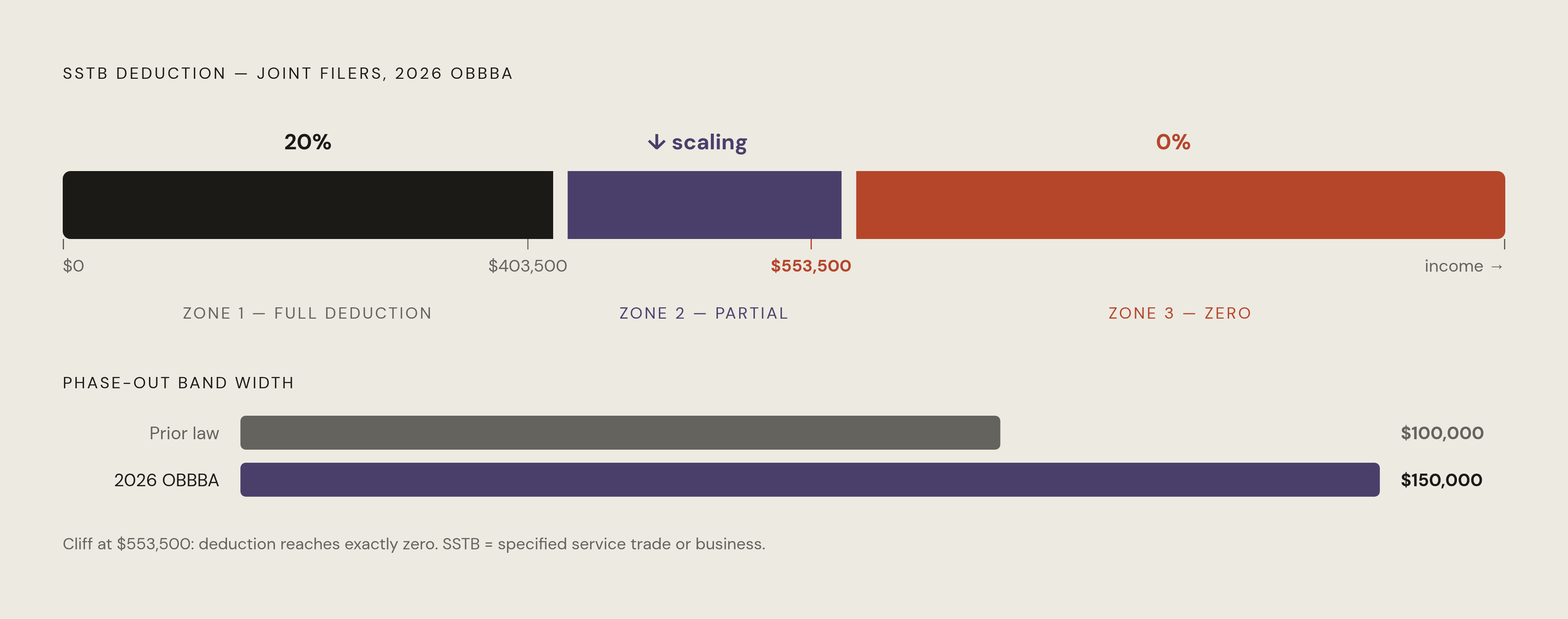
The SSTB rule is a slope that ends in a wall. It's a slope that ends in a wall. Below the lower threshold, an SSTB owner gets the full 20% deduction, no different from anyone else. Inside the phase-in range, a partial deduction applies, calculated through an "applicable percentage" that scales down QBI, W-2 wages, and UBIA from the business as income rises. Crossing the upper threshold means the deduction doesn't just shrink, it disappears completely. QBI, wages, and UBIA from the SSTB are excluded.
For 2024 returns, the phase-in for single filers begins at $191,950 and completes at $241,950. Joint filers start phasing out at $383,900 and lose the deduction entirely at $483,900. For 2025, those numbers move to $197,300 and $247,300 for single filers, and $394,600 to $494,600 for joint filers.
2026 brings a structural change, not just an inflation bump. Under the newly permanent OBBBA regime, single filers and heads of household phase in starting at $201,750 and fully phase out at $276,750. Joint filers start at $403,500 and complete the phase-out at $553,500. The width of that band matters as much as its location: the joint phase-out range widens to $150,000, up from the $100,000 band under prior law. That's a real expansion, and it means more joint-filing SSTB owners will land somewhere in the partial-deduction zone rather than falling off the cliff.
The mechanics bite hardest right at the threshold. The Tax Law Center at NYU Law has walked through the case of a law firm partner filing single with $247,300 of pass-through income, which happens to be exactly at the 2025 upper threshold, and that partner gets a QBI deduction of zero. Not a reduced deduction. Zero. A single dollar less in taxable income would have put a sliver of the deduction back in play. That cliff makes late-year income timing decisions consequential rather than cosmetic.
Because these thresholds move with inflation every year, using a stale number from a prior return is a real risk. A client who was comfortably under the threshold last year might, purely from the inflation adjustment interacting with a raise, end up meaningfully over it this year, and that shift alone can zero out a deduction that existed twelve months earlier.
W-2 wage and UBIA limits: why these matter for non-SSTB service businesses above the threshold
None of the wage or asset limitations discussed here apply to SSTBs above the threshold, because those businesses are already fully excluded from the deduction at that income level. Where the W-2 and UBIA limits actually matter is for non-SSTB service businesses (engineering firms, architecture practices, and any other trade or business that escapes the SSTB label) once their owners cross the same income thresholds described above.
For those businesses, the deduction gets capped at the greater of two tests: 50% of the W-2 wages the business paid, or 25% of W-2 wages plus 2.5% of the unadjusted basis immediately after acquisition, known as UBIA, of the business's qualified property. UBIA is essentially the original purchase price of depreciable assets. Land doesn't count toward it, since land isn't depreciable.
For most service firms, the 50% wage test is the one that governs, because service businesses tend to be payroll-heavy and asset-light. An architecture firm with a large salaried staff and a leased office space will lean on the wage test; the 25%-plus-UBIA alternative matters far more for capital-intensive operations like real estate, where the asset basis can dwarf the payroll.
This creates a genuine tension for S-corp owners. Raising an owner's W-2 salary increases the wage base that feeds into the 50% test, which can expand the deduction ceiling. But that same salary increase pulls dollars directly out of QBI, since reasonable compensation is excluded from qualified business income by definition. There's no formula that spits out the "right" salary in isolation. It requires running the numbers both ways for the specific business.
And the limitation can eliminate the deduction outright for a certain kind of taxpayer: the solo practitioner with no employees. A one-person consulting shop, engineering practice, or advisory firm that pays zero W-2 wages and has no significant depreciable property has no wage base and no UBIA to lean on. If that owner's income exceeds the threshold, the 50%-of-wages test caps the deduction at 50% of zero. The deduction is gone, for reasons that have nothing to do with SSTB status. It's gone, for reasons that have nothing to do with SSTB status.
How mixed-service businesses can inadvertently inherit SSTB status through the de minimis and related-party rules
A business doesn't have to be a law firm or a medical practice to get treated as an SSTB. The de minimis rule can pull an otherwise ordinary business into SSTB territory based on a fairly small slice of its revenue. For businesses with gross receipts of $25 million or less, the whole entity avoids SSTB classification only if no more than 10% of its receipts come from specified service activities. Above $25 million in gross receipts, that threshold tightens to 5%.
The regulations use an eyeglass store to illustrate how this plays out. Revenue from eye exams, an SSTB activity under "health," can taint the entire store's receipts as SSTB income once it crosses the de minimis line. Apply that logic to an ophthalmologist who also sells eyeglasses alongside medical exams: ophthalmology already falls under the health SSTB, so the product revenue from glasses sales gets swept into the same classification, and the whole business ends up treated as a single SSTB.
The proposed regulations offer a similar example with a dermatologist who uses the same staff and office to sell skincare products on the side. Because the product sales fall within the de minimis threshold, they're treated as incident to the medical SSTB rather than as a separate line of business, and the entire operation is deemed one SSTB.
The related-party rule creates a separate trap, one that has nothing to do with what percentage of revenue comes from where. When a non-SSTB business provides services or property to a commonly owned SSTB (50% or more common ownership), the portion of that non-SSTB's business serving the related SSTB gets carved out and treated as its own SSTB. The regulations lay out a specific scenario: a taxpayer owns an IT services LLC that pulls 40% of its revenue from a law firm owned by his sister. Because attribution rules treat him as owning both entities, that 40% slice of IT revenue gets reclassified as SSTB income and excluded from the deduction once his income clears the threshold, even though an IT consulting business isn't an SSTB on its own.
Owners running multiple entities, especially with family members holding stakes in related businesses, need to map every related-party relationship before assuming a non-SSTB entity is clean. Attribution doesn't require direct ownership to reach across and taint part of a business that looks, on paper, nothing like a law firm or a medical practice.
Planning strategies that can move an SSTB owner's taxable income into or below the deduction window
Since SSTB owners above the upper threshold get nothing, the central planning lever is managing taxable income so it lands below the phase-in threshold, or at minimum somewhere inside the partial-deduction band rather than above it. It's about managing taxable income so it lands below the phase-in threshold, or at minimum somewhere inside the partial-deduction band rather than above it.
Pre-tax retirement contributions do this directly. A SEP-IRA or a defined benefit plan reduces adjusted gross income and, with it, taxable income, which is the number the threshold test actually looks at. This works particularly well for sole proprietors and S-corp owners who have flexibility over how much they contribute each year. Defined benefit plans deserve specific mention here: for high-earning practitioners in their peak income years, a defined benefit plan can shelter substantially more income than another small-business retirement plan or a solo 401(k), simply because the contribution limits are actuarially calculated rather than fixed by a flat dollar cap.
The self-employed health insurance deduction and the deductible half of self-employment tax work in the same direction, though more modestly. Both reduce taxable income, which works in the same direction, but they also lower taxable income, and taxable income determines whether the phase-out applies. Charitable giving strategies, particularly bunching contributions into a donor-advised fund in a single year, accomplish something similar: they pull taxable income down in the year that matters without touching the character of the underlying business income.
Entity structure deserves its own look, especially for S-corp owners. The split between W-2 salary (excluded from QBI) and pass-through distribution (included in QBI) can be adjusted, but only within the bounds of what the IRS would call reasonable compensation for the work performed. A salary pushed too low to protect QBI invites scrutiny. A salary pushed too high shrinks QBI along with it, even as it might help the W-2 wage limitation for a non-SSTB business.
For a practitioner sitting near the boundary of the phase-in range, a relatively small reduction in taxable income can flip a zero deduction into a real partial one. That's the mechanical reward built into the phase-in math: it isn't a smooth, forgiving slope, so precise timing around the threshold, deferring a bonus, accelerating a deductible expense, topping off a retirement contribution before year-end, carries outsized value compared to the same move made by someone deep in the middle of the phase-out band.
None of this should be evaluated for a single filing year anymore. With the deduction now permanent, an income-shifting arrangement built to dodge SSTB exposure has to hold up under scrutiny indefinitely, not just survive one audit cycle. The IRS has already shown interest in aggressive structures built around SSTB avoidance, and a permanent deduction means permanent incentive for that scrutiny to continue.
The $400 minimum deduction under OBBBA offers one more angle, specifically for SSTB owners who also have some non-SSTB business activity: if that owner has at least $1,000 of QBI from a separate activity in which they materially participate, that floor benefit survives even when the bulk of their income comes from the specified service business. If that owner has at least $1,000 of QBI from a separate activity in which they materially participate, that floor benefit survives even when the bulk of their income comes from the specified service business and gets excluded.
Where classification remains unresolved, and what practitioners should document
Certain corners of the SSTB rules resist clean answers, and the reputation-or-skill catch-all is at the top of that list. Influencers, personal-brand consultants, and media personalities occupy a gray zone where their revenue can look like a product or licensing business on paper while functioning, in substance, as monetized reputation. The regulations give examples (the singer-songwriter collecting royalties) but plenty of modern business models don't map cleanly onto an older regulatory example built around traditional entertainment income.
The consulting boundary carries its own ambiguity. Whether advice counts as SSTB consulting or as embedded, non-SSTB service depends on whether a separate charge exists for that advice, a fact that turns on contract structure rather than on the substance of what's being advised. Two businesses giving functionally identical advice can land on opposite sides of the SSTB line purely because one bills for it separately and the other folds it into a product price.
Mixed-revenue businesses sitting close to the 5% or 10% de minimis thresholds face the sharpest year-to-year risk. A single new contract, a shift in product mix, or an unusually strong quarter for one revenue stream can tip an entity from safely non-SSTB into fully tainted SSTB status, and that determination gets made fresh each tax year based on that year's receipts.
Related-party attribution chains compound this uncertainty, since they can extend through family relationships that owners never think to examine. The IT services LLC example, where 40% of unrelated-looking consulting revenue got reclassified because of a sibling's law firm, demonstrates that the attribution rules reach further than direct ownership alone would suggest.
Given all of that, build the habit of tracking gross receipts by activity category every year, so a de minimis analysis can be run and defended rather than reconstructed after the fact. Track gross receipts by activity category every year, so a de minimis analysis can be run and defended rather than reconstructed after the fact. Write a plain characterization of each revenue stream and how it relates, or doesn't, to any SSTB activity in the business. Keep an ownership chart current across every related entity and every family member with a stake in any of them. And where consulting or advisory work is billed separately from a product or service, keep the contract language that supports that separation, because that language is often the entire basis for the SSTB determination if it's ever questioned.
Sources
- Qualified business income deduction | Internal Revenue Service
- Understanding Section 199A (Qualified Business Income Deduction) • BS&P
- Qualified business income deduction: Overview and FAQs
- What Is the Section 199A Deduction and Who Qualifies? - Lopes Law LLC | National Franchise Law Firm
- Tax Planning Strategies: Section 199A (QBI) Deduction
- uscode.house.gov
