Penalty Abatement Under IRS First-Time Abatement and Reasonable Cause Standards
Practitioners must apply FTA and Reasonable Cause in the right order to preserve relief options.
IRS penalty abatement under First-Time Abatement and Reasonable Cause standards requires more than identifying an available waiver. Practitioners must choose the right basis for relief and apply it in the right order. Automatic FTA for qualifying returns makes that sequencing more important, because relief granted today can consume an administrative waiver that a taxpayer may need later.
What penalty abatement actually is and what it is not
Penalty abatement removes assessed penalties and the interest charged on those penalties, but it leaves the original tax liability untouched. Interest on a penalty is removed automatically when that penalty is abated. Interest on the tax itself is not abatable on the same basis. The distinction matters because relief from a penalty is not relief from the obligation that produced it.
An abatement does not mean the IRS agrees that no return was required or that the taxpayer owed no tax. It provides administrative or statutory relief from the consequence of non-compliance. The two tracks addressed here are First-Time Abatement, including the Automatic Exemption from Penalty program, and Reasonable Cause. They reach that result through different standards, making the basis for relief consequential beyond the current assessment.
The three penalties FTA covers and the rates that make them worth pursuing
FTA covers three types of penalties, which are failure to file, failure to pay, and failure to deposit. When failure to file and failure to pay apply in the same month, the failure-to-file rate is reduced by the failure-to-pay amount. Together, the penalties can still be a large share of the original unpaid balance. Failure to deposit under IRC §6656 applies to payroll and employment tax deposits, with rates that rise from a low percentage for slightly late deposits to a significantly higher rate after an IRS notice.
For partnerships and S-corps, the multiplier is the number of owners. For tax year 2025 returns filed in 2026, penalties accrue at a set amount per partner per month under IRC §6698 and per shareholder per month under IRC §6699, each capped at twelve months. Even a moderately sized entity can therefore accumulate a large penalty bill. That structure warrants close monitoring of partnership and S-corp penalty accounts. Accuracy-related penalties under IRC §6662 and estimated tax underpayment penalties fall outside FTA and require a different relief path.
How FTA eligibility works: the three-part compliance test
FTA eligibility turns on compliance history. The test has three parts, which are filing compliance, payment compliance, and clean penalty history. All required returns for the prior three years must be filed, or valid extensions must be in place. Required payments or deposits must also be current, unless the taxpayer has an approved installment agreement and is current on its terms. These conditions make FTA more predictable than relief that depends on proving why compliance failed.
The history test looks at the same return type for the three tax years before the penalty year. A prior penalty is not necessarily disqualifying if it was removed for an acceptable reason other than FTA. Estimated tax penalties alone do not disqualify a taxpayer, and penalties removed through Reasonable Cause or an administrative waiver should not do so either. Those waivers include the pandemic-related failure-to-pay waivers for 2020 and 2021. For a joint return, however, neither spouse may carry a disqualifying prior penalty.
FTA applies to a single tax period and has no dollar limit. It is also not a lifetime benefit that can be used only once. A taxpayer may qualify again after a new clean three-year period. Its reach nevertheless excludes estate returns on Form 706, gift returns on Form 709, and most information returns. Those exclusions include W-2s, 1099s, Form 5471, Form 5472, Form 3520, Form 990 and related filings.
What changed in 2026: FTA goes automatic and what that means in practice
Beginning with the 2026 filing season, the IRS applies FTA automatically to qualifying taxpayers for 2025 tax year returns and later. The IRS formalized the shift on July 8, 2026 through the Automatic Exemption from Penalty program. IRS CEO Frank Bisignano stated, “Automatic Exemption from Penalty reflects the IRS' commitment to making the payment of taxes owed simpler and more consistent. By automatically applying penalty relief, the IRS recognizes that taxpayers who historically pay on time should not have to make a formal request for relief that is routinely granted.”
The Taxpayer Advocate Service had argued for years that the IRS already held the transcripts, penalty records, and filing histories needed to apply relief without a request. Automation removes that unnecessary step, but it does not guarantee that every qualifying assessment will be reversed. Timing gaps, account flags, cases that span more than one year, and business accounts with more than one penalty type can keep relief from being applied automatically. Practitioners should therefore verify that the abatement actually posted to the client’s transcript.
If automatic relief did not post, practitioners can still make a manual request through the Practitioner Priority Service, Form 843, or a written FTA letter. Penalties for 2024 and earlier still require a request by phone or mail. The AICPA’s March 6, 2026 request for a way to reverse automatically applied FTA also identifies an unresolved issue beyond delivery, namely whether the system grants relief on the right basis.
The structural flaw in automatic FTA: when the system uses the wrong track first
AEP applies the administrative waiver before the IRS looks at whether Reasonable Cause supports relief. That sequence creates a structural gap. FTA is granted by IRS policy, while Reasonable Cause relief rests on the taxpayer’s circumstances and can provide a statutory basis for abatement. Applying the administrative waiver first can consume it in a year when the taxpayer had another valid route.
A taxpayer who files late because of a serious illness illustrates the consequence. The illness may support Reasonable Cause, but AEP could suppress the penalty because the taxpayer has a clean history. If the taxpayer later makes an isolated mistake that does not meet the Reasonable Cause standard, the administrative waiver may no longer be available.
The National Taxpayer Advocate has warned that an administrative waiver should not displace relief Congress specifically provided by law. The AICPA has requested that taxpayers be allowed to substitute a valid Reasonable Cause statement for automatically applied FTA and restore the waiver. The IRS has not published a mechanism to opt out of, reverse, or redirect that automatic application. Practitioners must therefore address sequencing proactively. When the taxpayer has both a strong Reasonable Cause case and a clean history, Reasonable Cause should come first, with FTA kept as the fallback.
How Reasonable Cause works: the standard, the evidence, and the penalties it covers
Reasonable Cause requires an evidentiary case. The standard asks whether the taxpayer exercised ordinary business care and prudence but could not comply because of circumstances beyond the taxpayer’s control. IRC §6664(c)(1) and Treasury Regulation §1.6664-4 set out the Reasonable Cause rules for accuracy-related relief. IRM 20.1.1.3.2 tells reviewers to weigh all facts and circumstances and judge each case on its own. That flexibility allows the taxpayer’s circumstances to matter, but it also makes the outcome less predictable than FTA.
A submission must bring together a written explanation, dated third-party documentation, and a direct causal link to the missed deadline. Medical records, insurance claims, official disaster declarations, and death certificates can substantiate the underlying event. The narrative must then go beyond showing that hardship occurred to explain how the event kept the taxpayer from complying. Serious illness or incapacitation, natural disasters, destruction of records, and documented reliance on erroneous professional advice can support relief. The standard calls for a good-faith effort to comply.
Reasonable Cause reaches a wider range of returns and penalties than FTA, including information returns and estate and gift tax returns. For accuracy-related penalties under IRC §6662, it is the administrative relief path addressed here, but the showing is more demanding than an explanation of a missed deadline. The taxpayer must establish that the position had substantive merit or that professional advice was relied on in good faith. Documentation must therefore address the basis for the reported position.
Choosing between the two tracks: the decision logic practitioners should follow
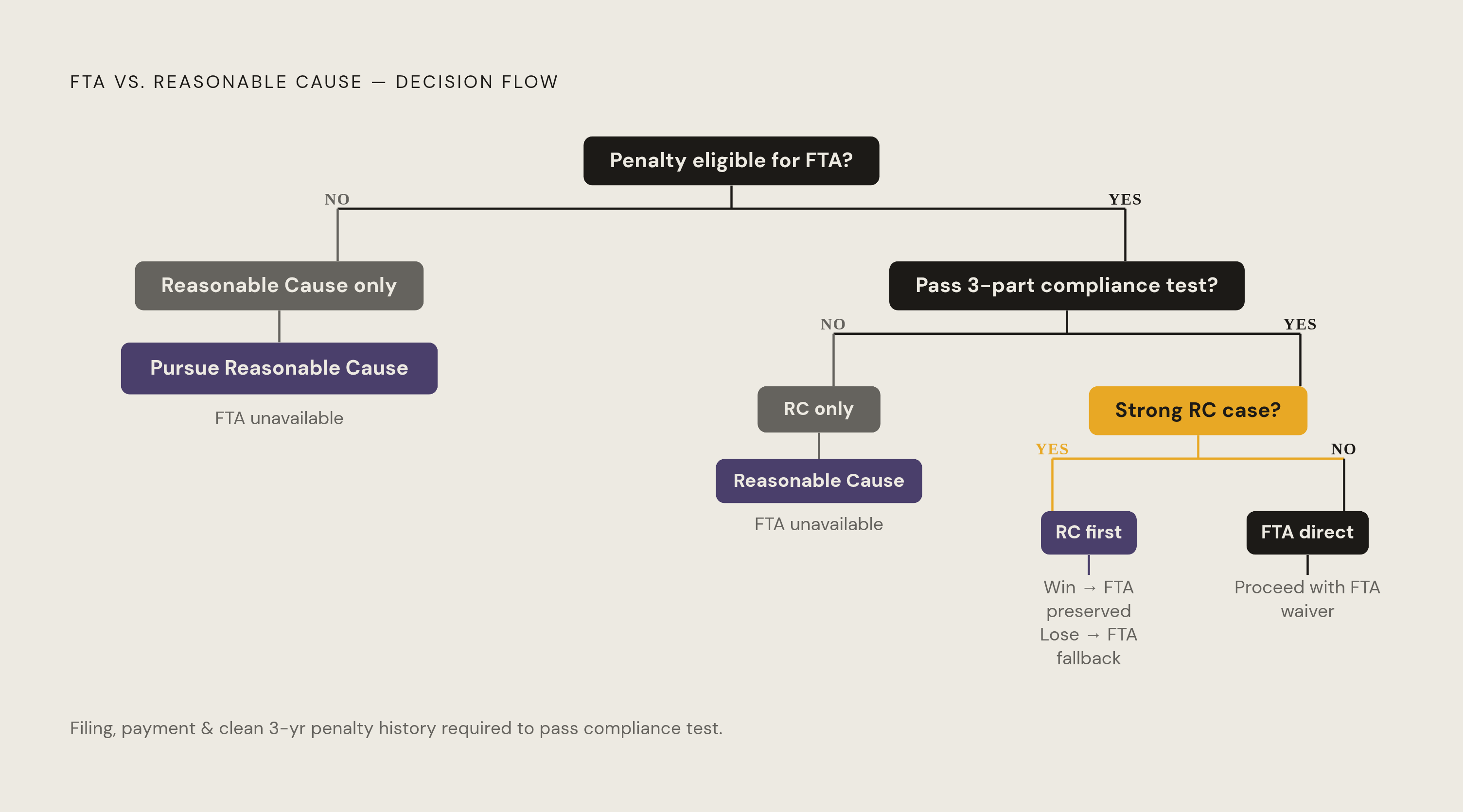
The practitioner’s review begins with the client’s transcript. Identify the penalty type and code, check the three-year history, and weigh whether the circumstances support Reasonable Cause before choosing which request to submit first. Accuracy-related penalties, returns excluded from FTA, and estimated tax underpayment penalties all need to be assessed for relief outside the administrative waiver. A failure to meet the clean-history test also removes FTA from consideration.
When both tracks are available, the strength of the Reasonable Cause case should determine which comes first. A well-supported claim should lead because success preserves the administrative waiver, while failure leaves FTA available as a fallback. If the client lacks that evidence but qualifies based on compliance history, FTA is still an option. The choice is therefore not simply which request is easier to prepare. It is which route resolves the assessment without unnecessarily consuming future relief.
If the transcript shows that AEP has already been applied, the task changes. Where the client had a valid Reasonable Cause case, practitioners should document the circumstances and monitor for IRS guidance permitting substitution. The AICPA’s requested remedy is not an existing reversal procedure. A file that supports Reasonable Cause cannot, on its own, restore a waiver that was used automatically.
Timing and exposure complete the decision. FTA must be requested within the refund statute of limitations, which is three years from the date the return was filed or two years after the tax is paid, whichever is later. For partnerships and S-corps, practitioners should check how much the penalties are per owner, per month before deciding which route to take. For returns outside FTA, the circumstances supporting Reasonable Cause should be documented thoroughly before submission.
How purpose-built practice management tools change the abatement workflow
Practitioners must spot penalties, check that automatic abatements posted, and make a manual request for any missing relief before deadlines pass. Reasonable Cause cases add document collection, client coordination, and review of the causal narrative. With many clients, it becomes hard to keep checking transcripts by hand and gathering evidence for each case. A valid relief opportunity may never reach the practitioner’s decision point.
Tools built for tax practitioners can support these specific tasks by detecting penalty transaction codes, flagging accounts where automatic FTA was not applied, and structuring document collection for Reasonable Cause submissions. A flagged assessment still requires judgment about eligibility and sequencing. A completed document request still requires review of whether the evidence explains the failure.
Automation built for these tasks can give practitioners more time to assess claims and manage IRS correspondence by cutting the time spent pulling transcripts and chasing records. That shift matters because automatic FTA has not removed the need for advice. It has made verification and sequencing central to delivering the right relief. A systematic workflow supports the same conclusion as the substantive rules, which is that successful abatement means removing the current penalty on the proper basis while preserving relief that should remain available.