Evaluating AI Research and Guidance Monitoring Tools for Tax Professionals
Professional liability hinges on verifying every AI-generated citation, not just adoption speed.
Evaluating AI research and guidance monitoring tools for tax professionals requires more than comparing answer speed. A defensible choice depends on verifiable citations, relevant primary authority, fact-specific analysis, and workflow fit. Purpose-built research and document processing serve different needs, so firms should assess whether a tool supports the work being automated without weakening professional review.
Why practitioners can no longer treat tool selection as a productivity decision alone
The IRS Office of Professional Responsibility put out OPR Alert 2026-19, Introductory Guidelines for Responsible AI Use in Federal Tax Practice, on June 24, 2026. The alert maps existing Circular 230 duties onto AI-assisted work and requires practitioners to verify every AI-produced fact, citation, and calculation before it reaches a client or the IRS. It also establishes that competence includes understanding the tools used. Responsibility remains with the practitioner. A firm therefore needs tools that let it meet its review obligations in practice.
IRC Section 6694 already imposes preparer penalties for unreasonable positions and does not recognize software as an excuse for skipping review. IRS Internal Revenue Manual 10.24.1 set up an AI governance framework for the whole agency on February 10, 2026, which was later updated on August 10, 2026. That framework governs only the IRS internally. For firms, naming approved AI tools in the Written Information Security Plan and vetting vendors are recommended practices under Publication 4557 guidance.
What hallucinations actually look like in tax research output, and why they are hard to catch
AI hallucinations in tax research often look like the clear, well-written analysis practitioners expect. A threshold figure from a prior tax year may appear as current, or a superseded ruling may be described as active. A genuine code section may be cited slightly out of context, making the answer look supported even though the provision does not establish the conclusion. Formatting offers no protection against these errors. An answer’s authority must support the proposition for the relevant year and facts, even when the answer sounds plausible.
A nonexistent case or ruling can arrive with enough surrounding detail to escape notice unless the practitioner opens the source. Citing that authority in a client memo or court filing exposes the practitioner to professional liability that a software vendor will not share. Tools that rely on a general-purpose model’s memory are structurally more prone to these failures than tools that retrieve real documents before answering.
The One Big Beautiful Budget Act illustrates a related problem even when the original source is genuine. IRS and Treasury have been issuing guidance on OBBBA provisions through late 2025 and into 2026, so guidance that was accurate six months earlier may have been superseded. A stale database will not flag that change. For guidance monitoring, source freshness is consequently part of accuracy.
Source transparency and whether a tool allows real verification
Every substantive claim should link to authority the practitioner can open, read, and compare with the conclusion. Inline citations make that comparison possible at the sentence level. A general reference to a platform’s database does not perform the same function, while a source list at the bottom leaves the practitioner to match individual claims to authority. The link must lead to usable support. Click-through verification asks both whether the cited passage says what the answer claims and whether it applies to the client’s facts.
Blue J provides inline citations and source lists with access to underlying authority, including the IRC, Treasury Regulations, federal tax cases, and IRS guidance. Its database is described as curated and updated daily. These features illustrate an answer structure that allows practitioners to verify generated conclusions. The practitioner still has to read the cited passage.
Retrieval-augmented generation grounds answers in retrieved documents rather than model memory alone, making verifiable citations structurally more likely. The evaluation step is to ask vendors directly about that architecture and then test its output. A question with a known answer provides a useful starting point. Opening every citation and checking whether each passage supports its attached sentence tests the connection that a demonstration can otherwise leave unexamined.
Coverage of primary authority and whether it matches the work a firm actually does
Federal primary authority is the baseline for research tools used in federal tax practice. Coverage should include the IRC, Treasury Regulations, IRS notices and rulings, and court decisions, although depth and update frequency require confirmation. A transparent citation cannot compensate for missing authority. The content library must cover the firm’s work regardless of how impressive its overall size sounds.
State and local tax practices need all-50-state coverage for their work on nexus, apportionment, and state conformity. CCH AnswerConnect’s SmartCharts compare selected tax topics across states and link to citations and Wolters Kluwer explanations. Access to underlying law depends on subscription level. That distinction affects both research usefulness and purchasing decisions because a comparison view and access to the law are not necessarily the same entitlement.
Checkpoint integrates Thomson Reuters’ editorial library, including WG&L treatises, while Bloomberg Tax includes Tax Management Portfolios and Blue J includes Tax Notes commentary. These materials help explain how courts have applied rules, but commentary alone provides a weaker basis for a position than supporting primary authority. Update frequency also deserves scrutiny where OBBBA guidance is changing. The practical evaluation step is to list the jurisdictions and tax types handled in a typical month, then ask the vendor to demonstrate those specific sources.
How tools handle fact-specific questions and whether they apply rules to the client's actual situation
An answer explaining how distributions are taxed is different from one addressing an S corporation distribution for a particular tax year, shareholder basis, and state. The facts determine which rules govern the result. A tool that repeats a correct general rule while ignoring those facts leaves the harder analytical work untouched.
The evaluation test is to supply the tax year, entity type, jurisdiction, and transaction details before asking the question. The answer should apply those facts. A useful tool should identify information that could change the conclusion rather than treat an incomplete question as sufficient for a definitive answer.
Agentic tools can perform multiple research steps autonomously and handle more complex fact patterns. However, those additional steps increase the distance between the practitioner and the reasoning, so the transparency criterion applies with greater force. More autonomous research requires a more inspectable result. The practical measure is time from question to a conclusion the practitioner can use, including the time spent resolving gaps, checking citations, and correcting the analysis.
How does a tax AI tool fit into existing compliance workflows?
Thomson Reuters CoCounsel Tax layers conversational AI on Checkpoint, allowing firms already using that platform to retain their research environment. Intuit ProConnect Tax’s SmartReturn embeds source-document import and side-by-side review inside the return workflow. Firms need to check a product’s research capability and its ability to remove source-document entry work separately, because doing one well gives no assurance that it can do the other.
Blue J announced a partnership with Legora on October 19, 2026, allowing eligible customers to query the research tool directly in Legora and receive answers with inline citations linking back to sources. Output format affects the same workflow calculation. Blue J and Bizora both offer memo and email drafting built on completed research, which can reduce the need to rewrite an answer before retaining it in a client file.
Leaving an existing environment, rebuilding context, and re-entering findings can absorb the time saved in generating an answer. Adoption after rollout is a useful proxy for fit because a tool abandoned after the first month has not become part of working practice. The evaluation should therefore measure context setup, source review, and output preparation as well as response time. For a mid-size accounting firm, tools should be compared across the full path to reviewed work.
Pricing structures and what they imply about the total cost of using a tool
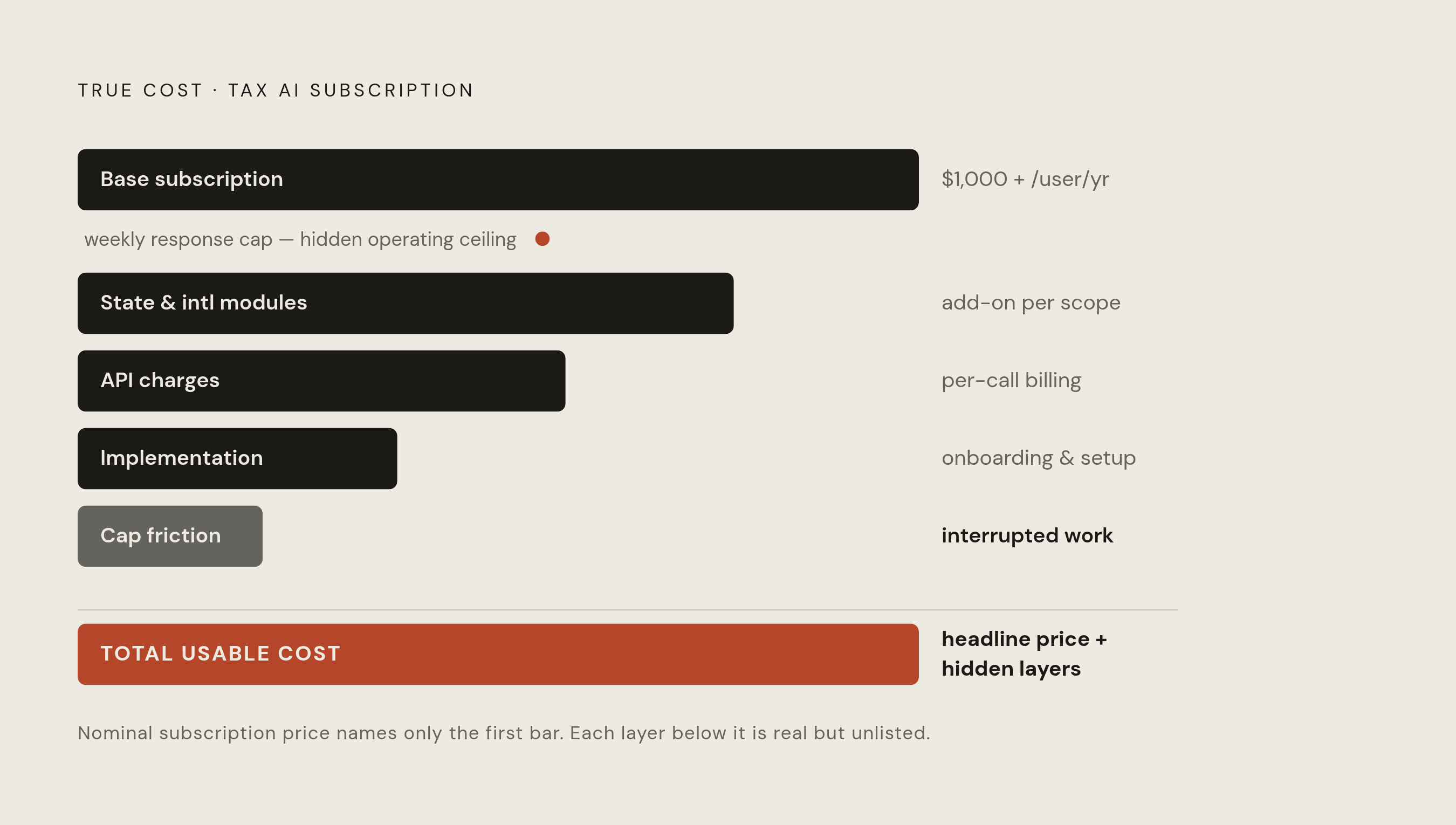
Published prices show how a firm would have to pay for a tool before it can judge whether the tool is worth the cost. CoCounsel Tax Essentials costs over a thousand dollars per user per year and sets a fixed cap on how many Checkpoint-backed responses each user can get per week. That cap is an operating constraint. How much it matters depends on how often practitioners need those responses in their day-to-day work.
CCH AnswerConnect starts at a published per-user annual rate, with expanded packages available by quote. LexisNexis Tolley+ with Protégé has a published monthly starting price, while broader Lexis+ with Protégé bundles are quote-based. These structures do not support a simple cheapest-to-most-expensive ranking. Differences in included content, usage allowances, and quoted packages can make nominal prices poor comparisons of usable access.
Total cost should include additional modules for state or international coverage, API charges, and implementation support. Usage caps and per-response limits can also create indirect costs if rationed access interrupts work, potentially offsetting a lower subscription price. Budget affects the practical scope of evaluation. A firm may need to check whether it can afford the authority and number of responses it needs before comparing interface features. Smaller firms should also weigh whether per-return pricing, where available, fits their volume better than an annual per-user subscription.
The unresolved questions around client disclosure and data handling that evaluation must account for
OPR Alert 2026-19 stops short of requiring disclosure to clients when AI touches their return. The AICPA, through Henry Grzes, its lead manager for tax practice and ethics, recommends obtaining signed client consent when AI plays a role. This is a conservative recommendation anticipating regulatory tightening. Firms selecting tools therefore face a disclosure decision that the research interface cannot settle.
Software vendors argue that a platform used solely to prepare a client’s return, with data protected and not repurposed, functions similarly to conventional third-party processing. That argument changes the framing without resolving the risk. Privilege presents a separate uncertainty with less direct guidance for routine tax practice. Two federal rulings issued in February 2026 reached opposite conclusions about whether AI use destroys attorney-client privilege or work-product protection, and neither arose in a tax matter.
Vendor evaluation should include data handling policies, subprocessor agreements, and what happens to client data after a session ends. A proposed framework examined at an October 2026 accounting technology event grouped AI risk into technical, practice, legal and regulatory, business, and workforce and strategic categories. Mapping candidates against those categories can expose concerns including extraction errors, data leakage, overtrust, and vendor dependence, but the proposal is not a codified regulatory standard.
The final compliance check is the firm’s Written Information Security Plan. Publication 4557 guidance provides the basis for vendor vetting, and the IRS offers a free WISP template. Naming approved AI tools in that plan is recommended practice for private firms. Research quality cannot excuse inadequate data safeguards. A tool that cannot satisfy the firm’s security vetting fails the evaluation even if its answers are accurate and well cited.